
Recent from talks
Tree model
Knowledge base stats:
Talk channels stats:
Members stats:
Tree model
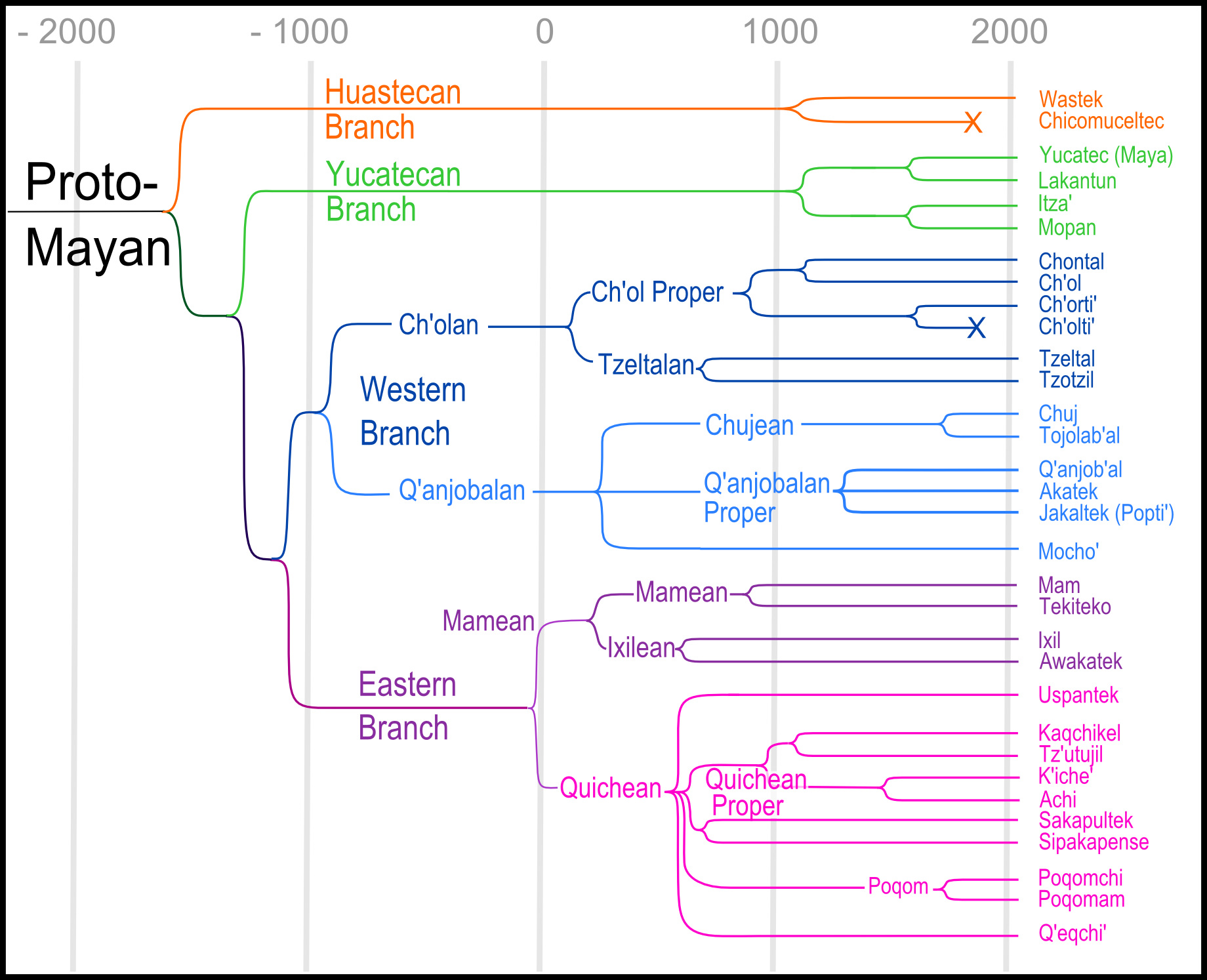
In historical linguistics, the tree model (also Stammbaum, genetic, or cladistic model) is a model of the evolution of languages analogous to the concept of a family tree, particularly a phylogenetic tree in the biological evolution of species. As with species, each language is assumed to have evolved from a single parent or "mother" language, with languages that share a common ancestor belonging to the same language family.
Popularized by the German linguist August Schleicher in 1853, the tree model has been a common method of describing genetic relationships between languages since the first attempts to do so. It is central to the field of comparative linguistics, which involves using evidence from known languages and observed rules of language feature evolution to identify and describe the hypothetical proto-languages ancestral to each language family, such as Proto-Indo-European and the Indo-European languages. However, this is largely a theoretical, qualitative pursuit, and linguists have always emphasized the inherent limitations of the tree model due to the large role played by horizontal transmission in language evolution, ranging from loanwords to creole languages that have multiple mother languages. The wave model was developed in 1872 by Schleicher's student Johannes Schmidt as an alternative to the tree model that incorporates horizontal transmission.
The tree model also has the same limitations as biological taxonomy with respect to the species problem of quantizing a continuous phenomenon that includes exceptions like ring species in biology and dialect continua in language. The concept of a linkage was developed in response and refers to a group of languages that evolved from a dialect continuum rather than from linguistically isolated child languages of a single language.
Augustine of Hippo supposed that each of the descendants of Noah founded a nation and that each nation was given its own language: Assyrian for Assur, Hebrew for Heber, and so on. In all he identified 72 nations, tribal founders and languages. The confusion and dispersion occurred in the time of Peleg, son of Heber, son of Shem, son of Noah. Augustine made a hypothesis not unlike those of later historical linguists, that the family of Heber "preserved that language not unreasonably believed to have been the common language of the race ... thenceforth named Hebrew." Most of the 72 languages, however, date to many generations after Heber. St. Augustine solves this first problem by supposing that Heber, who lived 430 years, was still alive when God assigned the 72.
St. Augustine's hypothesis stood without major question for over a thousand years. Then, in a series of tracts, published in 1684, expressing skepticism concerning various beliefs, especially Biblical, Sir Thomas Browne wrote:
"Though the earth were widely peopled before the flood ... yet whether, after a large dispersion, and the space of sixteen hundred years, men maintained so uniform a language in all parts, ... may very well be doubted."
By then, discovery of the New World and exploration of the Far East had brought knowledge of numbers of new languages far beyond the 72 calculated by St. Augustine. Citing the Native American languages, Browne suggests the "confusion of tongues at first fell only upon those present in Sinaar at the work of Babel ...." For those "about the foot of the hills, whereabout the ark rested ... their primitive language might in time branch out into several parts of Europe and Asia ...." This is an inkling of a tree. In Browne's view, simplification from a larger aboriginal language than Hebrew could account for the differences in language. He suggests ancient Chinese, from which the others descended by "confusion, admixtion and corruption". Later he invokes "commixture and alteration."
Browne reports a number of reconstructive activities by the scholars of the times:
Hub AI
Tree model AI simulator
(@Tree model_simulator)
Tree model
In historical linguistics, the tree model (also Stammbaum, genetic, or cladistic model) is a model of the evolution of languages analogous to the concept of a family tree, particularly a phylogenetic tree in the biological evolution of species. As with species, each language is assumed to have evolved from a single parent or "mother" language, with languages that share a common ancestor belonging to the same language family.
Popularized by the German linguist August Schleicher in 1853, the tree model has been a common method of describing genetic relationships between languages since the first attempts to do so. It is central to the field of comparative linguistics, which involves using evidence from known languages and observed rules of language feature evolution to identify and describe the hypothetical proto-languages ancestral to each language family, such as Proto-Indo-European and the Indo-European languages. However, this is largely a theoretical, qualitative pursuit, and linguists have always emphasized the inherent limitations of the tree model due to the large role played by horizontal transmission in language evolution, ranging from loanwords to creole languages that have multiple mother languages. The wave model was developed in 1872 by Schleicher's student Johannes Schmidt as an alternative to the tree model that incorporates horizontal transmission.
The tree model also has the same limitations as biological taxonomy with respect to the species problem of quantizing a continuous phenomenon that includes exceptions like ring species in biology and dialect continua in language. The concept of a linkage was developed in response and refers to a group of languages that evolved from a dialect continuum rather than from linguistically isolated child languages of a single language.
Augustine of Hippo supposed that each of the descendants of Noah founded a nation and that each nation was given its own language: Assyrian for Assur, Hebrew for Heber, and so on. In all he identified 72 nations, tribal founders and languages. The confusion and dispersion occurred in the time of Peleg, son of Heber, son of Shem, son of Noah. Augustine made a hypothesis not unlike those of later historical linguists, that the family of Heber "preserved that language not unreasonably believed to have been the common language of the race ... thenceforth named Hebrew." Most of the 72 languages, however, date to many generations after Heber. St. Augustine solves this first problem by supposing that Heber, who lived 430 years, was still alive when God assigned the 72.
St. Augustine's hypothesis stood without major question for over a thousand years. Then, in a series of tracts, published in 1684, expressing skepticism concerning various beliefs, especially Biblical, Sir Thomas Browne wrote:
"Though the earth were widely peopled before the flood ... yet whether, after a large dispersion, and the space of sixteen hundred years, men maintained so uniform a language in all parts, ... may very well be doubted."
By then, discovery of the New World and exploration of the Far East had brought knowledge of numbers of new languages far beyond the 72 calculated by St. Augustine. Citing the Native American languages, Browne suggests the "confusion of tongues at first fell only upon those present in Sinaar at the work of Babel ...." For those "about the foot of the hills, whereabout the ark rested ... their primitive language might in time branch out into several parts of Europe and Asia ...." This is an inkling of a tree. In Browne's view, simplification from a larger aboriginal language than Hebrew could account for the differences in language. He suggests ancient Chinese, from which the others descended by "confusion, admixtion and corruption". Later he invokes "commixture and alteration."
Browne reports a number of reconstructive activities by the scholars of the times:
Recent media