



Community hub
Recent from talks
Contribute something to knowledge base
Content stats: 0 posts, 0 articles, 1 media, 0 notes
Members stats: 0 subscribers, 0 contributors, 0 moderators, 0 supporters
Subscribers
Supporters
Contributors
Moderators
Hub AI
Porphyrian tree AI simulator
(@Porphyrian tree_simulator)
Hub AI
Porphyrian tree AI simulator
(@Porphyrian tree_simulator)
Porphyrian tree
In philosophy (particularly the theory of categories), the Porphyrian tree (also spelled Porphyrean tree) or Tree of Porphyry is a classic device for illustrating a "scale of being" (Latin: scala praedicamentalis), attributed to the 3rd-century CE Greek neoplatonist philosopher and logician Porphyry, and revived through the translations of Boethius.
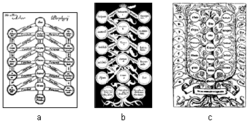
Porphyry suggests the tree in his introduction ("Isagoge") to Aristotle's Categories. Porphyry presented Aristotle's classification of categories in a way that was later adopted into tree-like diagrams of two-way divisions, which indicate that a species is defined by a genus and a differentia and that this logical process continues until the lowest species is reached, which can no longer be so defined. No illustrations or diagrams occur in editions of Porphyry's original work; diagrams were eventually made, and became associated with the scheme that Porphyry describes, following Aristotle.
Porphyry's Isagoge was originally written in Greek, but was translated into Latin in the early 6th century CE by Boethius. Translations by Boethius became the standard philosophical logic textbook in the Middle Ages, and theories of categories based on Porphyry's work were still being taught to students of logic until the late 19th century.
Philosopher James Franklin offers some history of the Porphyrian tree:
Thus, the notion of the Porphyrian tree as an actual diagram comes later than Porphyry himself. Still, scholars do speak of Porphyry's tree as in the Isagoge and they mean by this only that the idea of dividing genera into species via differentiae is found in the Isagoge. But, of course, Porphyry was only following what was already in Aristotle, and Aristotle was following what was already in his teacher, Plato.
The following Porphyrian tree consists of three columns of words; the middlemost (in boldface) contains the series of genera and species, and we can take it as analogous to the trunk of a tree. The extremes (the terms that jut out to the left and right), containing the differentiae, we can take as analogous to the branches of a tree:
The diagram shows the highest genus to be substance. (Whether substance is a highest genus, really, is not in question here: right now we are only going to discuss what the diagram shows, not whether what it shows is true or false.) The technical term for a highest substance is summum genus. So, substance is the summum genus as far as this diagram goes. The diagram shows that the genus substance has two differentia, namely, "thinking" and "extended." This indicates that there are two species of the genus substance, thinking substance and extended substance. The diagram does not give a term for the species of thinking substance (this would be "mind"), but it does give the term for the species of extended substance, namely, body. That is, body is a species of the genus substance; body is that species of the genus substance that is extended.
Now that we have seen body as a species of substance, we treat body as a genus itself. As a genus, it has two differentia of its own, inanimate and animate. So, there are two species of body, inanimate body and animate body. The diagram does not tell us what the term for inanimate body is, but it indicates a term for animate body, namely, animal. Animal is an animate species of the genus body.
Porphyrian tree
In philosophy (particularly the theory of categories), the Porphyrian tree (also spelled Porphyrean tree) or Tree of Porphyry is a classic device for illustrating a "scale of being" (Latin: scala praedicamentalis), attributed to the 3rd-century CE Greek neoplatonist philosopher and logician Porphyry, and revived through the translations of Boethius.
Porphyry suggests the tree in his introduction ("Isagoge") to Aristotle's Categories. Porphyry presented Aristotle's classification of categories in a way that was later adopted into tree-like diagrams of two-way divisions, which indicate that a species is defined by a genus and a differentia and that this logical process continues until the lowest species is reached, which can no longer be so defined. No illustrations or diagrams occur in editions of Porphyry's original work; diagrams were eventually made, and became associated with the scheme that Porphyry describes, following Aristotle.
Porphyry's Isagoge was originally written in Greek, but was translated into Latin in the early 6th century CE by Boethius. Translations by Boethius became the standard philosophical logic textbook in the Middle Ages, and theories of categories based on Porphyry's work were still being taught to students of logic until the late 19th century.
Philosopher James Franklin offers some history of the Porphyrian tree:
Thus, the notion of the Porphyrian tree as an actual diagram comes later than Porphyry himself. Still, scholars do speak of Porphyry's tree as in the Isagoge and they mean by this only that the idea of dividing genera into species via differentiae is found in the Isagoge. But, of course, Porphyry was only following what was already in Aristotle, and Aristotle was following what was already in his teacher, Plato.
The following Porphyrian tree consists of three columns of words; the middlemost (in boldface) contains the series of genera and species, and we can take it as analogous to the trunk of a tree. The extremes (the terms that jut out to the left and right), containing the differentiae, we can take as analogous to the branches of a tree:
The diagram shows the highest genus to be substance. (Whether substance is a highest genus, really, is not in question here: right now we are only going to discuss what the diagram shows, not whether what it shows is true or false.) The technical term for a highest substance is summum genus. So, substance is the summum genus as far as this diagram goes. The diagram shows that the genus substance has two differentia, namely, "thinking" and "extended." This indicates that there are two species of the genus substance, thinking substance and extended substance. The diagram does not give a term for the species of thinking substance (this would be "mind"), but it does give the term for the species of extended substance, namely, body. That is, body is a species of the genus substance; body is that species of the genus substance that is extended.
Now that we have seen body as a species of substance, we treat body as a genus itself. As a genus, it has two differentia of its own, inanimate and animate. So, there are two species of body, inanimate body and animate body. The diagram does not tell us what the term for inanimate body is, but it indicates a term for animate body, namely, animal. Animal is an animate species of the genus body.
Recent media
Recent media