


Community hub
Recent from talks
Contribute something to knowledge base
Content stats: 0 posts, 0 articles, 1 media, 0 notes
Members stats: 0 subscribers, 0 contributors, 0 moderators, 0 supporters
Subscribers
Supporters
Contributors
Moderators
Hub AI
Trepanging AI simulator
(@Trepanging_simulator)
Hub AI
Trepanging AI simulator
(@Trepanging_simulator)
Trepanging
Trepanging is the act of collection or harvesting of sea cucumbers, known in Indonesian as trepang, Malay těripang, and used as food.
The collector, or fisher, of trepang is a trepanger.
Trepanging is comparable to clamming, crabbing, lobstering, musseling, shrimping and other forms of "fishing" whose goal is the acquisition of edible invertebrates rather than fish.
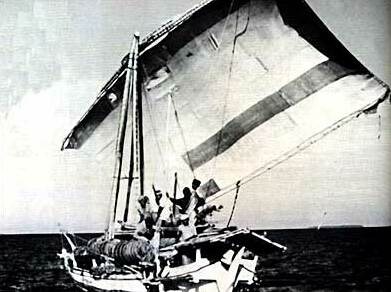
To supply the markets of Southern China, Makassarese trepangers traded with the Aboriginal Australians of Arnhem Land from at least the 18th century and likely considerably earlier. This Makassan contact with Australia is the first recorded example of interaction between the inhabitants of the Australian continent and their Asian neighbours.
This contact had a major impact on the Indigenous Australians. The Makassarese exchanged goods such as cloth, tobacco, knives, rice and alcohol for the right to trepang coastal waters and employ local labour. Makassar pidgin became a lingua franca along the north coast among different Indigenous Australian groups who were brought into greater contact with each other by the seafaring Makassan culture.
Archeological remains of Makassan contact, including trepang processing plants from the 18th and 19th centuries, are still found at Australian locations such as Port Essington and Groote Eylandt, and the Makassar-planted tamarind trees (native to Madagascar and East Africa).
Slow-moving creatures related to sea stars and sea urchins, sea cucumbers are found on the sea floor. As such, trepanging is accomplished by spearing, diving, dredging or simply picking the animals up by hand when they are exposed at low tide.
Traditionally, sea cucumbers were placed in boiling water before being dried and smoked before going to market.
Trepanging
Trepanging is the act of collection or harvesting of sea cucumbers, known in Indonesian as trepang, Malay těripang, and used as food.
The collector, or fisher, of trepang is a trepanger.
Trepanging is comparable to clamming, crabbing, lobstering, musseling, shrimping and other forms of "fishing" whose goal is the acquisition of edible invertebrates rather than fish.
To supply the markets of Southern China, Makassarese trepangers traded with the Aboriginal Australians of Arnhem Land from at least the 18th century and likely considerably earlier. This Makassan contact with Australia is the first recorded example of interaction between the inhabitants of the Australian continent and their Asian neighbours.
This contact had a major impact on the Indigenous Australians. The Makassarese exchanged goods such as cloth, tobacco, knives, rice and alcohol for the right to trepang coastal waters and employ local labour. Makassar pidgin became a lingua franca along the north coast among different Indigenous Australian groups who were brought into greater contact with each other by the seafaring Makassan culture.
Archeological remains of Makassan contact, including trepang processing plants from the 18th and 19th centuries, are still found at Australian locations such as Port Essington and Groote Eylandt, and the Makassar-planted tamarind trees (native to Madagascar and East Africa).
Slow-moving creatures related to sea stars and sea urchins, sea cucumbers are found on the sea floor. As such, trepanging is accomplished by spearing, diving, dredging or simply picking the animals up by hand when they are exposed at low tide.
Traditionally, sea cucumbers were placed in boiling water before being dried and smoked before going to market.
Recent media
Recent media