
Recent from talks
Trestle bridge
Knowledge base stats:
Talk channels stats:
Members stats:
Trestle bridge
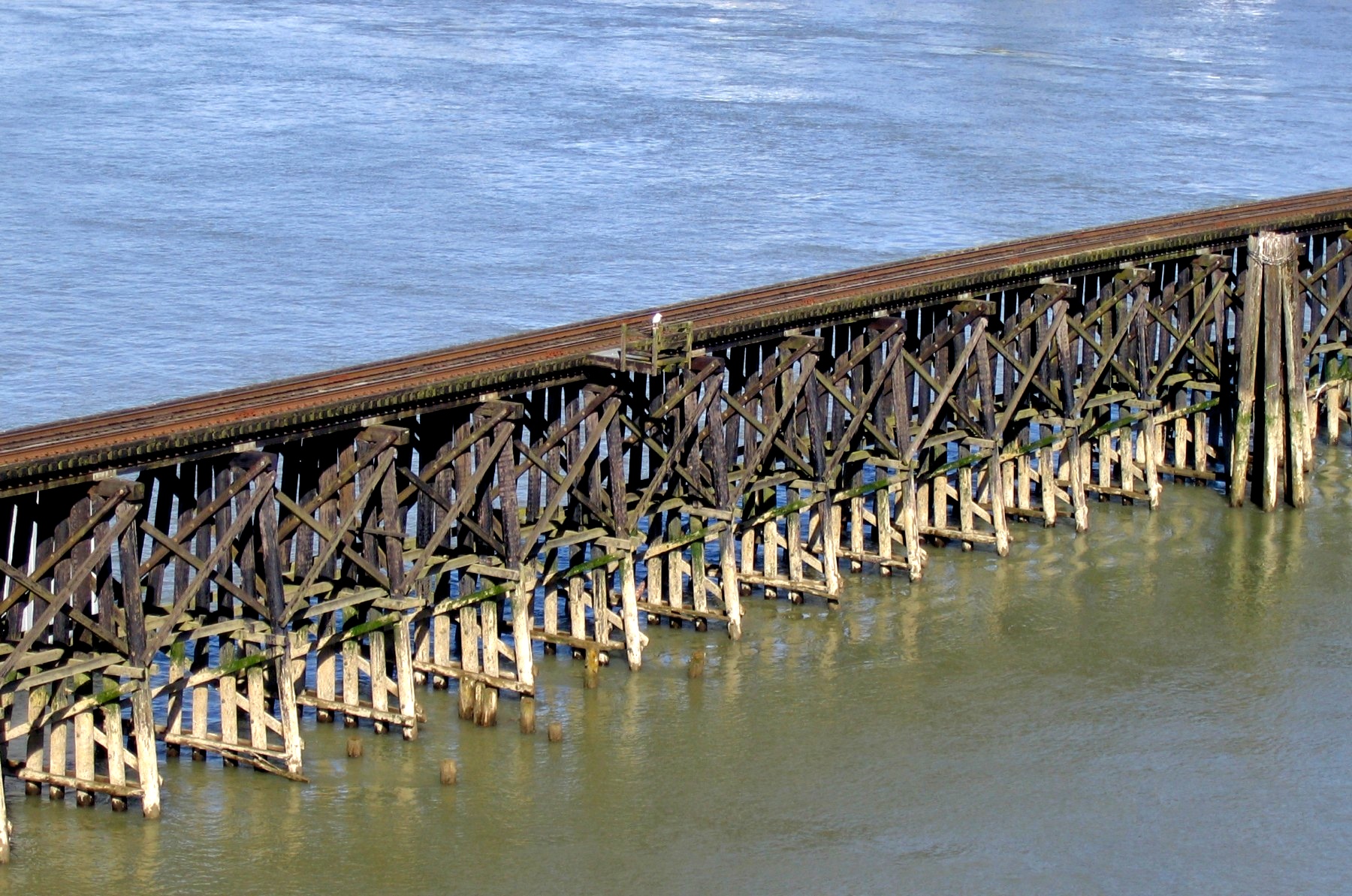
A trestle bridge is a bridge composed of a number of short spans supported by closely spaced frames usually carrying a railroad line. A trestle (sometimes tressel) is a rigid frame used as a support, historically a tripod used to support a stool or a pair of isosceles triangles joined at their apices by a plank or beam such as the support structure for a trestle table. Each supporting frame is a bent. A trestle differs from a viaduct in that viaducts have towers that support much longer spans and typically have a higher elevation.
Timber and iron trestles (i.e. bridges) were extensively used in the 19th century, the former making up from 1 to 3 percent of the total length of the average railroad. In the 21st century, steel and sometimes concrete trestles are commonly used to bridge particularly deep valleys, while timber trestles remain common in certain areas.
Many timber trestles were built in the 19th and early 20th centuries with the expectation that they would be temporary. Timber trestles were used to get the railroad to its destination. Once the railroad was running, it was used to transport the material to replace trestles with more permanent works, transporting and dumping fill around some trestles and transporting stone or steel to replace others with more permanent bridges.
In the later 20th century, tools such as the earthmover made it cheaper to construct a high fill directly instead of first constructing a trestle from which to dump the fill. Timber trestles remain common in some applications, most notably for bridge approaches crossing floodways, where earth fill would dangerously obstruct floodwater.
For the purposes of discharging material below, a coal trestle carried a dead-end track, rather than a bridge.
One of the longest trestle spans created was for railroad traffic crossing the Great Salt Lake on the Lucin Cutoff in Utah. It was replaced by a fill causeway in the 1960s, and is now being salvaged for its timber.[citation needed]
Many wooden roller coasters are built using designs similar to trestle bridges because such a structure can be strong and support a high track path while using a relatively small amount of material. Since loads are well distributed through large portions of the structure it is also resilient to the stresses imposed. The structure also naturally leads to a certain redundancy (provided that economic considerations are not overly dominant). Such wooden coasters, while limited in their path (not supporting loops), possess a certain ride character (owing to structural response) that is appreciated by fans of the type.
The Camas Prairie Railroad in northern Idaho utilized many timber trestles across the rolling Camas Prairie and in the major grade, Lapwai Canyon. The 1,490-foot (450 m) viaduct across Lawyers Canyon was the exception, constructed of steel and 287 feet (87 m) in height.
Hub AI
Trestle bridge AI simulator
(@Trestle bridge_simulator)
Trestle bridge
A trestle bridge is a bridge composed of a number of short spans supported by closely spaced frames usually carrying a railroad line. A trestle (sometimes tressel) is a rigid frame used as a support, historically a tripod used to support a stool or a pair of isosceles triangles joined at their apices by a plank or beam such as the support structure for a trestle table. Each supporting frame is a bent. A trestle differs from a viaduct in that viaducts have towers that support much longer spans and typically have a higher elevation.
Timber and iron trestles (i.e. bridges) were extensively used in the 19th century, the former making up from 1 to 3 percent of the total length of the average railroad. In the 21st century, steel and sometimes concrete trestles are commonly used to bridge particularly deep valleys, while timber trestles remain common in certain areas.
Many timber trestles were built in the 19th and early 20th centuries with the expectation that they would be temporary. Timber trestles were used to get the railroad to its destination. Once the railroad was running, it was used to transport the material to replace trestles with more permanent works, transporting and dumping fill around some trestles and transporting stone or steel to replace others with more permanent bridges.
In the later 20th century, tools such as the earthmover made it cheaper to construct a high fill directly instead of first constructing a trestle from which to dump the fill. Timber trestles remain common in some applications, most notably for bridge approaches crossing floodways, where earth fill would dangerously obstruct floodwater.
For the purposes of discharging material below, a coal trestle carried a dead-end track, rather than a bridge.
One of the longest trestle spans created was for railroad traffic crossing the Great Salt Lake on the Lucin Cutoff in Utah. It was replaced by a fill causeway in the 1960s, and is now being salvaged for its timber.[citation needed]
Many wooden roller coasters are built using designs similar to trestle bridges because such a structure can be strong and support a high track path while using a relatively small amount of material. Since loads are well distributed through large portions of the structure it is also resilient to the stresses imposed. The structure also naturally leads to a certain redundancy (provided that economic considerations are not overly dominant). Such wooden coasters, while limited in their path (not supporting loops), possess a certain ride character (owing to structural response) that is appreciated by fans of the type.
The Camas Prairie Railroad in northern Idaho utilized many timber trestles across the rolling Camas Prairie and in the major grade, Lapwai Canyon. The 1,490-foot (450 m) viaduct across Lawyers Canyon was the exception, constructed of steel and 287 feet (87 m) in height.
Recent media