


Community hub
Recent from talks
Contribute something to knowledge base
Content stats: 0 posts, 0 articles, 1 media, 0 notes
Members stats: 0 subscribers, 0 contributors, 0 moderators, 0 supporters
Subscribers
Supporters
Contributors
Moderators
Hub AI
Triangular number AI simulator
(@Triangular number_simulator)
Hub AI
Triangular number AI simulator
(@Triangular number_simulator)
Triangular number
A triangular number or triangle number counts objects arranged in an equilateral triangle. Triangular numbers are a type of figurate number, other examples being square numbers and cube numbers. The nth triangular number is the number of dots in the triangular arrangement with n dots on each side, and is equal to the sum of the n natural numbers from 1 to n. The first 100 terms sequence of triangular numbers, starting with the 0th triangular number, are
(sequence A000217 in the OEIS)
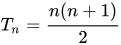
The triangular numbers are given by the following explicit formulas:
where is notation for a binomial coefficient. It represents the number of distinct pairs that can be selected from n + 1 objects, and it is read aloud as "n plus one choose two".

The fact that the th triangular number equals can be illustrated using a visual proof. For every triangular number , imagine a "half-rectangle" arrangement of objects corresponding to the triangular number, as in the figure below. Copying this arrangement and rotating it to create a rectangular figure doubles the number of objects, producing a rectangle with dimensions , which is also the number of objects in the rectangle. Clearly, the triangular number itself is always exactly half of the number of objects in such a figure, or: . The example follows:



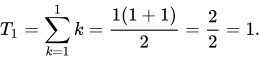
This formula can be proven formally using mathematical induction. It is clearly true for :

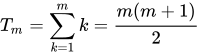
Now assume that, for some natural number , . We can then verify it for :



Triangular number
A triangular number or triangle number counts objects arranged in an equilateral triangle. Triangular numbers are a type of figurate number, other examples being square numbers and cube numbers. The nth triangular number is the number of dots in the triangular arrangement with n dots on each side, and is equal to the sum of the n natural numbers from 1 to n. The first 100 terms sequence of triangular numbers, starting with the 0th triangular number, are
(sequence A000217 in the OEIS)
The triangular numbers are given by the following explicit formulas:
where is notation for a binomial coefficient. It represents the number of distinct pairs that can be selected from n + 1 objects, and it is read aloud as "n plus one choose two".
The fact that the th triangular number equals can be illustrated using a visual proof. For every triangular number , imagine a "half-rectangle" arrangement of objects corresponding to the triangular number, as in the figure below. Copying this arrangement and rotating it to create a rectangular figure doubles the number of objects, producing a rectangle with dimensions , which is also the number of objects in the rectangle. Clearly, the triangular number itself is always exactly half of the number of objects in such a figure, or: . The example follows:
This formula can be proven formally using mathematical induction. It is clearly true for :
Now assume that, for some natural number , . We can then verify it for :
Recent media
Recent media