
Recent from talks
Octahedral molecular geometry
Knowledge base stats:
Talk channels stats:
Members stats:
Octahedral molecular geometry
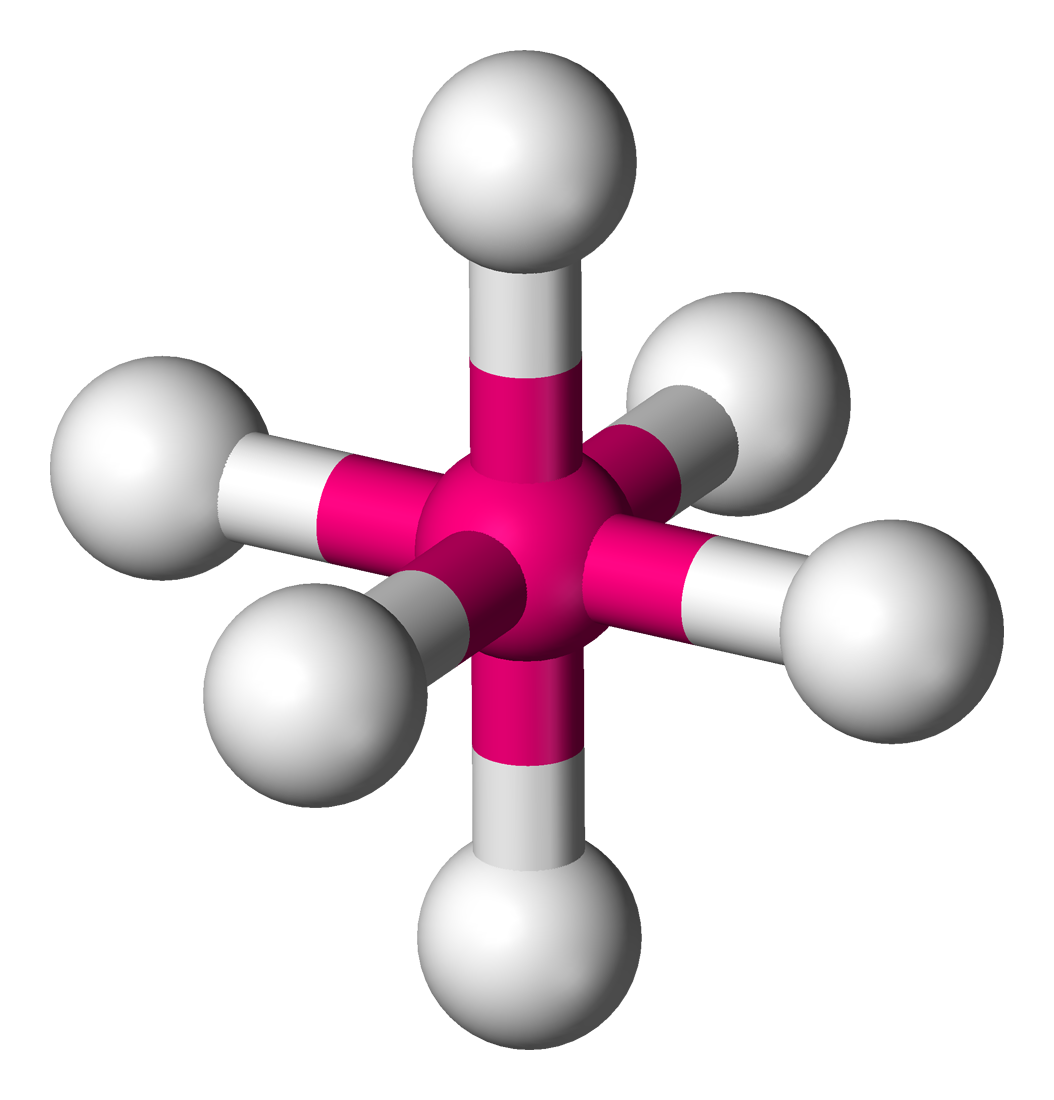
In chemistry, octahedral molecular geometry, also called square bipyramidal, describes the shape of compounds with six atoms or groups of atoms or ligands symmetrically arranged around a central atom, defining the vertices of an octahedron. The octahedron has eight faces, hence the prefix octa. The octahedron is one of the Platonic solids, although octahedral molecules typically have an atom in their centre and no bonds between the ligand atoms. A perfect octahedron belongs to the point group Oh. Examples of octahedral compounds are sulfur hexafluoride SF6 and molybdenum hexacarbonyl Mo(CO)6. The term "octahedral" is used somewhat loosely by chemists, focusing on the geometry of the bonds to the central atom and not considering differences among the ligands themselves. For example, [Co(NH3)6]3+, which is not octahedral in the mathematical sense due to the orientation of the N−H bonds, is referred to as octahedral.
The concept of octahedral coordination geometry was developed by Alfred Werner to explain the stoichiometries and isomerism in coordination compounds. His insight allowed chemists to rationalize the number of isomers of coordination compounds. Octahedral transition-metal complexes containing amines and simple anions are often referred to as Werner-type complexes.
When two or more types of ligands (La, Lb, ...) are coordinated to an octahedral metal centre (M), the complex can exist as isomers. The naming system for these isomers depends upon the number and arrangement of different ligands.
For MLa
4Lb
2, two isomers exist. The cis isomer has the two Lb ligands adjacent to each other, whereas the trans isomer has them 180° to each other. It was the analysis of such complexes that led Alfred Werner to the 1913 Nobel Prize–winning postulation of octahedral complexes.
For MLa
3Lb
3, two isomers are possible. The facial isomer (fac) has each set of three identical ligands occupying one face of the octahedron surrounding the central atom; all of the identical ligands are cis to each other. The meridional isomer (mer) has each set of three identical ligands occupying a plane passing through the central atom; two of the three are trans to each other and the third is cis to the first two.
Complexes with three bidentate ligands or two cis bidentate ligands can exist as enantiomeric pairs. Examples are shown below.
For MLa
2Lb
2Lc
2, a total of five geometric isomers and six stereoisomers are possible.
The number of possible isomers can reach 30 for an octahedral complex with six different ligands (in contrast, only two stereoisomers are possible for a tetrahedral complex with four different ligands). The following table lists all possible combinations for monodentate ligands:
Hub AI
Octahedral molecular geometry AI simulator
(@Octahedral molecular geometry_simulator)
Octahedral molecular geometry
In chemistry, octahedral molecular geometry, also called square bipyramidal, describes the shape of compounds with six atoms or groups of atoms or ligands symmetrically arranged around a central atom, defining the vertices of an octahedron. The octahedron has eight faces, hence the prefix octa. The octahedron is one of the Platonic solids, although octahedral molecules typically have an atom in their centre and no bonds between the ligand atoms. A perfect octahedron belongs to the point group Oh. Examples of octahedral compounds are sulfur hexafluoride SF6 and molybdenum hexacarbonyl Mo(CO)6. The term "octahedral" is used somewhat loosely by chemists, focusing on the geometry of the bonds to the central atom and not considering differences among the ligands themselves. For example, [Co(NH3)6]3+, which is not octahedral in the mathematical sense due to the orientation of the N−H bonds, is referred to as octahedral.
The concept of octahedral coordination geometry was developed by Alfred Werner to explain the stoichiometries and isomerism in coordination compounds. His insight allowed chemists to rationalize the number of isomers of coordination compounds. Octahedral transition-metal complexes containing amines and simple anions are often referred to as Werner-type complexes.
When two or more types of ligands (La, Lb, ...) are coordinated to an octahedral metal centre (M), the complex can exist as isomers. The naming system for these isomers depends upon the number and arrangement of different ligands.
For MLa
4Lb
2, two isomers exist. The cis isomer has the two Lb ligands adjacent to each other, whereas the trans isomer has them 180° to each other. It was the analysis of such complexes that led Alfred Werner to the 1913 Nobel Prize–winning postulation of octahedral complexes.
For MLa
3Lb
3, two isomers are possible. The facial isomer (fac) has each set of three identical ligands occupying one face of the octahedron surrounding the central atom; all of the identical ligands are cis to each other. The meridional isomer (mer) has each set of three identical ligands occupying a plane passing through the central atom; two of the three are trans to each other and the third is cis to the first two.
Complexes with three bidentate ligands or two cis bidentate ligands can exist as enantiomeric pairs. Examples are shown below.
For MLa
2Lb
2Lc
2, a total of five geometric isomers and six stereoisomers are possible.
The number of possible isomers can reach 30 for an octahedral complex with six different ligands (in contrast, only two stereoisomers are possible for a tetrahedral complex with four different ligands). The following table lists all possible combinations for monodentate ligands:
Recent media