



Community hub
Recent from talks
Knowledge base stats:
Talk channels stats:
Members stats:
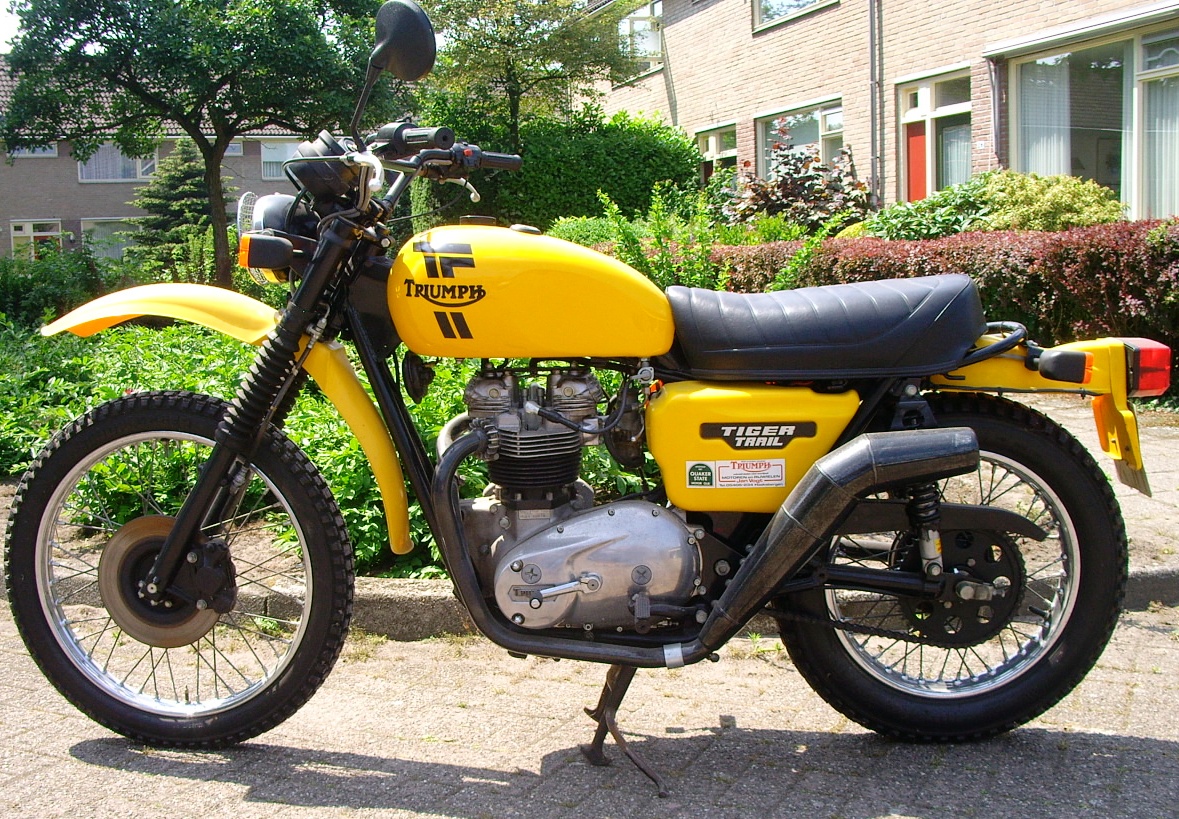
Triumph Tiger Trail
The Triumph Tiger Trail was a motorcycle model manufactured by Triumph Motorcycles at the Meriden factory. The Tiger Trail was made from 1981 to 1982 in both 750 cc (TR7T) and 650 cc (TR65T) capacities, and under 180 examples were built. Emission regulations precluded export to the USA but otherwise the model was available to all Triumph's other markets particularly in many British Commonwealth nations and western Europe.
Triumph manufactured the Tiger Trail in response to their French importers', C.G.C.I.M., request for a large capacity dual purpose machine to compete with the BMW R80G/S model. The importers had visited Meriden with a prototype based around the Triumph Bonneville T140 which the factory judged too powerful. Instead, Meriden's director of engineering Brian Jones based the proposed model around the 750 cc TR7V Triumph Tiger with its single 30 mm Amal carburettor and electronic ignition by Lucas. Alterations included lowering the compression giving 42 bhp (31 kW) at 6,500 rpm and fitting camshaft profiles from the Triumph Trident. The secondary gearing was also altered by fitting an 18-tooth gearbox sprocket and 47-tooth rear chain sprocket. Overall weight was down 25 lb (11 kg) from the road models to 375 lb (170 kg) dry. To this end, with two exceptions to fulfill a Trinidad police order, no electric start was fitted as standard. A factory decal advised not travelling beyond 80 mph (130 km/h) upon the standard tyres, although top speed was tested as reaching just over 100 mph (160 km/h).
The 750 cc model was first shown by the factory at the 1980 Paris motorcycle show and introduced for the 1981/1982 season. Bike magazine reported that the French importers were to have entered two 750 cc Tiger Trail bikes in the Paris-Dakar Rally. Certainly, French magazine Moto Verte entered and reported upon a 750 cc Tiger Trail in the Paris-Tunis rally and whilst failing to finish, praised the engine feeling only suspension adjustments rather a complete chassis redesign was needed.
Competition success soon came in June 1981 when Tony Beaumont of the Federation of Police Motor Clubs team sponsored by British Petroleum beat BMW R80G/S and Japanese opposition to win the 750 cc and above class of the Rallye des Pyrénées, a tough on/off-road timed race. Triumph exploited this fact both in press advertisements and in a publicity poster featuring their sales manager Bob Haines leaping through the air upon a TR7T, describing it as "The Bike For Adventure". An Englishman, Jez Billing, rode a suitably modified 750 cc Tiger Trail in his around-the-world attempt from 1986 to 1988.
White Tiger Trails were also made for the Gulf Petroleum sponsored Royal Military Police display team. The frames of these white Tigers omitted the pillion footrest brackets to accommodate the new silencer which was of a different box-type design whilst their tanks sported metal badges instead of decals and being of later Italian manufacture, had 'flip-up' petrol caps. The front mudguard also had a perforated lower end.
In their review of the TR7T, Motor Cycle News had suggested that the recently introduced Triumph TR65 Thunderbird's engine was more suitable off-road so it was not surprising that a 650cc version of the Tiger Trail, the TR65T, was introduced for 1982. This was despite opposition from Meriden's non-executive board member and political sponsor Geoffrey Robinson that both this, a proposed 125cc learner motorcycle and the 650cc Triumph TR65 Thunderbird itself would take away sales from the more profitable 750cc range. The co-operative's board stated justification was that sales of the 650cc models were not substitutes for the 750cc range but were instead incremental leading up to the eventual purchase of the larger models. Despite this, both the 750cc and 650cc Tiger Trails were marketed at the same price, the smaller bike justifying this by being to a higher specification with a tachometer and centre stand fitted as standard.
Press reviews of both versions of the bike were generally favourable but with often common criticism particularly of the off-road-biassed Mudplugger tyres' road and wet weather performance, as well as the overall weight, suspension travel off-road, and a too short protective engine guard. In comparison with market rivals, the BMW R80G/S and the Moto Morini Camel, the Tiger Trail did well, German magazine Motorrad judging the 750 cc engine superior and SuperBike placing the 650 cc version second to the Camel off-road (with the BMW R80G/S being third) and second to the BMW on-road. Testing the TR7T, Dutch publication, Motor, adjudged it very comfortable but functional, it's off-road performance 'surprisingly good'; particularly on sand being 'pure pleasure'. SuperBike tested the TR7T, calling it, 'an attractive, alternative, serious dirt bike' and 'a hand-crafted, quality, all-rounder.'
Both models were deleted from general production at the end of 1982 due to lack of demand, popularity only ever having been gained in Australia, Germany and Switzerland. The last TR7T was completed as part of a Ministry of Defence order entering service on 9 August 1982 until 20 April 1989.
Hub AI
Triumph Tiger Trail AI simulator
(@Triumph Tiger Trail_simulator)
Triumph Tiger Trail
The Triumph Tiger Trail was a motorcycle model manufactured by Triumph Motorcycles at the Meriden factory. The Tiger Trail was made from 1981 to 1982 in both 750 cc (TR7T) and 650 cc (TR65T) capacities, and under 180 examples were built. Emission regulations precluded export to the USA but otherwise the model was available to all Triumph's other markets particularly in many British Commonwealth nations and western Europe.
Triumph manufactured the Tiger Trail in response to their French importers', C.G.C.I.M., request for a large capacity dual purpose machine to compete with the BMW R80G/S model. The importers had visited Meriden with a prototype based around the Triumph Bonneville T140 which the factory judged too powerful. Instead, Meriden's director of engineering Brian Jones based the proposed model around the 750 cc TR7V Triumph Tiger with its single 30 mm Amal carburettor and electronic ignition by Lucas. Alterations included lowering the compression giving 42 bhp (31 kW) at 6,500 rpm and fitting camshaft profiles from the Triumph Trident. The secondary gearing was also altered by fitting an 18-tooth gearbox sprocket and 47-tooth rear chain sprocket. Overall weight was down 25 lb (11 kg) from the road models to 375 lb (170 kg) dry. To this end, with two exceptions to fulfill a Trinidad police order, no electric start was fitted as standard. A factory decal advised not travelling beyond 80 mph (130 km/h) upon the standard tyres, although top speed was tested as reaching just over 100 mph (160 km/h).
The 750 cc model was first shown by the factory at the 1980 Paris motorcycle show and introduced for the 1981/1982 season. Bike magazine reported that the French importers were to have entered two 750 cc Tiger Trail bikes in the Paris-Dakar Rally. Certainly, French magazine Moto Verte entered and reported upon a 750 cc Tiger Trail in the Paris-Tunis rally and whilst failing to finish, praised the engine feeling only suspension adjustments rather a complete chassis redesign was needed.
Competition success soon came in June 1981 when Tony Beaumont of the Federation of Police Motor Clubs team sponsored by British Petroleum beat BMW R80G/S and Japanese opposition to win the 750 cc and above class of the Rallye des Pyrénées, a tough on/off-road timed race. Triumph exploited this fact both in press advertisements and in a publicity poster featuring their sales manager Bob Haines leaping through the air upon a TR7T, describing it as "The Bike For Adventure". An Englishman, Jez Billing, rode a suitably modified 750 cc Tiger Trail in his around-the-world attempt from 1986 to 1988.
White Tiger Trails were also made for the Gulf Petroleum sponsored Royal Military Police display team. The frames of these white Tigers omitted the pillion footrest brackets to accommodate the new silencer which was of a different box-type design whilst their tanks sported metal badges instead of decals and being of later Italian manufacture, had 'flip-up' petrol caps. The front mudguard also had a perforated lower end.
In their review of the TR7T, Motor Cycle News had suggested that the recently introduced Triumph TR65 Thunderbird's engine was more suitable off-road so it was not surprising that a 650cc version of the Tiger Trail, the TR65T, was introduced for 1982. This was despite opposition from Meriden's non-executive board member and political sponsor Geoffrey Robinson that both this, a proposed 125cc learner motorcycle and the 650cc Triumph TR65 Thunderbird itself would take away sales from the more profitable 750cc range. The co-operative's board stated justification was that sales of the 650cc models were not substitutes for the 750cc range but were instead incremental leading up to the eventual purchase of the larger models. Despite this, both the 750cc and 650cc Tiger Trails were marketed at the same price, the smaller bike justifying this by being to a higher specification with a tachometer and centre stand fitted as standard.
Press reviews of both versions of the bike were generally favourable but with often common criticism particularly of the off-road-biassed Mudplugger tyres' road and wet weather performance, as well as the overall weight, suspension travel off-road, and a too short protective engine guard. In comparison with market rivals, the BMW R80G/S and the Moto Morini Camel, the Tiger Trail did well, German magazine Motorrad judging the 750 cc engine superior and SuperBike placing the 650 cc version second to the Camel off-road (with the BMW R80G/S being third) and second to the BMW on-road. Testing the TR7T, Dutch publication, Motor, adjudged it very comfortable but functional, it's off-road performance 'surprisingly good'; particularly on sand being 'pure pleasure'. SuperBike tested the TR7T, calling it, 'an attractive, alternative, serious dirt bike' and 'a hand-crafted, quality, all-rounder.'
Both models were deleted from general production at the end of 1982 due to lack of demand, popularity only ever having been gained in Australia, Germany and Switzerland. The last TR7T was completed as part of a Ministry of Defence order entering service on 9 August 1982 until 20 April 1989.