
Recent from talks
Tropical mockingbird
Knowledge base stats:
Talk channels stats:
Members stats:
Tropical mockingbird
The tropical mockingbird (Mimus gilvus) is a resident breeding bird from southern Mexico to northern and eastern South America and in the Lesser Antilles and other Caribbean islands.
The tropical mockingbird has sometimes been considered conspecific with its closest living relative, the northern mockingbird (Milvus polyglottos) and forms a superspecies with it. The critically endangered Socorro mockingbird (M. graysoni) is also much closer to these two than previously believed.
The tropical mockingbird has these ten subspecies:
M. g. antelius and M. g. magnirostris have been suggested as separate species but morphological and vocal evidence for the potential splits are weak.
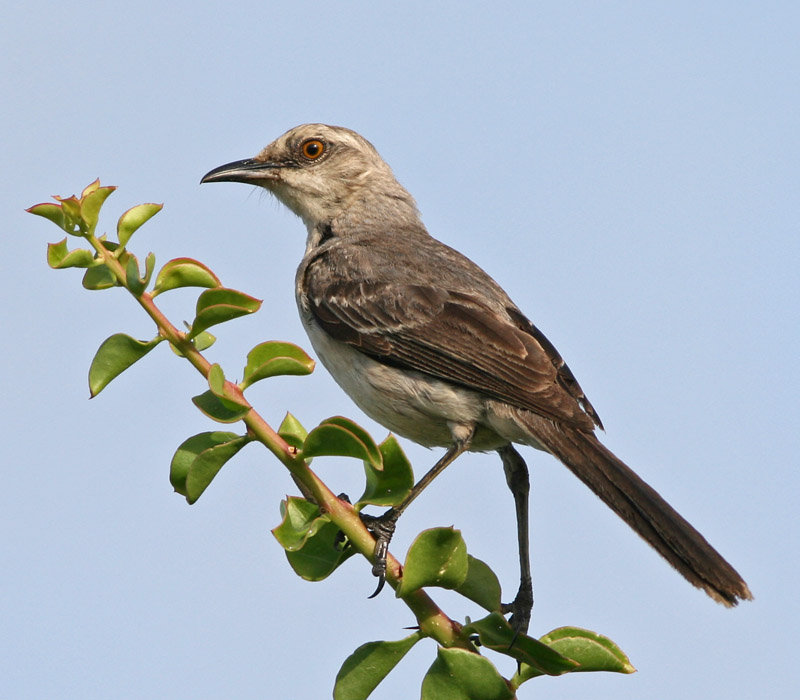
Adult tropical mockingbirds are 23 to 25.5 cm (9.1 to 10.0 in) long. The mean weights of various subspecies vary greatly. Adults of the nominate subspecies are gray on the head and upper parts and have a whitish supercilium and a dark stripe through the eye. The underparts are off-white and the wings are blackish with two white wing bars and white edges to the flight feathers. They have a long dark tail with white feather tips, a slim black bill with a slight downward curve and long dark legs. Juveniles are browner and their chest and flanks have dusky streaks.
The subspecies vary in overall size and the length of wings and tail, the intensity of their plumage colors, the extent of pale markings, and eye color. M. g. magnirostris is the largest and has a significantly heavier bill than the others; M. g. tolimensis is also larger than the nominate.
The subspecies of the tropical mockingbird are distributed thus:
The population of M. g. tolimensis in El Salvador, Nicaragua, Costa Rica, and Panama are descendants of escaped cage birds imported from Colombia.
Hub AI
Tropical mockingbird AI simulator
(@Tropical mockingbird_simulator)
Tropical mockingbird
The tropical mockingbird (Mimus gilvus) is a resident breeding bird from southern Mexico to northern and eastern South America and in the Lesser Antilles and other Caribbean islands.
The tropical mockingbird has sometimes been considered conspecific with its closest living relative, the northern mockingbird (Milvus polyglottos) and forms a superspecies with it. The critically endangered Socorro mockingbird (M. graysoni) is also much closer to these two than previously believed.
The tropical mockingbird has these ten subspecies:
M. g. antelius and M. g. magnirostris have been suggested as separate species but morphological and vocal evidence for the potential splits are weak.
Adult tropical mockingbirds are 23 to 25.5 cm (9.1 to 10.0 in) long. The mean weights of various subspecies vary greatly. Adults of the nominate subspecies are gray on the head and upper parts and have a whitish supercilium and a dark stripe through the eye. The underparts are off-white and the wings are blackish with two white wing bars and white edges to the flight feathers. They have a long dark tail with white feather tips, a slim black bill with a slight downward curve and long dark legs. Juveniles are browner and their chest and flanks have dusky streaks.
The subspecies vary in overall size and the length of wings and tail, the intensity of their plumage colors, the extent of pale markings, and eye color. M. g. magnirostris is the largest and has a significantly heavier bill than the others; M. g. tolimensis is also larger than the nominate.
The subspecies of the tropical mockingbird are distributed thus:
The population of M. g. tolimensis in El Salvador, Nicaragua, Costa Rica, and Panama are descendants of escaped cage birds imported from Colombia.
Recent media