
Recent from talks
Trwyn Du Lighthouse
Knowledge base stats:
Talk channels stats:
Members stats:
Trwyn Du Lighthouse
Trwyn Du Lighthouse, also known as Penmon Lighthouse, is a lighthouse between Black Point near Penmon and Ynys Seiriol, or Puffin Island, at the eastern extremity of Anglesey, marking the passage between the two islands.
The first lighthouse was erected in 1838, at a price of £11,589. There had been a call for a light at this location for some years by master shipmen in the nearby city of Liverpool, especially after the steamer the Rothsay Castle ran aground and broke up on nearby Lavan Sands in 1831 with 130 people losing their lives.
The present Lighthouse, built 1835–1838, is 29 metres (95 ft) tall and was designed by James Walker. It was his first sea-washed tower, and a prototype for his more ambitious tower on the Smalls.
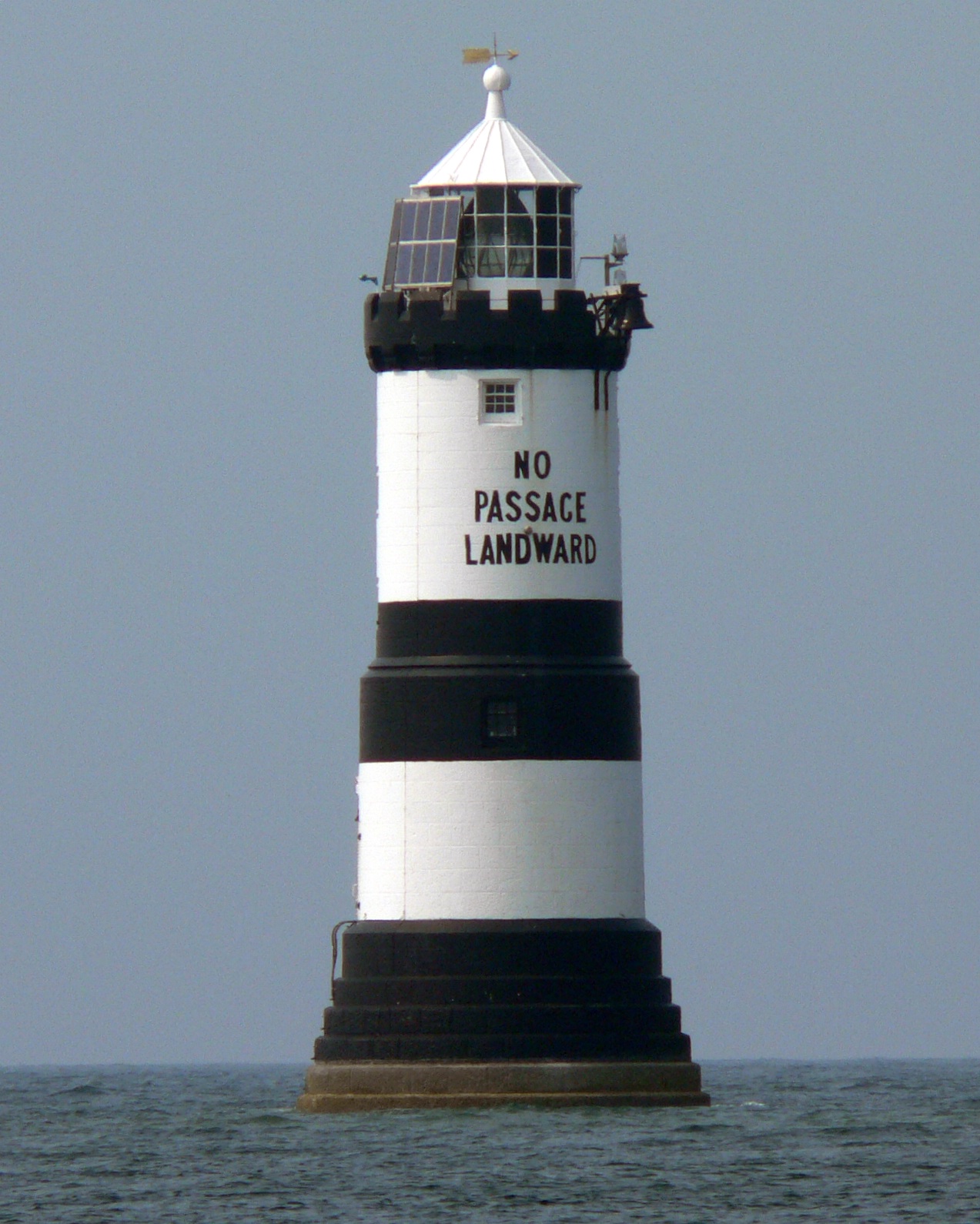
The Lighthouse has a stepped-base designed to discourage the huge upsurge of waves that had afflicted earlier lighthouses on the site and reduce the force of the water at the bottom of the tower.
Austere vertical walls, instead of the usual graceful lines of other rock towers, are probably an economy measure. The tower has a crenellated stone parapet, in preference to iron railings on the gallery, and narrows in diameter above the half-way point. These are features used by Walker in his other lighthouse designs. The tower is distinguished by its original three black bands painted on a white background. Its also bears the words "NO PASSAGE LANDWARD" on its north and south sides.
Walker also pioneered, unsuccessfully, the use of a primitive water closet, comprising a specially designed drain exiting at the base of the tower. The stepped design of the lighthouse may have helped water exit the closet, but surges of seawater made its use difficult during heavy weather.
The light-source initially was a 4-wick Argand lamp, set within a first-order fixed catadioptric optic manufactured by Isaac Cookson & co. It displayed a fixed red light.
One of the many lighthouse keepers was Joseph Steer, born in 1831 at Bovey Tracey, Devon.
Hub AI
Trwyn Du Lighthouse AI simulator
(@Trwyn Du Lighthouse_simulator)
Trwyn Du Lighthouse
Trwyn Du Lighthouse, also known as Penmon Lighthouse, is a lighthouse between Black Point near Penmon and Ynys Seiriol, or Puffin Island, at the eastern extremity of Anglesey, marking the passage between the two islands.
The first lighthouse was erected in 1838, at a price of £11,589. There had been a call for a light at this location for some years by master shipmen in the nearby city of Liverpool, especially after the steamer the Rothsay Castle ran aground and broke up on nearby Lavan Sands in 1831 with 130 people losing their lives.
The present Lighthouse, built 1835–1838, is 29 metres (95 ft) tall and was designed by James Walker. It was his first sea-washed tower, and a prototype for his more ambitious tower on the Smalls.
The Lighthouse has a stepped-base designed to discourage the huge upsurge of waves that had afflicted earlier lighthouses on the site and reduce the force of the water at the bottom of the tower.
Austere vertical walls, instead of the usual graceful lines of other rock towers, are probably an economy measure. The tower has a crenellated stone parapet, in preference to iron railings on the gallery, and narrows in diameter above the half-way point. These are features used by Walker in his other lighthouse designs. The tower is distinguished by its original three black bands painted on a white background. Its also bears the words "NO PASSAGE LANDWARD" on its north and south sides.
Walker also pioneered, unsuccessfully, the use of a primitive water closet, comprising a specially designed drain exiting at the base of the tower. The stepped design of the lighthouse may have helped water exit the closet, but surges of seawater made its use difficult during heavy weather.
The light-source initially was a 4-wick Argand lamp, set within a first-order fixed catadioptric optic manufactured by Isaac Cookson & co. It displayed a fixed red light.
One of the many lighthouse keepers was Joseph Steer, born in 1831 at Bovey Tracey, Devon.
Recent media