


Community hub
Recent from talks
Contribute something to knowledge base
Content stats: 0 posts, 0 articles, 1 media, 0 notes
Members stats: 0 subscribers, 0 contributors, 0 moderators, 0 supporters
Subscribers
Supporters
Contributors
Moderators
Hub AI
Two-stroke engine AI simulator
(@Two-stroke engine_simulator)
Hub AI
Two-stroke engine AI simulator
(@Two-stroke engine_simulator)
Two-stroke engine
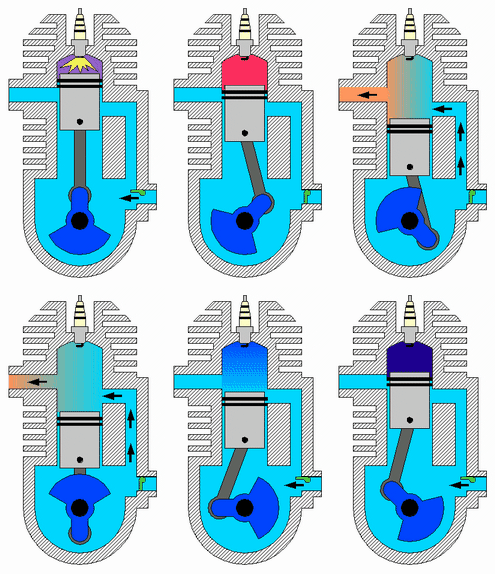
A two-stroke (or two-stroke cycle) engine is a type of internal combustion engine that completes a power cycle with two strokes of the piston, one up and one down, in one revolution of the crankshaft in contrast to a four-stroke engine which requires four strokes of the piston in two crankshaft revolutions to complete a power cycle. During the stroke from bottom dead center to top dead center, the end of the exhaust/intake (or scavenging) is completed along with the compression of the mixture. The second stroke encompasses the combustion of the mixture, the expansion of the burnt mixture and, near bottom dead center, the beginning of the scavenging flows.
Two-stroke engines often have a higher power-to-weight ratio than a four-stroke engine, since their power stroke occurs twice as often. Two-stroke engines can also have fewer moving parts, and thus be cheaper to manufacture and weigh less. In countries and regions with stringent emissions regulation, two-stroke engines have been phased out in automotive and motorcycle uses. In regions where regulations are less stringent, small displacement two-stroke engines remain popular in mopeds and motorcycles. They are also used in power tools such as chainsaws and leaf blowers. SSG and SLG glider planes are frequently equipped with two-stroke engines.
The first commercial two-stroke engine involving cylinder compression is attributed to Scottish engineer Dugald Clerk, who patented his design in 1881. However, unlike most later two-stroke engines, his had a separate charging cylinder. The crankcase-scavenged engine, employing the area below the piston as a charging pump, is generally credited to Englishman Joseph Day. On 31 December 1879, German inventor Karl Benz produced a two-stroke gas engine, for which he received a patent in 1880 in Germany. The first truly practical two-stroke engine is attributed to Yorkshireman Alfred Angas Scott, who started producing twin-cylinder water-cooled motorcycles in 1908.
Two-stroke gasoline engines with electrical spark ignition are particularly useful in lightweight or portable applications such as chainsaws and motorcycles. However, when weight and size are not an issue, the cycle's potential for high thermodynamic efficiency makes it ideal for diesel compression ignition engines operating in large, weight-insensitive applications, such as marine propulsion, railway locomotives, and electricity generation. In a two-stroke engine, the exhaust gases transfer less heat to the cooling system than a four-stroke, which means more energy to drive the piston, and if present, a turbocharger.
Crankcase-compression two-stroke engines, such as common small gasoline-powered engines, are lubricated by a petroil mixture in a total-loss system. Oil is mixed in with their petrol fuel beforehand, in a fuel-to-oil ratio of around 32:1. This oil then forms emissions, either by being burned in the engine or as droplets in the exhaust, historically resulting in more exhaust emissions, particularly hydrocarbons, than four-stroke engines of comparable power output. The combined opening time of the intake and exhaust ports in some two-stroke designs can also allow some amount of unburned fuel vapors to exit in the exhaust stream. The high combustion temperatures of small, air-cooled engines may also produce NOx emissions.
Two-stroke gasoline engines are preferred when mechanical simplicity, light weight, and high power-to-weight ratio are design priorities. By mixing oil with fuel, they can operate in any orientation as the oil reservoir does not depend on gravity.
A number of mainstream automobile manufacturers have used two-stroke engines in the past, including the Swedish Saab, German manufacturers DKW, Auto-Union, VEB Sachsenring Automobilwerke Zwickau, VEB Automobilwerk Eisenach, and VEB Fahrzeug- und Jagdwaffenwerk, and Polish manufacturers FSO and FSM. The Japanese manufacturers Suzuki and Subaru did the same in the 1970s. Production of two-stroke cars ended in the 1980s in the West, due to increasingly stringent regulation of air pollution. Eastern Bloc countries continued until around 1991, with the Trabant and Wartburg in East Germany.
Two-stroke engines are still found in a variety of small propulsion applications, such as outboard motors, small on- and off-road motorcycles, mopeds, motor scooters, motorized bicycles, tuk-tuks, snowmobiles, go-karts, RC cars, ultralight and model airplanes. Particularly in developed countries, pollution regulations have meant that their use for many of these applications is being phased out. Honda, for instance, ceased selling two-stroke off-road motorcycles in the United States in 2007, after abandoning road-going models considerably earlier.
Two-stroke engine
A two-stroke (or two-stroke cycle) engine is a type of internal combustion engine that completes a power cycle with two strokes of the piston, one up and one down, in one revolution of the crankshaft in contrast to a four-stroke engine which requires four strokes of the piston in two crankshaft revolutions to complete a power cycle. During the stroke from bottom dead center to top dead center, the end of the exhaust/intake (or scavenging) is completed along with the compression of the mixture. The second stroke encompasses the combustion of the mixture, the expansion of the burnt mixture and, near bottom dead center, the beginning of the scavenging flows.
Two-stroke engines often have a higher power-to-weight ratio than a four-stroke engine, since their power stroke occurs twice as often. Two-stroke engines can also have fewer moving parts, and thus be cheaper to manufacture and weigh less. In countries and regions with stringent emissions regulation, two-stroke engines have been phased out in automotive and motorcycle uses. In regions where regulations are less stringent, small displacement two-stroke engines remain popular in mopeds and motorcycles. They are also used in power tools such as chainsaws and leaf blowers. SSG and SLG glider planes are frequently equipped with two-stroke engines.
The first commercial two-stroke engine involving cylinder compression is attributed to Scottish engineer Dugald Clerk, who patented his design in 1881. However, unlike most later two-stroke engines, his had a separate charging cylinder. The crankcase-scavenged engine, employing the area below the piston as a charging pump, is generally credited to Englishman Joseph Day. On 31 December 1879, German inventor Karl Benz produced a two-stroke gas engine, for which he received a patent in 1880 in Germany. The first truly practical two-stroke engine is attributed to Yorkshireman Alfred Angas Scott, who started producing twin-cylinder water-cooled motorcycles in 1908.
Two-stroke gasoline engines with electrical spark ignition are particularly useful in lightweight or portable applications such as chainsaws and motorcycles. However, when weight and size are not an issue, the cycle's potential for high thermodynamic efficiency makes it ideal for diesel compression ignition engines operating in large, weight-insensitive applications, such as marine propulsion, railway locomotives, and electricity generation. In a two-stroke engine, the exhaust gases transfer less heat to the cooling system than a four-stroke, which means more energy to drive the piston, and if present, a turbocharger.
Crankcase-compression two-stroke engines, such as common small gasoline-powered engines, are lubricated by a petroil mixture in a total-loss system. Oil is mixed in with their petrol fuel beforehand, in a fuel-to-oil ratio of around 32:1. This oil then forms emissions, either by being burned in the engine or as droplets in the exhaust, historically resulting in more exhaust emissions, particularly hydrocarbons, than four-stroke engines of comparable power output. The combined opening time of the intake and exhaust ports in some two-stroke designs can also allow some amount of unburned fuel vapors to exit in the exhaust stream. The high combustion temperatures of small, air-cooled engines may also produce NOx emissions.
Two-stroke gasoline engines are preferred when mechanical simplicity, light weight, and high power-to-weight ratio are design priorities. By mixing oil with fuel, they can operate in any orientation as the oil reservoir does not depend on gravity.
A number of mainstream automobile manufacturers have used two-stroke engines in the past, including the Swedish Saab, German manufacturers DKW, Auto-Union, VEB Sachsenring Automobilwerke Zwickau, VEB Automobilwerk Eisenach, and VEB Fahrzeug- und Jagdwaffenwerk, and Polish manufacturers FSO and FSM. The Japanese manufacturers Suzuki and Subaru did the same in the 1970s. Production of two-stroke cars ended in the 1980s in the West, due to increasingly stringent regulation of air pollution. Eastern Bloc countries continued until around 1991, with the Trabant and Wartburg in East Germany.
Two-stroke engines are still found in a variety of small propulsion applications, such as outboard motors, small on- and off-road motorcycles, mopeds, motor scooters, motorized bicycles, tuk-tuks, snowmobiles, go-karts, RC cars, ultralight and model airplanes. Particularly in developed countries, pollution regulations have meant that their use for many of these applications is being phased out. Honda, for instance, ceased selling two-stroke off-road motorcycles in the United States in 2007, after abandoning road-going models considerably earlier.
Recent media
Recent media