Hubbry Logo
Type 98 Chi-Ho medium tankType 98 Chi-Ho medium tankMain
Open search
Type 98 Chi-Ho medium tank
Community hub
Type 98 Chi-Ho medium tank
logo
8 pages, 0 posts
0 subscribers
Be the first to start a discussion here.
Type 98 Chi-Ho medium tank
from Wikipedia

The experimental Type 98 Chi-Ho was a prototype Japanese medium tank. It was developed on orders from the Imperial Japanese Army. "Chi Ho" indicates that it is designated as the 5th (I, Ro, Ha, Ni, Ho) medium (Chi) tank. A total of four prototypes were completed. Two were built in 1940 and two were built in 1941. It did not enter production.

Key Information

History and development

[edit]

In the late 1930s, the Imperial Japanese Army was in search for a successor to the Type 89 medium tank. The experimental Type 97 Chi-Ni medium tank was considered as meeting the requirement of a "light and low-cost tank which can be deployed in large numbers"; while the Chi-Ha (later the Type 97 Chi-Ha) was thought as the more effective fighting vehicle for the needs of the military. With the outbreak of the Sino-Japanese war on 7 July 1937, the peacetime budgetary limitations were removed and the more capable and expensive Mitsubishi Chi-Ha model was accepted as the new Type 97 medium tank by the army.[2][3]

However, the army chief staff did not give up on the idea of a lower-cost and lighter weight medium tank and thus this vehicle was developed. A total of four prototypes were built.[1]

Design

[edit]

External characteristics

[edit]
Drawing of a Type 98 Chi-Ho
  • The turret resembles that of the later produced Type 97 Shinhoto Chi-Ha.
  • There was no cupola and no rear mounted machine gun on the turret. A machine gun was placed in the forward left side of the turret.[1]
  • Equipped with the then experimental Type 1 47 mm tank gun.
  • Each side had 5 road wheels, using the same bell crank suspension found on other Japanese tanks.
  • Fitted with a sled in the rear.
  • The muffler was placed in the rear left side of the tank.

Armament

[edit]

Heavy emphasis was placed on a gun with a high penetration and the high velocity 47mm tank cannon was selected. Both the Chi-Ni and the Chi-Ha were equipped with a Type 97 57 mm main gun. The cannon was a short-barreled weapon with a relatively low muzzle velocity, but sufficient as the tank was intended primarily for infantry support.[4]

The shortcomings of the Type 97 Chi-Ha, with its low-velocity 57 mm gun, became clear during the 1939 Battles of Khalkhin Gol against the Soviet Union.[5] The 45 mm gun of the Soviet BT-5 and BT-7 tanks[6] out-ranged the Japanese tank gun, resulting in heavy Japanese losses. This convinced the army of the need for a more powerful gun. The following change order looked closely at the next medium tank shortly before this vehicle was completed. In the change order sent to the tank research committee, Showa 14 were design conditions "for the next tank`s turret, even if taking the 57mm cannon into account, further research will be made into firepower. The caliber, if by no choice, will be no smaller than 47mm. The likelihood of being pressed into tank battles in future wars is something that should be considered." This tank's experimental 47mm tank cannon was derived from the research results of the "Experimental type 97 47mm cannon" and the "experimental 47mm cannon". From June 1940, a completed cannon of the experimental 47mm cannon begun various testing and in September, the experimental 47mm tank cannon was mounted on a Type 98 Chi-Ho turret. The turret was then mounted on a Type 97 Chi-Ha's hull and underwent testing.[7] The Type 1 47 mm tank gun was designed specifically to counter the Soviet tanks.[7]

The intention behind the machine gun being mounted in the forward left side of the turret is not clearly known, but it may be akin to a coaxial machine gun. A coaxial machine gun is placed alongside the main armament on the same axle. With that setup, when using the main cannon, the machine can could help predict where the main cannon's fire would land or suppress the enemy while loading the main armament. The machine gun mounted in the Type 98 turret was not a belt-fed type, but rather the Type 97 tank-mounted heavy machine gun, which used 20-round magazines. This presented a limitation in sustaining continuous firing attacks.

Mobility and testing

[edit]
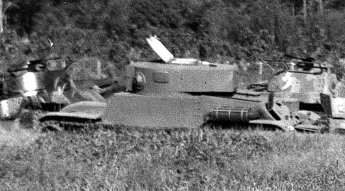
Type 98 Chi-Ho being pulled from tank test bed

The engine mounted in the tank was a Mitsubishi 120 HP diesel engine.[1] Also, it was the first Japanese made tank to use a hydraulic system in the steering system.

Up until then, some advances over the Chi-Ha variants can be seen, but some aspects in the tank hull were still lagging behind. A sled was attached to the rear part of the hull. This is commonly seen on World War I and inter-war tanks. It was thought that by extending the length of the hull, it gained the benefit of crossing trenches, but in that, there was a problem. As a tank mounts a sled, it becomes tail heavy (center of weight shifts backwards) and that presented uncertainty when crossing wide trenches. By becoming tail heavy, the rear portion of the suspension would undertake a greater load and thus wear out faster. Furthermore, the somewhat increase in weight would reduce mobility. With the applied limitations on the tank's weight, it is not believed that the armor protection level could have been improved. Without a cupola, the ability to observe outside would have been worse than the Chi-Ha.

Mitsubishi and Jidosha Kogyo completed the first two prototypes in 1940 and the Kokura and Sagami Arsenals produced two more the following year.[1] After field tests, the tank was not selected for production. The Imperial Japanese Army realized that further research and a better design were needed to counter the 1940s generation of Allied armor, such as the M4 Sherman. A new tank design based on an improved Type 97 design was conceived. The first of this new series was the Type 1 Chi-He medium tank. Work on that design began in 1941.[8] However, production of the Type 1 Chi-He did not begin until 1943, due to the higher priority of steel allocated to the Imperial Navy for warship construction.[9]

Notes

[edit]

References

[edit]
[edit]
Revisions and contributorsEdit on WikipediaRead on Wikipedia
from Grokipedia
The Type 98 Chi-Ho was an experimental prototype medium tank developed by for the in 1939 as a potential successor to the Type 97 Chi-Ha. Completed in July 1939, the Chi-Ho represented an early effort to incorporate improved anti-tank capabilities and lighter weight design, weighing approximately 10.7 tons with armor up to 25 mm thick, while retaining a similar layout to earlier medium tank prototypes like the Type 97 Chi-Ni. Intended to test new ideas such as a more powerful 47 mm main gun in a two-man turret, the project emphasized mobility for infantry support in the ongoing , achieving speeds around 40 km/h with a 120 hp inline-6 . Despite these advancements, only four prototypes were built, and the design was canceled in favor of further refinements leading to later models like the Type 1 Chi-He, due to production constraints and shifting priorities toward lighter, more versatile vehicles. The Chi-Ho never saw combat and exemplified Japan's pre-war challenges in balancing tank innovation with resource limitations.

Development

Background and Requirements

In the late 1930s, the Imperial Japanese Army's tank development efforts were driven by the need to modernize its armored forces amid escalating conflicts in China. The , which had entered service in 1932, proved increasingly inadequate by 1939; its underpowered engine limited speed to around 26 km/h, thin armor (up to 17 mm) offered poor protection against anti-tank weapons, and the 57 mm gun struggled against emerging threats like Chinese 37 mm anti-tank guns encountered during the Second Sino-Japanese War (1937–1945). These limitations were exacerbated by the war's demands, as Japanese forces required vehicles capable of supporting while navigating rough terrain in . The Army Technical Headquarters recognized the Type 89's obsolescence and, overriding some general staff preferences, pushed for successors emphasizing support over heavy combat roles. To address production challenges during the early phases of the Sino-Japanese War, where resource shortages in steel, iron, and fuel constrained manufacturing, the issued specifications in 1938 for a new design. This vehicle was to weigh approximately 10–12 tons for cost-effectiveness and ease of production, while offering enhanced mobility (targeting speeds over 40 km/h) and firepower superior to the Type 89, without excessive complexity. The Type 98 Chi-Ho project was formally initiated in 1938 under these guidelines, with development orders placed in 1939 (Showa 14) to firms including , leveraging their expertise to distribute workload and accelerate prototyping amid wartime industrial pressures. The design drew limited influences from the experimental Type 97 Chi-Ni medium tank of 1937, incorporating elements of its layout for improved balance and lighter construction.

Prototyping Process

The prototyping of the Type 98 Chi-Ho medium tank began following the Imperial Japanese Army's 1939 requirements for an improved medium tank design, building on the Type 97 Chi-Ha platform. The prototypes were primarily intended to test innovative features, including a two-man turret with a 47 mm main gun for improved anti-tank capability. In 1940, two prototypes were constructed by Mitsubishi Heavy Industries and Jidosha Kogyo Co., Ltd., with assembly finalized that year after initial design work traced back to July 1939. These early prototypes incorporated key design decisions influenced by the Type 97 Chi-Ha, including the adoption of a diesel engine for better fuel efficiency and reliability, rated at 120 horsepower at 1,300 rpm, and a bellcrank suspension system to enhance mobility over varied terrain. To refine elements such as chassis integration and component placement, two additional prototypes were built in 1941 by the Kokura Arsenal and Sagami Arsenal. All four prototypes were intended strictly as experimental vehicles, with no plans for serial production at this stage, allowing engineers to iterate on the overall layout without committing to mass manufacturing. The initial rollout of the first two prototypes occurred in 1940, followed by basic trials to assess assembly integrity and fundamental handling characteristics before more extensive evaluations. These efforts highlighted the tank's potential as a successor to the Chi-Ha but were ultimately overshadowed by shifting priorities toward the Type 1 Chi-He design.

Testing and Cancellation

The four prototypes of the Type 98 Chi-Ho medium , constructed between 1940 and 1941, underwent evaluation trials at facilities during 1940–1941. These tests emphasized the vehicle's reliability, speed, and handling characteristics under various conditions. Powered by a 120 hp , the tank demonstrated a maximum road speed of 41 km/h, though off-road performance remained constrained by the suspension system. Testing highlighted several shortcomings that limited the design's viability. Improvements over the earlier Type 89 medium tank were deemed marginal, particularly in mobility and , while the armor layout proved vulnerable to standard anti-tank weapons of the era. Additionally, the projected production costs were considered excessive relative to the incremental benefits, straining Japan's limited industrial resources. The project's cancellation was formalized in 1941 due to production constraints and the selection of the more advanced Type 1 Chi-He as the successor to the Type 97 Chi-Ha. Following cancellation, the prototypes served limited roles in additional component evaluations but saw no further development or production. By late 1941, they were either scrapped or placed in storage, with none entering combat service.

Design

Hull and Suspension

The hull of the Type 98 Chi-Ho featured a compact measuring 5.29 meters in length, 2.29 meters in width, and 2.12 meters in height, with an overall combat weight of 10.73 tons to support a of four. This lightweight configuration classified it as a despite its modest dimensions, emphasizing maneuverability over heavy protection in line with priorities for cost-effective production. The chassis was based on the experimental Type 97 Chi-Ni medium tank but underwent significant lightening modifications to reduce manufacturing costs and improve affordability for potential . External features included angled hull plates that echoed the layout of the Type 97 Shinhoto Chi-Ha, a flat superstructure without a commander's for a lower profile, and a positioned on the rear left side to minimize exhaust visibility. A hull-mounted was integrated into the frontal plate to provide supplementary from the fixed structure. The suspension system employed a (seesaw-linked) type, incorporating five road wheels per side along with a rear idler to distribute weight evenly. This setup, combined with a rear-mounted , enhanced cross-country performance by improving stability and traction over uneven terrain, addressing limitations observed in earlier Japanese designs.

Turret and Armament

The was equipped with a single-piece cast turret, closely resembling the design of the Type 97 Shinhoto Chi-Ha, which was manually traversed using a handwheel mechanism operated by the gunner. This turret accommodated a two-man crew, the and gunner (who also loaded), and featured no commander's or rear-mounted , emphasizing a compact layout for improved visibility and weight distribution. The turret's rotation was limited to manual operation due to the absence of power traverse systems, allowing for 360-degree traversal but at a rate dependent on crew effort. The primary armament consisted of the Type 1 47 mm high-velocity tank gun, mounted in the front of the turret with an range of -10 to +20 degrees and full 360-degree traverse via the turret ring. This gun featured a barrel length of approximately 48 calibers (2.25 m overall), achieving a of around 830 m/s for armor-piercing rounds, enabling effective engagement of armored targets at ranges up to 1,000 m. Developed specifically for improved anti-tank performance over earlier 57 mm weapons, the Type 1 gun utilized semi-automatic vertical sliding breech blocks and fired a variety of ammunition types, including high-explosive and armor-piercing shells, with penetration capabilities sufficient against contemporary medium tanks at medium ranges. Secondary armament included two 7.7 mm Type 97 heavy machine guns: one mounted coaxially to the main gun in the turret for close-defense fire, and the other positioned in the forward-left hull, integrated into the bow gunner's station for suppressive fire against infantry. The coaxial machine gun was synchronized with the main gun for simultaneous operation, while the hull-mounted weapon was independently aimed and fired by the assistant driver. Ammunition storage comprised approximately 100 rounds for the 47 mm gun, primarily stored in the turret and hull sponsons, and over 1,000 rounds for the machine guns, distributed across ready racks and internal bins to support sustained combat operations. The hull machine gun's mounting allowed for limited traverse and elevation from within the fixed chassis structure.

Armor Layout

The Type 98 Chi-Ho medium tank utilized face-hardened plates for its armor, a standard material in designs of the late 1930s to provide balanced hardness and against small-arms fire and shell fragments. Armor thickness varied across the vehicle, ranging from 5 to 25 mm, with the thickest protection applied to the frontal hull and turret at 25 mm to deflect low-velocity projectiles from contemporary weapons. Sides and rear sections featured 15-20 mm plating, while the bottom and top received thinner 5-10 mm coverage to minimize weight penalties. The armor layout incorporated sloped frontal armor on both the hull and turret, angled to enhance deflection effectiveness against incoming fire without increasing overall thickness, reflecting early Japanese efforts to improve passive protection through geometry. This configuration contributed to the tank's overall weight of 10.73 tons, tying into its compact dimensions of 5.29 meters in length. However, the thin armor profile was vulnerable to anything beyond 37 mm anti-tank guns by the early 1940s, underscoring its design philosophy rooted in the 1939 context of anticipated light and medium threats in Asian theaters rather than heavy European-style engagements. Construction combined riveted hull assembly for rapid prototyping with some welded elements in the turret, prioritizing simplicity and ease of manufacture during the experimental phase over advanced all-welded techniques seen in later designs.

Engine and Mobility

The Type 98 Chi-Ho prototypes utilized a delivering 120 horsepower at 1,300 rpm. This powerplant was selected for its reliability in Japanese armored designs, providing sufficient output for the tank's intended medium-weight class while maintaining in operational conditions. The engine's performance translated to a of approximately 11.2 hp/ton, based on the prototypes' combat weight of 10.73 tons. Paired with a 4-speed manual gearbox and a hydraulic system, it enabled effective power distribution and improved , particularly in confined or uneven environments. The fuel system held 210 liters, supporting an operational range of about 200 km on roads. On-road mobility reached a maximum speed of 41 km/h, while cross-country performance was estimated at 25 km/h, reflecting the engine's balance of and the vehicle's overall efficiency. The suspension system complemented these capabilities by maintaining a ground clearance of roughly 0.6 meters and allowing the tank to negotiate slopes up to 30 degrees, thus enhancing tactical versatility in varied terrains.

Legacy

Influence on Successors

The Type 98 Chi-Ho, despite its cancellation in 1941 due to perceived inadequacies in armor and overall design, directly influenced the development of its intended successor, the . The Chi-He adopted key concepts from the Chi-Ho prototypes, including the integration of the 47 mm Type 1 anti-tank gun for improved firepower against contemporary threats and the use of a for better and range. These elements addressed the Chi-Ho's experimental focus on balancing mobility with enhanced armament, though the Chi-He featured a more robust hull with up to 50 mm frontal armor and a redesigned turret for better crew . The lightweight chassis and suspension systems tested on the Chi-Ho prototypes also informed resource-efficient designs in the Chi-He, particularly amid Japan's wartime material shortages that prioritized naval over armored vehicle production. Bell-crank suspension components from the Chi-Ho trials were carried over, contributing to the Chi-He's improved cross-country performance while maintaining a weight around 18 tons for logistical compatibility with existing transport . This emphasis on economical helped mitigate production delays, allowing limited Chi-He output starting in 1943. On a broader scale, the Chi-Ho's foundational advancements paved the way for the introduced in 1944, which evolved the 47 mm gun platform into an up-gunned variant with a 75 mm Type 3 cannon to counter heavier Allied armor. The 's design retained diesel propulsion and modular chassis principles derived from Chi-Ho testing, enhancing firepower without fully redesigning the lineage. These iterative improvements highlighted the Chi-Ho's role in shifting Japanese tank doctrine toward versatile, adaptable mediums suited to island defense scenarios. In historiography, the Type 98 Chi-Ho is recognized as a transitional that bridged 1930s experimental efforts with the more practical 1940s production models, underscoring Japan's challenges in scaling innovative designs under resource constraints. Analyses emphasize its contributions to armament and engine reliability, which influenced the Imperial Japanese Army's late-war armored evolution despite the prototype's limited visibility in combat records.

Preservation Status

No complete examples of the Type 98 Chi-Ho medium tank survive today, as all four prototypes were either scrapped or destroyed during or immediately after World War II. With zero units entering serial production, the vehicle's physical remnants were limited to wartime testing and disposal efforts by Allied forces on captured Japanese equipment. Certain components from the Chi-Ho prototypes may have been repurposed or incorporated into the development of the later prototypes, reflecting shared design elements in suspension and turret configurations. Archival materials, including technical drawings and historical photographs of the prototypes—such as images showing the turret alongside the Se-Ri armored recovery vehicle during testing—have been preserved in Japanese military archives and made available through public collections. In museums, the Type 98 Chi-Ho is represented through scale models and partial replicas rather than original hardware, often featured in exhibits on armored development; notable examples include displays at the Museum in , which houses artifacts from Japanese WWII vehicles like the Type 97 Chi-Ha, and the in , known for its collection of captured Japanese tanks such as the Type 95 Ha-Go. Post-2000 research, drawing on declassified documents and technical reports, has enabled historians to reconstruct key specifications and performance data for the Chi-Ho, though significant gaps persist in detailed testing records due to wartime destruction of records.
Add your contribution
Related Hubs
User Avatar
No comments yet.