



Community hub
Recent from talks
Contribute something to knowledge base
Content stats: 0 posts, 0 articles, 1 media, 0 notes
Members stats: 0 subscribers, 0 contributors, 0 moderators, 0 supporters
Subscribers
Supporters
Contributors
Moderators
Hub AI
Typhoon Melor AI simulator
(@Typhoon Melor_simulator)
Hub AI
Typhoon Melor AI simulator
(@Typhoon Melor_simulator)
Typhoon Melor
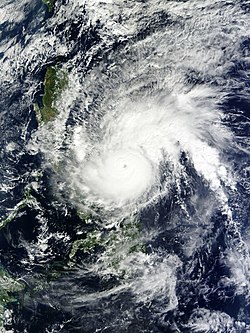
Typhoon Melor, known in the Philippines as Typhoon Nona, was a powerful tropical cyclone that struck the Philippines in mid-December 2015. The twenty-seventh named storm and the eighteenth typhoon of the annual typhoon season, Melor killed 51 people and caused ₱7.04 billion (US$148.3 million) in damage.
The typhoon began developing on December 7 as a low-pressure area 120 km (75 mi) of Chuuk. Soon, it intensified into a tropical depression on December 10, and then into a tropical storm south of Yap, and was named Melor. The Philippine Atmospheric, Geophysical and Astronomical Services Administration (PAG-ASA) initially decided to name Melor as "Nonoy", but due to political reasons, it was named "Nona" instead. On December 13, Tropical Storm Melor (Nona) became a typhoon, and made its first landfall on Northern Samar. The typhoon made several landfalls in Sorsogon, Burias Island, Romblon, and Oriental Mindoro, before weakening into a tropical storm. It turned southward on entering the South China Sea before weakening into a tropical depression and dissipating in the Sulu Sea.
During December 10, the Japan Meteorological Agency started to monitor a tropical depression, that had developed about 665 km (415 mi) to the south of Guam. The system was located within a favorable environment for further development, with low vertical wind shear and sea surface temperatures of between 29–30 °C (84–86 °F). Moreover, the JMA started to issue tropical cyclone warnings to the system on the same day, expecting a tropical storm within 24 hours. Based on a developing low-level circulation center (LLCC) obscured by the mid-level deep convection in an area of strong westward upper-level diffluence and moderate easterly vertical wind shear, the Joint Typhoon Warning Center (JTWC) issued a Tropical Cyclone Formation Alert (TCFA) to the system early on December 11. The JMA, however, upgraded the tropical depression to a tropical storm immediately after issuing that TCFA and named it Melor, when the storm was only about 50 km (31 mi) south of Yap. In the afternoon, the JTWC upgraded it to a tropical depression and designated it as 28W, just six hours before the center upgraded Melor to a tropical storm that was tracking west-northwestward along the southern periphery of a deep-layered subtropical ridge.
The PAGASA was about to name the tropical storm as Nonoy, yet it was named Nona after entering the Philippine Area of Responsibility on December 12, owing to political reasons. When Melor was forming an eye in the afternoon, the JMA upgraded it to a severe tropical storm. Due to low vertical wind shear, warm sea surface temperatures above 28°C and robust poleward outflow enhanced by a very powerful Aleutian low, Melor intensified into a typhoon early on December 13, as tightly curved spiral banding was observed wrapping into a tiny but clear eye. The JTWC upgraded Melor to a SSHWS Category 4-equivalent typhoon at noon. Although the eye appeared to be cloud-filled temporarily, the eyewall consolidated further. Melor made landfall over Batag Island of Laoang, Northern Samar of the Philippines at 11:00 PST (03:00 UTC) on December 14. The JMA reported a peak intensity of ten-minute maximum sustained winds at 175 km/h (110 mph) and a central pressure of 935 hPa (27.61 inHg). The typhoon formed a well-defined eye and then maintained it for several hours while crossing the northern coast of Samar. Later, it made its second landfall over Bulusan, Sorsogon at 16:00 PST (08:00 UTC) and third landfall over Burias Island at 21:45 PST (13:45 UTC), resulting in a cloud-filled eye again. Shortly after Melor made its fourth landfall over Banton Island, Romblon at 05:30 PST on December 15 (21:30 UTC on December 14), the typhoon significantly intensified again with a distinct 25-km (15-mile) eye and a compact core. Right before making its fifth landfall on Pinamalayan, Oriental Mindoro at 10:30 PST (02:30 UTC), the JTWC indicated that Melor had reached peak intensity with one-minute maximum sustained winds at 230 km/h (145 mph), just shy of the super typhoon status.
Shortly after the typhoon made its final landfall, its eye rapidly became cloud-filled. Inflow along the southwestern quadrant was forced over the mountainous central terrain of Mindoro, and strong poleward outflow was also weakening owing to the decreasing linkage to mid-latitude flow. Emerging into the South China Sea and moving northwestward in the afternoon, Melor started to encounter strong vertical wind shear as well as strong northeasterly low-level flow associated with a developing cold surge. Melor was downgraded to a severe tropical storm by the JMA and a tropical storm by the JTWC early on December 16 when the upper-level environment was deteriorating and causing the system to disintegrate, leading to the steering influence shifting to the low-level flow. Thus, the quickly weakening storm made a U-turn and moved southward. The JMA downgraded Melor to a tropical storm at noon, although the system's convection had been sheared away from the low-level circulation center. Several of meteorological agencies downgraded Melor to a tropical depression early on December 17, including the JMA and JTWC, who issued final warnings on the system; however, satellite imageries depicted an open trough instead of a discernable LLCC. The system completely dissipated in the Sulu Sea before noon.
In preparation for the typhoon, 700,000 residents in several provinces were evacuated. On Albay, work on all government and private offices was suspended, except for disaster response. Classes were also suspended on most of Bicol and parts of Eastern Visayas. A no-sail zone was implemented in areas where the typhoon was expected to pass. Many flights to areas in Bicol and Eastern Luzon were cancelled on December 14, following the approaching typhoon. On December 13, storm signal no. 3 was raised on Catanduanes, Sorsogon, Albay, Northern Samar, Eastern Samar, and Samar.
As the typhoon neared Northern Samar on December 14, PAGASA raised storm signal no. 2 on southern Quezon and signal no. 1 on Batangas, Cavite, Rizal, Laguna, and the rest of Quezon (including Polillo Island). Ferry services between Batangas City, Mindoro, and Caticlan were suspended when storm signal no. 1 was raised on Aklan.
The Metropolitan Manila Development Authority(MMDA) placed a yellow alert on Metro Manila as Typhoon Nona approached Mindoro. Storm signal no. 1 was raised on Metro Manila when the typhoon neared Northern Samar. On December 16, preschool classes were suspended on the whole region, while classes on all levels were suspended on Muntinlupa, Pateros, Taguig, San Juan, Pasay, Quezon City, Malabon, and Valenzuela.
Typhoon Melor
Typhoon Melor, known in the Philippines as Typhoon Nona, was a powerful tropical cyclone that struck the Philippines in mid-December 2015. The twenty-seventh named storm and the eighteenth typhoon of the annual typhoon season, Melor killed 51 people and caused ₱7.04 billion (US$148.3 million) in damage.
The typhoon began developing on December 7 as a low-pressure area 120 km (75 mi) of Chuuk. Soon, it intensified into a tropical depression on December 10, and then into a tropical storm south of Yap, and was named Melor. The Philippine Atmospheric, Geophysical and Astronomical Services Administration (PAG-ASA) initially decided to name Melor as "Nonoy", but due to political reasons, it was named "Nona" instead. On December 13, Tropical Storm Melor (Nona) became a typhoon, and made its first landfall on Northern Samar. The typhoon made several landfalls in Sorsogon, Burias Island, Romblon, and Oriental Mindoro, before weakening into a tropical storm. It turned southward on entering the South China Sea before weakening into a tropical depression and dissipating in the Sulu Sea.
During December 10, the Japan Meteorological Agency started to monitor a tropical depression, that had developed about 665 km (415 mi) to the south of Guam. The system was located within a favorable environment for further development, with low vertical wind shear and sea surface temperatures of between 29–30 °C (84–86 °F). Moreover, the JMA started to issue tropical cyclone warnings to the system on the same day, expecting a tropical storm within 24 hours. Based on a developing low-level circulation center (LLCC) obscured by the mid-level deep convection in an area of strong westward upper-level diffluence and moderate easterly vertical wind shear, the Joint Typhoon Warning Center (JTWC) issued a Tropical Cyclone Formation Alert (TCFA) to the system early on December 11. The JMA, however, upgraded the tropical depression to a tropical storm immediately after issuing that TCFA and named it Melor, when the storm was only about 50 km (31 mi) south of Yap. In the afternoon, the JTWC upgraded it to a tropical depression and designated it as 28W, just six hours before the center upgraded Melor to a tropical storm that was tracking west-northwestward along the southern periphery of a deep-layered subtropical ridge.
The PAGASA was about to name the tropical storm as Nonoy, yet it was named Nona after entering the Philippine Area of Responsibility on December 12, owing to political reasons. When Melor was forming an eye in the afternoon, the JMA upgraded it to a severe tropical storm. Due to low vertical wind shear, warm sea surface temperatures above 28°C and robust poleward outflow enhanced by a very powerful Aleutian low, Melor intensified into a typhoon early on December 13, as tightly curved spiral banding was observed wrapping into a tiny but clear eye. The JTWC upgraded Melor to a SSHWS Category 4-equivalent typhoon at noon. Although the eye appeared to be cloud-filled temporarily, the eyewall consolidated further. Melor made landfall over Batag Island of Laoang, Northern Samar of the Philippines at 11:00 PST (03:00 UTC) on December 14. The JMA reported a peak intensity of ten-minute maximum sustained winds at 175 km/h (110 mph) and a central pressure of 935 hPa (27.61 inHg). The typhoon formed a well-defined eye and then maintained it for several hours while crossing the northern coast of Samar. Later, it made its second landfall over Bulusan, Sorsogon at 16:00 PST (08:00 UTC) and third landfall over Burias Island at 21:45 PST (13:45 UTC), resulting in a cloud-filled eye again. Shortly after Melor made its fourth landfall over Banton Island, Romblon at 05:30 PST on December 15 (21:30 UTC on December 14), the typhoon significantly intensified again with a distinct 25-km (15-mile) eye and a compact core. Right before making its fifth landfall on Pinamalayan, Oriental Mindoro at 10:30 PST (02:30 UTC), the JTWC indicated that Melor had reached peak intensity with one-minute maximum sustained winds at 230 km/h (145 mph), just shy of the super typhoon status.
Shortly after the typhoon made its final landfall, its eye rapidly became cloud-filled. Inflow along the southwestern quadrant was forced over the mountainous central terrain of Mindoro, and strong poleward outflow was also weakening owing to the decreasing linkage to mid-latitude flow. Emerging into the South China Sea and moving northwestward in the afternoon, Melor started to encounter strong vertical wind shear as well as strong northeasterly low-level flow associated with a developing cold surge. Melor was downgraded to a severe tropical storm by the JMA and a tropical storm by the JTWC early on December 16 when the upper-level environment was deteriorating and causing the system to disintegrate, leading to the steering influence shifting to the low-level flow. Thus, the quickly weakening storm made a U-turn and moved southward. The JMA downgraded Melor to a tropical storm at noon, although the system's convection had been sheared away from the low-level circulation center. Several of meteorological agencies downgraded Melor to a tropical depression early on December 17, including the JMA and JTWC, who issued final warnings on the system; however, satellite imageries depicted an open trough instead of a discernable LLCC. The system completely dissipated in the Sulu Sea before noon.
In preparation for the typhoon, 700,000 residents in several provinces were evacuated. On Albay, work on all government and private offices was suspended, except for disaster response. Classes were also suspended on most of Bicol and parts of Eastern Visayas. A no-sail zone was implemented in areas where the typhoon was expected to pass. Many flights to areas in Bicol and Eastern Luzon were cancelled on December 14, following the approaching typhoon. On December 13, storm signal no. 3 was raised on Catanduanes, Sorsogon, Albay, Northern Samar, Eastern Samar, and Samar.
As the typhoon neared Northern Samar on December 14, PAGASA raised storm signal no. 2 on southern Quezon and signal no. 1 on Batangas, Cavite, Rizal, Laguna, and the rest of Quezon (including Polillo Island). Ferry services between Batangas City, Mindoro, and Caticlan were suspended when storm signal no. 1 was raised on Aklan.
The Metropolitan Manila Development Authority(MMDA) placed a yellow alert on Metro Manila as Typhoon Nona approached Mindoro. Storm signal no. 1 was raised on Metro Manila when the typhoon neared Northern Samar. On December 16, preschool classes were suspended on the whole region, while classes on all levels were suspended on Muntinlupa, Pateros, Taguig, San Juan, Pasay, Quezon City, Malabon, and Valenzuela.
Recent media
Recent media