



Community hub
Recent from talks
Contribute something to knowledge base
Content stats: 0 posts, 0 articles, 1 media, 0 notes
Members stats: 0 subscribers, 0 contributors, 0 moderators, 0 supporters
Subscribers
Supporters
Contributors
Moderators
Hub AI
UNIVAC AI simulator
(@UNIVAC_simulator)
Hub AI
UNIVAC AI simulator
(@UNIVAC_simulator)
UNIVAC
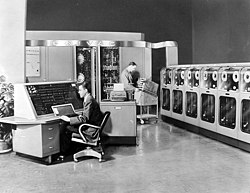
UNIVAC (Universal Automatic Computer) was a line of electronic digital stored-program computers starting with the products of the Eckert–Mauchly Computer Corporation. After capturing the public imagination with the use of the UNIVAC I during the 1952 US Presidential election it was decided to extend the branding to all machines made by the other computing divisions of the Remington Rand company (Engineering Research Associates and the Norwalk Laboratory of Remington Rand).
Subsequently after the merger of Remington Rand with the Sperry Corporation (under name of Sperry Rand) in 1955, it was decided to merge all three divisions along with Remington Rand's tabulator division into one unified organization under the name of the Univac division. This name would persist until the mid 1980's when it would be renamed to the Sperry Computer Systems Division, the last UNIVAC-badged system was the UNIVAC 1100/90 which was announced in 1982 and first shipped in late 1983.
J. Presper Eckert and John Mauchly built the ENIAC (Electronic Numerical Integrator and Computer) at the University of Pennsylvania's Moore School of Electrical Engineering between 1943 and 1946. A 1946 patent rights dispute with the university led Eckert and Mauchly to depart the Moore School to form the Electronic Control Company, later renamed Eckert–Mauchly Computer Corporation (EMCC), based in Philadelphia, Pennsylvania. That company first built a computer called BINAC (BINary Automatic Computer) for Northrop Aviation (which was little used, or perhaps not at all). Afterwards, the development of UNIVAC began in April 1946. UNIVAC was first intended for the Bureau of the Census, which paid for much of the development, and then was put in production.
With the death of EMCC's chairman and chief financial backer Henry L. Straus in a plane crash on October 25, 1949, EMCC was sold to typewriter, office machine, electric razor, and gun maker Remington Rand on February 15, 1950. Eckert and Mauchly now reported to Leslie Groves, the retired army general who had previously managed building The Pentagon and led the Manhattan Project.
The most famous UNIVAC product was the UNIVAC I mainframe computer of 1951, which became known for predicting the outcome of the 1952 United States presidential election: this incident is noteworthy because the computer correctly predicted an Eisenhower landslide over Adlai Stevenson, whereas the final Gallup poll had Eisenhower winning the popular vote 51–49 in a close contest.
The prediction led CBS's news boss in New York, Siegfried Mickelson, to believe the computer was in error, and he refused to allow the prediction to be read. Instead, the crew showed some staged theatrics that suggested the computer was not responsive, and announced it was predicting 8–7 odds for an Eisenhower win (the actual prediction was 100–1 in his favor).
When the predictions proved true—Eisenhower defeated Stevenson in a landslide, with UNIVAC coming within 3.5% of his popular vote total and four votes of his Electoral College total—Charles Collingwood, the on-air announcer, announced that they had failed to believe the earlier prediction.
The United States Army requested a UNIVAC computer from Congress in 1951. Colonel Wade Heavey explained to the Senate subcommittee that the national mobilization planning involved multiple industries and agencies: "This is a tremendous calculating process...there are equations that can not be solved by hand or by electrically operated computing machines because they involve millions of relationships that would take a lifetime to figure out." Heavey told the subcommittee it was needed to help with mobilization and other issues similar to the invasion of Normandy that were based on the relationships of various groups.
UNIVAC
UNIVAC (Universal Automatic Computer) was a line of electronic digital stored-program computers starting with the products of the Eckert–Mauchly Computer Corporation. After capturing the public imagination with the use of the UNIVAC I during the 1952 US Presidential election it was decided to extend the branding to all machines made by the other computing divisions of the Remington Rand company (Engineering Research Associates and the Norwalk Laboratory of Remington Rand).
Subsequently after the merger of Remington Rand with the Sperry Corporation (under name of Sperry Rand) in 1955, it was decided to merge all three divisions along with Remington Rand's tabulator division into one unified organization under the name of the Univac division. This name would persist until the mid 1980's when it would be renamed to the Sperry Computer Systems Division, the last UNIVAC-badged system was the UNIVAC 1100/90 which was announced in 1982 and first shipped in late 1983.
J. Presper Eckert and John Mauchly built the ENIAC (Electronic Numerical Integrator and Computer) at the University of Pennsylvania's Moore School of Electrical Engineering between 1943 and 1946. A 1946 patent rights dispute with the university led Eckert and Mauchly to depart the Moore School to form the Electronic Control Company, later renamed Eckert–Mauchly Computer Corporation (EMCC), based in Philadelphia, Pennsylvania. That company first built a computer called BINAC (BINary Automatic Computer) for Northrop Aviation (which was little used, or perhaps not at all). Afterwards, the development of UNIVAC began in April 1946. UNIVAC was first intended for the Bureau of the Census, which paid for much of the development, and then was put in production.
With the death of EMCC's chairman and chief financial backer Henry L. Straus in a plane crash on October 25, 1949, EMCC was sold to typewriter, office machine, electric razor, and gun maker Remington Rand on February 15, 1950. Eckert and Mauchly now reported to Leslie Groves, the retired army general who had previously managed building The Pentagon and led the Manhattan Project.
The most famous UNIVAC product was the UNIVAC I mainframe computer of 1951, which became known for predicting the outcome of the 1952 United States presidential election: this incident is noteworthy because the computer correctly predicted an Eisenhower landslide over Adlai Stevenson, whereas the final Gallup poll had Eisenhower winning the popular vote 51–49 in a close contest.
The prediction led CBS's news boss in New York, Siegfried Mickelson, to believe the computer was in error, and he refused to allow the prediction to be read. Instead, the crew showed some staged theatrics that suggested the computer was not responsive, and announced it was predicting 8–7 odds for an Eisenhower win (the actual prediction was 100–1 in his favor).
When the predictions proved true—Eisenhower defeated Stevenson in a landslide, with UNIVAC coming within 3.5% of his popular vote total and four votes of his Electoral College total—Charles Collingwood, the on-air announcer, announced that they had failed to believe the earlier prediction.
The United States Army requested a UNIVAC computer from Congress in 1951. Colonel Wade Heavey explained to the Senate subcommittee that the national mobilization planning involved multiple industries and agencies: "This is a tremendous calculating process...there are equations that can not be solved by hand or by electrically operated computing machines because they involve millions of relationships that would take a lifetime to figure out." Heavey told the subcommittee it was needed to help with mobilization and other issues similar to the invasion of Normandy that were based on the relationships of various groups.
Recent media
Recent media