



Community hub
Recent from talks
Knowledge base stats:
Talk channels stats:
Members stats:
USA 17
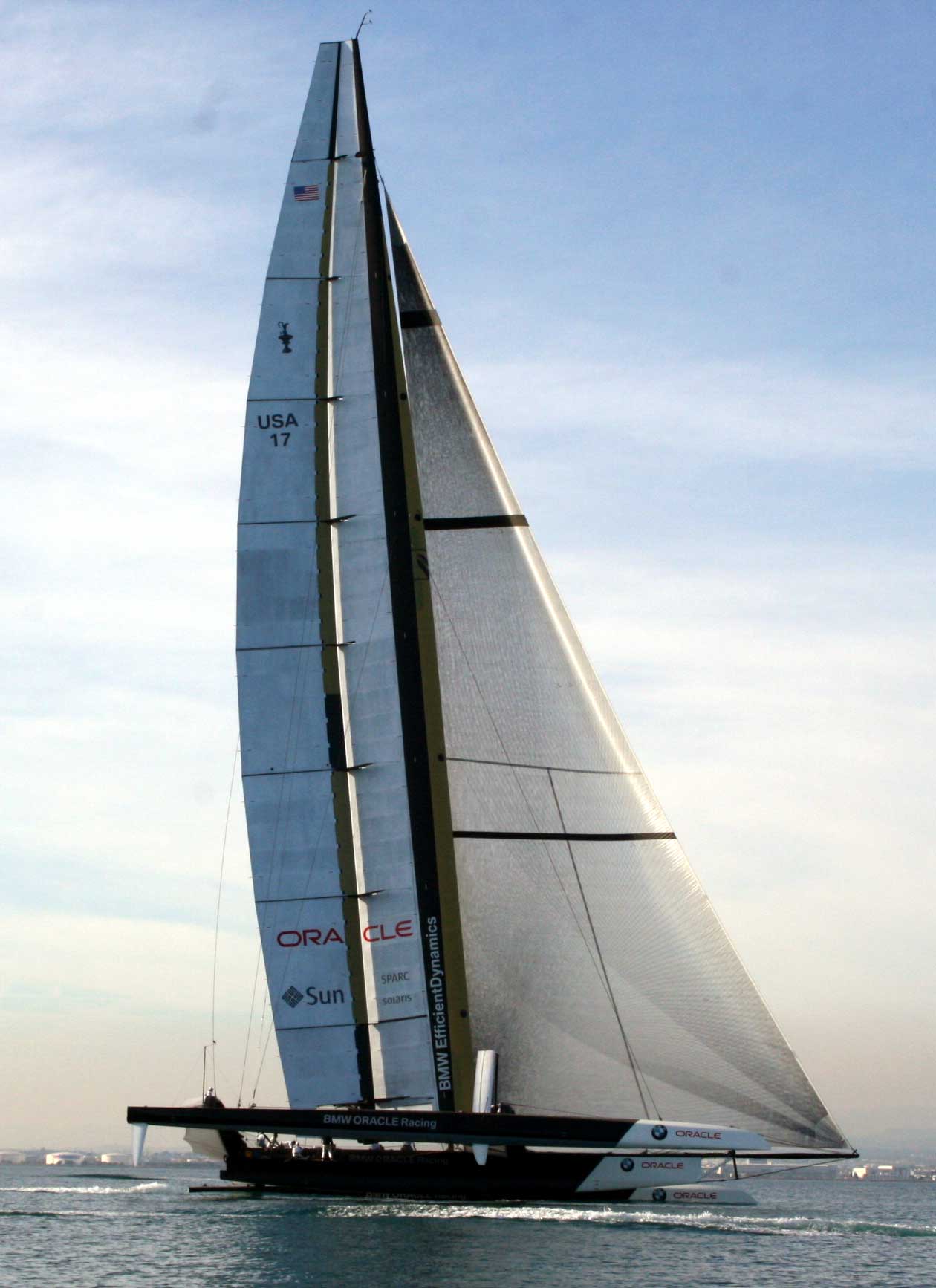
USA-17 (formerly known as BMW Oracle Racing 90 or BOR90) is a sloop rigged racing trimaran built by the American sailing team BMW Oracle Racing to challenge for the 2010 America's Cup. Designed by VPLP Yacht Design with consultation from Franck Cammas and his Groupama multi-hull sailing team, BOR90 is very light for her size being constructed almost entirely out of carbon fiber and epoxy resin, and exhibits very high performance being able to sail at 2.0 to 2.5 times the true wind speed. From the actual performance of the boat during the 2010 America's Cup races, it can be seen that she could achieve a velocity made good upwind of over twice the wind speed and downwind of over 2.5 times the wind speed. She can apparently sail at 20 degrees off the apparent wind. The boat sails so fast downwind that the apparent wind she generates is only 5-6 degrees different from that when she is racing upwind; that is, the boat is always sailing upwind with respect to the apparent wind.
USA 17 was designed by VPLP.
BOR 90 was launched in Anacortes, Washington in August 2008 after more than 9 months of construction. She underwent initial testing in Anacortes before being shipped to San Diego, California for additional sea trials and development.
In March 2009, USA 17 (then referred to as BOR90) was pulled from the water for extensive modification in BMW Oracle Racing's San Diego shop. She emerged in early July, 2009, featuring wave-piercing hulls and other modifications. She was further modified subsequently, in particular in October 2009 to add an engine to power hydraulic winches.
On November 8, 2009, the team announced that a rigid sail wing had been built for the yacht. The wingsail was initially 190 feet (58 m) tall and some 80 percent larger than the wing of a Boeing 747 airplane; it was later extended to 223 feet (68 m). The wing has a very high aspect ratio, meaning that it is very tall and narrow. It can change camber to adjust lift in order to optimize performance. The wing consists of two main elements, separated by a vertical slot through which air can flow. The rear element is made up of several separate sections, whose angle can be adjusted separately, much like the flaps on an airplane's wing. Thus the lift of the sail can be controlled very finely, both overall, and for each section.
The wing is more efficient than a traditional soft-sail rig setup. On November 10, BMW reported that they hit 32 miles per hour (28 kn) boat speed in a 10-knot (19 km/h; 12 mph) reported wind speed. During the first race of the 2010 America's Cup, USA 17 was able to sail upwind faster than Alinghi 5 even without a jib. Since the sail area of USA 17's wing is much larger than the sail area of Alinghi 5's mainsail and jib combined, it is clear that the rigid wing is much more efficient than even high-performance traditional sails.
The first race of the 2010 America's Cup took place on February 12, 2010. USA 17 beat the defender, Alinghi 5. USA 17 started behind by 1:27 after start box maneuvering with Alinghi, but was ahead by 3:21 at the windward mark and by about 9 minutes at the finish. Her official finish time was 15:28 ahead of the loser because Alinghi 5 had to perform a penalty turn, having failed to stay clear at the start.
Wind speeds were 5–10 knots (9.3–18.5 km/h; 5.8–11.5 mph) during the first race. USA 17 reached the windward mark in 1h29, so her velocity made good was about 13.5 knots (25.0 km/h; 15.5 mph), or about 1.8 times wind speed. USA 17 took 63 minutes to reach the downwind mark, so her velocity made good downwind was about 19 knots (35 km/h; 22 mph), or about 2.5 times wind speed.
Hub AI
USA 17 AI simulator
(@USA 17_simulator)
USA 17
USA-17 (formerly known as BMW Oracle Racing 90 or BOR90) is a sloop rigged racing trimaran built by the American sailing team BMW Oracle Racing to challenge for the 2010 America's Cup. Designed by VPLP Yacht Design with consultation from Franck Cammas and his Groupama multi-hull sailing team, BOR90 is very light for her size being constructed almost entirely out of carbon fiber and epoxy resin, and exhibits very high performance being able to sail at 2.0 to 2.5 times the true wind speed. From the actual performance of the boat during the 2010 America's Cup races, it can be seen that she could achieve a velocity made good upwind of over twice the wind speed and downwind of over 2.5 times the wind speed. She can apparently sail at 20 degrees off the apparent wind. The boat sails so fast downwind that the apparent wind she generates is only 5-6 degrees different from that when she is racing upwind; that is, the boat is always sailing upwind with respect to the apparent wind.
USA 17 was designed by VPLP.
BOR 90 was launched in Anacortes, Washington in August 2008 after more than 9 months of construction. She underwent initial testing in Anacortes before being shipped to San Diego, California for additional sea trials and development.
In March 2009, USA 17 (then referred to as BOR90) was pulled from the water for extensive modification in BMW Oracle Racing's San Diego shop. She emerged in early July, 2009, featuring wave-piercing hulls and other modifications. She was further modified subsequently, in particular in October 2009 to add an engine to power hydraulic winches.
On November 8, 2009, the team announced that a rigid sail wing had been built for the yacht. The wingsail was initially 190 feet (58 m) tall and some 80 percent larger than the wing of a Boeing 747 airplane; it was later extended to 223 feet (68 m). The wing has a very high aspect ratio, meaning that it is very tall and narrow. It can change camber to adjust lift in order to optimize performance. The wing consists of two main elements, separated by a vertical slot through which air can flow. The rear element is made up of several separate sections, whose angle can be adjusted separately, much like the flaps on an airplane's wing. Thus the lift of the sail can be controlled very finely, both overall, and for each section.
The wing is more efficient than a traditional soft-sail rig setup. On November 10, BMW reported that they hit 32 miles per hour (28 kn) boat speed in a 10-knot (19 km/h; 12 mph) reported wind speed. During the first race of the 2010 America's Cup, USA 17 was able to sail upwind faster than Alinghi 5 even without a jib. Since the sail area of USA 17's wing is much larger than the sail area of Alinghi 5's mainsail and jib combined, it is clear that the rigid wing is much more efficient than even high-performance traditional sails.
The first race of the 2010 America's Cup took place on February 12, 2010. USA 17 beat the defender, Alinghi 5. USA 17 started behind by 1:27 after start box maneuvering with Alinghi, but was ahead by 3:21 at the windward mark and by about 9 minutes at the finish. Her official finish time was 15:28 ahead of the loser because Alinghi 5 had to perform a penalty turn, having failed to stay clear at the start.
Wind speeds were 5–10 knots (9.3–18.5 km/h; 5.8–11.5 mph) during the first race. USA 17 reached the windward mark in 1h29, so her velocity made good was about 13.5 knots (25.0 km/h; 15.5 mph), or about 1.8 times wind speed. USA 17 took 63 minutes to reach the downwind mark, so her velocity made good downwind was about 19 knots (35 km/h; 22 mph), or about 2.5 times wind speed.