Hubbry Logo
SailSailMain
Open search
Sail
Community hub
Sail
logo
8 pages, 0 posts
0 subscribers
Be the first to start a discussion here.
Sail
Sail
from Wikipedia

A sail is a tensile structure, which is made from fabric or other membrane materials, that uses wind power to propel sailing craft, including sailing ships, sailboats, windsurfers, ice boats, and even sail-powered land vehicles. Sails may be made from a combination of woven materials—including canvas or polyester cloth, laminated membranes or bonded filaments, usually in a three- or four-sided shape.

A sail provides propulsive force via a combination of lift and drag, depending on its angle of attack, its angle with respect to the apparent wind. Apparent wind is the air velocity experienced on the moving craft and is the combined effect of the true wind velocity with the velocity of the sailing craft. Angle of attack is often constrained by the sailing craft's orientation to the wind or point of sail. On points of sail where it is possible to align the leading edge of the sail with the apparent wind, the sail may act as an airfoil, generating propulsive force as air passes along its surface, just as an airplane wing generates lift, which predominates over aerodynamic drag retarding forward motion. The more that the angle of attack diverges from the apparent wind as a sailing craft turns downwind, the more drag increases and lift decreases as propulsive forces, until a sail going downwind is predominated by drag forces. Sails are unable to generate propulsive force if they are aligned too closely to the wind.

Sails may be attached to a mast, boom or other spar or may be attached to a wire that is suspended by a mast. They are typically raised by a line, called a halyard, and their angle with respect to the wind is usually controlled by a line, called a sheet. In use, they may be designed to be curved in both directions along their surface, often as a result of their curved edges. Battens may be used to extend the trailing edge of a sail beyond the line of its attachment points.

Other non-rotating airfoils that power sailing craft include wingsails, which are rigid wing-like structures, and kites that power kite-rigged vessels, but do not employ a mast to support the airfoil and are beyond the scope of this article.

Rigs

[edit]

Sailing craft employ two types of rig, the square rig and the fore-and-aft rig.

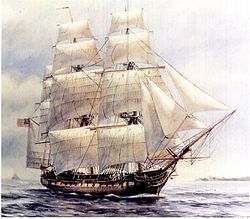
The square rig carries the primary driving sails on horizontal spars, which are perpendicular or square, to the keel of the vessel and to the masts. These spars are called yards and their tips, beyond the lifts, are called the yardarms[1]. A ship mainly so rigged is called a square-rigger.[2]

A fore-and-aft rig consists of sails that are set along the line of the keel rather than perpendicular to it. Vessels so rigged are described as fore-and-aft rigged.[3]

History

[edit]
Egyptian sailing ship, ca. 1422–1411 BCE

The invention of the sail was a technological advance of equal or even greater importance than the invention of the wheel.[a] It has been suggested by some that it has the significance of the development of the Neolithic lifestyle or the first establishment of cities. Yet it is not known when or where this invention took place.[4]: 173 

Much of the early development of water transport is believed to have occurred in two main "nursery" areas of the world: Island Southeast Asia and the Mediterranean region. In both of these, warmer waters reduce the risk of hypothermia when using rafts (a raft is usually a "flow through" structure), and a number of intervisible islands create both an invitation to travel and an environment where advanced navigation techniques are not needed. Alongside this, the Nile has a northward flowing current with a prevailing wind in the opposite direction, so giving the potential to drift in one direction and sail in the other.[5]: 113 [6]: 7  Many do not consider sails to have been used before the 5th millennium BCE. Others consider sails to have been invented much earlier.[4]: 174, 175 

Archaeological studies of the Cucuteni-Trypillian culture ceramics show use of sailing boats from the sixth millennium BCE onwards.[7] Excavations of the Ubaid period (c. 6000–4300 BCE) in Mesopotamia provide direct evidence of sailing boats.[8]

Square rigs

[edit]

Sails from ancient Egypt are depicted around 3200 BCE,[9][10] where reed boats sailed upstream against the River Nile's current. Ancient Sumerians used square rigged sailing boats at about the same time, and it is believed they established sea trading routes as far away as the Indus valley. Greeks and Phoenicians began trading by ship by around 1200 BCE.

V-shaped square rigs with two spars that come together at the hull were the ancestral sailing rig of the Austronesian peoples before they developed the fore-and-aft crab claw, tanja and junk rigs.[11] The date of introduction of these later Austronesian sails is disputed.[12]

Lateen rigs

[edit]
A traditional Maldivian Baghlah with a fore-and-aft rig lateen rig

Lateen sails emerged by around the 2nd century CE in the Mediterranean. They did not become common until the 5th century, when there is evidence that the Mediterranean square sail (which had been in wide use throughout the classical period) was undergoing a simplification of its rigging components.[b] Both the increasing popularity of the lateen and the changes to the contemporary square rig are suggested to be cost saving measures, reducing the number of expensive components needed to fit out a ship.[13]

It has been a common and erroneous presumption among maritime historians that lateen had significantly better sailing performance than the square rig of the same period. Analysis of voyages described in contemporary accounts and also in various replica vessels demonstrates that the performance of square rig and lateen were very similar. Lateen provided a cheaper rig to build and maintain, with no degradation of performance.[14][13]

The lateen was adopted by Arab seafarers (usually in the sub-type: the settee sail), but the date is uncertain, with no firm evidence for their use in the Western Indian Ocean before 1500 CE. There is, however, good iconographic evidence of square sails being used by Arab, Persian and Indian ships in this region in, for instance, 1519.[15]

The popularity of the caravel in Northern European waters from about 1440 made lateen sails familiar in this part of the world. Additionally, lateen sails were used for the mizzen on early three-masted ships, playing a significant role in the development of the full-rigged ship. It did not, however, provide much of the propulsive force of these vessels – rather serving as a balancing sail that was needed for some manoeuvres in some sea and wind conditions. The extensive amount of contemporary maritime art showing the lateen mizzen on 16th and 17th century ships often has the sail furled. Practical experience on the Duyfken replica confirmed the role of the lateen mizzen.[16][17] [18]

Crab claw rigs

[edit]
Fijian voyaging outrigger boat with a crab claw sail
Philippine lanong with tanja sails

Austronesian invention of catamarans, outriggers, and the bi-sparred triangular crab claw sails enabled their ships to sail for vast distances in open ocean. It led to the Austronesian Expansion. From Taiwan, they rapidly settled the islands of Maritime Southeast Asia, then later sailed further onwards to Micronesia, Island Melanesia, Polynesia, and Madagascar, eventually settling a territory spanning half the globe.[19][20]

The proto-Austronesian words for sail, lay(r), and some other rigging parts date to about 3000 BCE when this group began their Pacific expansion.[21] Austronesian rigs are distinctive in that they have spars supporting both the upper and lower edges of the sails (and sometimes in between).[20] The sails were also made from salt-resistant woven leaves, usually from pandan plants.[22][23]

Crab claw sails used with single-outrigger ships in Micronesia, Island Melanesia, Polynesia, and Madagascar were intrinsically unstable when tacking leeward. To deal with this, Austronesians in these regions developed the shunting technique in sailing, in conjunction with uniquely reversible single-outriggers. In the rest of Austronesia, crab claw sails were mainly for double-outrigger (trimarans) and double-hulled (catamarans) boats, which remained stable even leeward.[20][24][19][25][26]

In western Island Southeast Asia, later square sails also evolved from the crab claw sail, the tanja and the junk rig, both of which retained the Austronesian characteristic of having more than one spar supporting the sail.[27][28]

Aerodynamic forces

[edit]
Aerodynamic forces for two points of sail.
Left-hand boat:
Down wind—predominant drag propels the boat with little heeling moment.
Right-hand boat:
Up wind (close-hauled)—predominant lift both propels the boat and contributes to heel.
Sail angles of attack and resulting (idealized) flow patterns that provide propulsive lift.

Aerodynamic forces on sails depend on wind speed and direction and the speed and direction of the craft. The direction that the craft is traveling with respect to the true wind (the wind direction and speed over the surface) is called the "point of sail". The speed of the craft at a given point of sail contributes to the apparent wind (VA), the wind speed and direction as measured on the moving craft. The apparent wind on the sail creates a total aerodynamic force, which may be resolved into drag, the force component in the direction of the apparent wind and lift, the force component normal (90°) to the apparent wind. Depending on the alignment of the sail with the apparent wind, lift or drag may be the predominant propulsive component. Total aerodynamic force also resolves into a forward, propulsive, driving force, resisted by the medium through or over which the craft is passing (e.g., through water, air, or over ice, sand) and a lateral force, resisted by the underwater foils, ice runners, or wheels of the sailing craft.[29]

For apparent wind angles aligned with the entry point of the sail, the sail acts as an airfoil and lift is the predominant component of propulsion. For apparent wind angles behind the sail, lift diminishes and drag increases as the predominant component of propulsion. For a given true wind velocity over the surface, a sail can propel a craft to a higher speed, on points of sail when the entry point of the sail is aligned with the apparent wind, than it can with the entry point not aligned, because of a combination of the diminished force from airflow around the sail and the diminished apparent wind from the velocity of the craft. Because of limitations on speed through the water, displacement sailboats generally derive power from sails generating lift on points of sail that include close-hauled through broad reach (approximately 40° to 135° off the wind).[30] Because of low friction over the surface and high speeds over the ice that create high apparent wind speeds for most points of sail, iceboats can derive power from lift further off the wind than displacement boats.[31]

Downwind sailing with a spinnaker

Types

[edit]
Different sail types.[32]

Each rig is configured in a sail plan, appropriate to the size of the sailing craft. A sail plan is a set of drawings, usually prepared by a naval architect which shows the various combinations of sail proposed for a sailing ship. Sail plans may vary for different wind conditions—light to heavy. Both square-rigged and fore-and-aft rigged vessels have been built with a wide range of configurations for single and multiple masts with sails and with a variety of means of primary attachment to the craft, including:[33]

  • Jibs, which are usually attached to forestays, and staysails, which are mounted on other stays (typically wire cable) that support other masts from the bow aft.
  • Gaff-rigged quadrilateral and Bermuda triangular sails, fore-and-aft sails directly attached to the mast at the luff.
  • Square sails and such fore-and-aft quadrilateral sails as lug rigs, junk and spritsails and such triangular sails as the lateen, and the crab claw have their primary attachment to the vessel via a spar.
  • Symmetrical spinnakers' primary attachment to a vessel is by a halyard.

High-performance yachts, including the International C-Class Catamaran, have used or use rigid wing sails, which perform better than traditional soft sails but are more difficult to manage.[34] A rigid wing sail was used by Stars and Stripes, the defender which won the 1988 America's Cup, and by USA-17, the challenger which won the 2010 America's Cup.[35] USA 17's performance during the 2010 America's Cup races demonstrated a velocity made good upwind of over twice the wind speed and downwind of over 2.5 times the wind speed and the ability to sail as close as 20 degrees off the apparent wind.[36]

Shape

[edit]
Corners and sides of a quadrilateral fore-and-aft sail

The shape of a sail is defined by its edges and corners in the plane of the sail, laid out on a flat surface. The edges may be curved, either to extend the sail's shape as an airfoil or to define its shape in use. In use, the sail becomes a curved shape, adding the dimension of depth or draft.

  • Edges – The top of all sails is called the head, the leading edge is called the luff on fore-and-aft sails[37] and on windward leech symmetrical sails, the trailing edge is the leech, and the bottom edge is the foot. The head is attached at the throat and peak to a gaff, yard, or sprit.[38] For a triangular sail the head refers to the topmost corner.[37]
A fore-and-aft triangular mainsail achieves a better approximation of a wing form by extending the leech aft, beyond the line between the head and clew on an arc called the roach, rather than having a triangular shape. This added area would flutter in the wind and not contribute to the efficient airfoil shape of the sail without the presence of battens.[39] Offshore cruising mainsails sometimes have a hollow leech (the inverse of a roach) to obviate the need for battens and their ensuing likelihood of chafing the sail.[40] The roach on a square sail design is the arc of a circle above a straight line from clew to clew at the foot of a square sail, which allows the foot of the sail to clear stays coming up the mast, as the sails are rotated from side to side.[41]
  • Corners – The names of corners of sails vary, depending on shape and symmetry. In a triangular sail, the corner where the luff and the leech connect is called the head.[42][37] On a square sail, the top corners are head cringles, where there are grommets, called cringles.[43] On a quadrilateral sail, the peak is the upper aft corner of the sail, at the top end of a gaff or other spar. The throat is the upper forward corner of the sail, at the bottom end of a gaff or other spar. Gaff-rigged sails, and certain similar rigs, employ two halyards to raise the sails: the throat halyard raises the forward, throat end of the gaff, while the peak halyard raises the aft, peak end.[44]
The corner where the leech and foot connect is called the clew on a fore-and-aft sail. On a jib, the sheet is connected to the clew; on a mainsail, the sheet is connected to the boom (if present) near the clew.[37] Clews are the lower two corners of a square sail. Square sails have sheets attached to their clews like triangular sails, but the sheets are used to pull the sail down to the yard below rather than to adjust the angle it makes with the wind.[44] The corner where the leech and the foot connect is called the clew.[37] The corner on a fore-and-aft sail where the luff and foot connect is called the tack[37] and, on a mainsail, is located where the boom and mast connect.[37]
In the case of a symmetrical spinnaker, each of the lower corners of the sail is a clew. However, under sail on a given tack, the corner to which the spinnaker sheet is attached is called the clew, and the corner attached to the spinnaker pole is referred to as the tack.[44][45] On a square sail underway, the tack is the windward clew and also the line holding down that corner.[46]
  • Draft – Those triangular sails that are attached to both a mast along the luff and a boom along the foot have depth, called draft, which results from the luff and foot being curved, rather than straight as they are attached to those spars. Draft creates a more efficient airfoil shape for the sail. Draft can also be induced in triangular staysails by adjustment of the sheets and the angle from which they reach the sails.[47]

Material

[edit]
Laminated sail with Kevlar and carbon fibers.

Sail characteristics derive, in part, from the design, construction and the attributes of the fibers, which are woven together to make the sail cloth. There are several key factors in evaluating a fiber for suitability in weaving a sail-cloth: initial modulus, breaking strength (tenacity), creep, and flex strength. Both the initial cost and its durability of the material define its cost-effectiveness over time.[39][48]

Traditionally, sails were made from flax or cotton canvas,[48] although Scandinavian, Scottish and Icelandic cultures used woolen sails from the 11th into the 19th centuries.[49] Materials used in sails, as of the 21st century, include nylon for spinnakers, where light weight and elastic resistance to shock load are valued and a range of fibers, used for triangular sails, that includes Dacron, aramid fibers including Kevlar, and other liquid crystal polymer fibers including Vectran.[48][39] Woven materials, like Dacron, may specified as either high or low tenacity, as indicated, in part by their denier count (a unit of measure for the linear mass density of fibers).[50]

Construction

[edit]

Cross-cut sails have the panels sewn parallel to one another, often parallel to the foot of the sail, and are the least expensive of the two sail constructions. Triangular cross-cut sail panels are designed to meet the mast and stay at an angle from either the warp or the weft (on the bias) to allow stretching along the luff, but minimize stretching on the luff and foot, where the fibers are aligned with the edges of the sail.[51]

Radial sails have panels that "radiate" from corners in order to efficiently transmit stress and are typically of higher performance than cross-cut sails. A bi-radial sail has panels radiating from two of three corners; a tri-radial sail has panels radiating from all three corners. Mainsails are more likely to be bi-radial, since there is very little stress at the tack, whereas head sails (spinnakers and jibs) are more likely to be tri-radial, because they are tensioned at their corners.[48]

Higher performance sails may be laminated, constructed directly from multiple plies of filaments, fibers, taffetas, and films, instead of woven textiles that are adhered together. Molded sails are laminated sails formed over a curved mold and adhered together into a shape that does not lie flat.[48]

Conventional sail panels are sewn together. Sails are tensile structures, so the role of a seam is to transmit a tensile load from panel to panel. For a sewn textile sail this is done through thread and is limited by the strength of the thread and the strength of the hole in the textile through which it passes. Sail seams are often overlapped between panels and sewn with zig-zag stitches that create many connections per unit of seam length.[48][52]

Whereas textiles are typically sewn together, other sail materials may be ultrasonically welded, a technique whereby high frequency ultrasonic acoustic vibrations are locally applied to workpieces being held together under pressure to create a solid state weld. It is commonly used for plastics, and especially for joining dissimilar materials.[52]

Sails feature reinforcements of fabric layers where lines attach at grommets or cringles.[43] A bolt rope may be sewn onto the edges of a sail to reinforce it, or to fix the sail into a groove in the boom, in the mast, or in the luff foil of a roller-furling jib.[41] They may have stiffening features, called battens, that help shape the sail, when full length,[53] or just the roach, when present.[39] They may have a variety of means of reefing them (reducing sail area), including rows of short lines affixed to the sail to wrap up unused sail, as on square and gaff rigs,[54] or simply grommets through which a line or a hook may pass, as on Bermuda mainsails.[55] Fore-and-aft sails may have tell-tales—pieces of yarn, thread or tape that are affixed to sails—to help visualize airflow over their surfaces.[39]

Comparison of jib panel construction

Running rigging

[edit]
Running rigging on a sailing yacht:
  1. Main sheet
  2. Jib sheet
  3. Boom vang
  4. Downhaul
  5. Jib halyard
Square sail edges and corners (top). Running rigging (bottom).

The lines that attach to and control sails are part of the running rigging and differ between square and fore-and-aft rigs. Some rigs shift from one side of the mast to the other, e.g. the dipping lug sail and the lateen. The lines can be categorized as those that support the sail, those that shape it, and those that control its angle to the wind.

Fore-and-aft rigged vessels

[edit]

Fore-and-aft rigged vessels have rigging that supports, shapes, and adjusts the sails to optimize their performance in the wind, which include the following lines:

  • SupportingHalyards raise sails and control luff tension. Topping lifts hold booms and yards aloft.[56] On a gaff sail, brails run from the leech to the spar to facilitate furling.[57]
  • ShapingBarber haulers adjust a spinnaker/jib sheeting angle inboard at right angles to the sheet with a ring or clip on the sheet attached to cordage which is secured and adjusted via fairlead and cam cleat.[58] Kicking straps/boom vangs control a boom-footed sail's leech tension by exerting downward force mid-boom.[56] Cunninghams tighten the luff of a boom-footed sail by pulling downward on a cringle in the luff of a mainsail above the tack.[59] Downhauls lower a sail or a yard and can adjust the tension on the luff of a sail.[56] Outhauls control the foot tension of a boom-footed sail.[56]
  • Adjusting angle to the windSheets control angle of attack with respect to the apparent wind, the amount of leech "twist" near the head of the sail, and the foot tension of loose-footed sails.[56] A preventer attaches to the end of the boom from a point near the mast to prevent an accidental gybe.[56] Guys control spinnaker pole angle with respect to the apparent wind.

Square-rigged vessels

[edit]

Square-rigged vessels require more controlling lines than fore-and-aft rigged ones, including the following.

  • SupportingHalyards raise and lower the yards.[56] Brails run from the leech to the spar to facilitate furling.[57] Buntlines serve to raise the foot up for shortening sail or for furling.[57] Lifts adjust the tilt of a yard, to raise or lower the ends off the horizontal.[57] Leechlines run to the leech (outer vertical edges) of a sail and serve to pull the leech both in and up when furling.[57]
  • ShapingBowlines run from the leech forward towards the bow to control the weather leech, keeping it taut and thus preventing it from curling back on itself.[57] Clewlines raise the clews to the yard above.[57]
  • Adjusting angle to the windBraces adjust the fore and aft angle of a yard (i.e. to rotate the yard laterally, fore and aft, around the mast).[57] Sheets attach to the clew to control the sail's angle to the wind.[57] Tacks haul the clew of a square sail forward.[57]
[edit]

Sails on high-performance sailing craft.

Sails on craft subject to low forward resistance and high lateral resistance typically have full-length battens.[53]

See also

[edit]

Legend

[edit]

Notes

[edit]

References

[edit]

Further reading

[edit]
[edit]
Revisions and contributorsEdit on WikipediaRead on Wikipedia
from Grokipedia
A sail is a large sheet of fabric or other flexible material, such as , , or laminates, attached to a mast and on a vessel to capture and propel it forward through . These structures, typically tensile and aerodynamic in , enable without mechanical engines by converting forces into , forming the core of technology used on ships, boats, and other . Sails have been essential to , facilitating exploration, trade, and warfare for millennia. The origins of sails trace back to around 3500 BC, where early depictions on show reed or woven fabric sails on simple boats navigating the . By 1200 BC, advanced square-rigged sails powered large fleets, as evidenced by Greek vessels in the , marking the beginning of widespread sailing for commerce and conflict. Over centuries, sail evolution shifted from square sails suited only for downwind travel to versatile triangular fore-and-aft rigs in the 18th and 19th centuries, coinciding with hull improvements that allowed tacking against the wind and revolutionized . In modern sailing, sails incorporate high-performance materials like woven (Dacron), fibers such as , and (Spectra or Dyneema) in laminated or membrane constructions to minimize stretch, enhance durability, and optimize speed. Common types include the , a principal fore-and-aft sail set abaft the mast for primary ; headsails like the or , forward sails that balance the vessel and aid upwind performance; and specialized downwind sails such as the , a large, ballooning sail for light airs. Innovations like rigid sails, seen in races, further push efficiency with adjustable, airfoil-shaped structures capable of speeds exceeding 30 knots. Today, sails remain vital for recreational , , and even experimental on commercial ships to reduce consumption.

Fundamentals

Definition and Function

A sail is a large, flexible surface, typically constructed from fabric or other lightweight materials, that serves as the primary device for wind-powered such as boats, ships, and canoes. It functions by capturing the of the wind and converting it into forward , distinguishing it from stationary wind-capturing devices like windmills, which generate rotational mechanical power rather than directional movement. The core mechanism of a sail involves presenting a curved profile to the oncoming at an optimal , creating a differential: higher on the windward side pushes the sail, while lower on the leeward side pulls it, resulting in net propulsive force. This aerodynamic action allows vessels to move efficiently, even against the wind through maneuvers like tacking, and has powered maritime activities for millennia without relying on fuel or engines. Throughout history, sails have enabled extensive exploration, trade, and cultural exchange by facilitating long-distance voyages across oceans. For instance, Polynesian navigators used sails woven from or leaves on double-hulled voyaging canoes to traverse over 2,000 miles between islands like Hawai‘i and , supporting deliberate settlement of the Pacific from around 300 B.C. In modern contexts, sails continue to drive recreational , competitive racing—such as the , where innovative sail designs have achieved speeds exceeding 30 knots—and sustainable propulsion experiments on commercial vessels.

Basic Components

A sail's basic structure is defined by its edges and corners, which facilitate attachment to the rigging and contribute to the overall shape and functionality. The luff is the forward or leading edge, facing into the wind, and is typically attached to the mast (for mainsails) or forestay (for headsails) using slides, hanks, or a bolt rope to provide stability and allow the sail to be hoisted efficiently. The leech forms the aft or trailing edge, which helps control airflow and sail twist, often reinforced to maintain tension during operation. The foot constitutes the bottom edge, running horizontally between the forward and aft lower corners, and is secured to the boom or deck to define the sail's base and enable outhaul adjustments for shape control. The corners of a sail serve as critical attachment points for elements that secure and adjust its position. The head is the top corner where the luff and meet, connected to a for raising and lowering the sail along the mast. The tack, located at the forward intersection of the luff and foot, is fastened to the deck, boom, or gooseneck to anchor the sail's lower forward position and prevent forward flapping. The clew, at the aft intersection of the and foot, attaches to the sheet and outhaul lines, allowing sailors to trim the sail's angle and tension for optimal performance. Many sails incorporate a roach, a curved extension along the beyond a straight line from head to clew, which increases the sail's projected area to generate more power without adding excessive weight or heeling moment. This feature enhances structural efficiency by distributing forces more evenly across the sail during wind interaction. Sails are broadly categorized into soft and rigid types, differing in their component composition and maintenance. Soft sails, made from flexible fabrics like Dacron or laminates, rely on battens—thin, stiff rods (often or carbon) inserted into pockets along the leech or roach—to support the sail's curvature, reduce fluttering, and preserve aerodynamic shape under varying wind loads. In contrast, rigid sails, such as wingsails, are constructed as solid, semi-rigid airfoils resembling aircraft wings, lacking traditional edges and corners; instead, they feature integrated structural elements like a fixed mast mount and adjustable flaps for camber control, providing inherent stability without battens or fabric attachments.

Historical Development

Origins and Early Use

The earliest known evidence of sails appears in around 3500 BCE, depicted on a Naqada II (Gerzean) vessel showing a equipped with a simple square sail on the River. These early sails were typically rectangular or square mats woven from reeds or palm fibers, attached to a single central mast to harness for downstream travel. Archaeological models, such as those associated with Khufu's from circa 2500 BCE, further illustrate these basic configurations, with sails likely made from lightweight, flexible materials to facilitate easy deployment and adjustment. From , the technology of sailing spread to neighboring regions, reaching by the late fourth millennium BCE, where reed boats on the and rivers adopted similar single-masted square sails for local and early along riverine routes. In the Indus Valley Civilization, around 2500 BCE, terracotta seals from depict vessels with apparent masts and sails, supporting maritime networks that exchanged goods like beads and with across the . By the Early in the Aegean, circa 2550–2200 BCE, Minoan frescoes and seals show the adoption of sails on curved-hull ships, enhancing coastal and inter-island between , the , and mainland . This diffusion facilitated vital economic activities, as sails allowed for more efficient transport of commodities such as grain, timber, and metals compared to purely oar- or paddle-powered vessels. The introduction of sails marked a profound technological advancement over paddling, reducing labor and enabling vessels to cover greater distances with the aid of , which revolutionized mobility in ancient societies. In and , this shift supported burgeoning riverine economies, while in the Aegean and Indus regions, it bolstered coastal fishing fleets and overseas exchanges. A striking example of sails' cultural impact is seen among the , who by 1500 BCE integrated them into outrigger canoes for intentional long-distance voyages across the Pacific Ocean, colonizing remote islands from to and demonstrating sails' role in expansive .

Square Rigs

Square rigs feature sails suspended from horizontal yards positioned perpendicular to the mast, forming a rectangular shape that extends symmetrically and aft when properly trimmed. This configuration, one of the earliest and most enduring sail arrangements, primarily generates through wind pressure on the sail's leeward side, making it particularly effective for downwind but limiting maneuverability to windward. The sails are typically made of or similar material, attached along the yard's length and controlled to optimize their angle relative to the wind direction. The historical prominence of square rigs dates back to around 2000 BCE in the , where Egyptian depictions show broad, low square sails on single-masted vessels, enabling early seafaring and . By 1200 BCE, these rigs were widespread, as evidenced in reliefs at , and persisted through on Roman galleys, which combined oars with square sails for and commerce. Square rigs reached their zenith during the Age of Sail from the 15th to 19th centuries, powering European , , and naval dominance; vessels like the 19th-century clippers exemplified their evolution into fast, multi-masted configurations for transoceanic routes. Operationally, square rigs involve multiple sails stacked vertically on each mast, such as the courses (lowest sails) and topsails (above them), to maximize sail area and power. Trimming occurs by rotating the yardarms using braces—lines attached to the yard ends that swing the yard to adjust the sail's —while sheets control the sail's clew (lower corners) to maintain tension and shape. This setup allows limited tacking through coordinated brace and sheet adjustments, though it requires a large for handling, especially when or furling sails in heavy weather. Square rigs offered significant advantages in downwind and beam-reach conditions, providing high propulsive power in steady due to their large sail area and stability, as demonstrated by HMS Victory, the British Navy's flagship at the 1805 , which carried over 6,000 square yards of canvas across three masts. However, their disadvantages included poor upwind performance, as the flat sail shape stalled easily when close-hauled, limiting pointing angles to about 70 degrees off the wind and necessitating frequent wearing (gybing) maneuvers instead of efficient tacking. These traits made square rigs ideal for ocean passages but less suitable for coastal or variable-wind navigation. The decline of square rigs accelerated in the mid-19th century with the rise of steamships, which offered reliable speed independent of wind; by the , iron-hulled steamers began dominating commercial routes, rendering pure sailing vessels uneconomical for most trade despite brief revivals in designs. By 1869, the opening of the further favored steam power, as square-rigged ships struggled with the canal's calm waters and scheduling demands.

Lateen Rigs

The rig features a triangular sail suspended from a long yard, or yardarm, set obliquely to the mast, typically at an of about 45 degrees, which allows the sail to be angled relative to the wind for optimal . This configuration distinguishes it from rectangular square sails, as the triangular shape reduces drag and enables the vessel to sail closer to the wind by harnessing aerodynamic lift more efficiently. The sail is hoisted via a attached near the yard's midpoint and can be trimmed by adjusting sheets attached to the clew (lower aft corner), facilitating precise control during maneuvers. The sail's origins trace to the Mediterranean, where iconographic evidence, such as tombstone representations, indicates its development by the CE, possibly evolving from earlier settee or related fore-and-aft configurations used in Greco-Roman and vessels. By the , Arab mariners had widely adopted the rig for its versatility in winds, integrating it into dhows—traditional ships with a single mast and curved hulls designed for stability in open waters—and spreading it further to the regions. The rig was already established in the Mediterranean by , enhancing maneuverability in regional waters. Prominent examples include the xebec, a fast, oar-assisted with three sails that excelled in raiding and commerce across the Mediterranean from the 16th to 19th centuries, and dhows that dominated routes carrying spices, textiles, and slaves. In Europe, the rig influenced the during the 15th-century ; Portuguese explorers like used lateen-rigged caravels to round the in 1488, while Columbus's and Pinta featured lateen sails on their mizzenmasts for the 1492 voyage, enabling close-hauled sailing at angles as low as 20 degrees off the wind. Mechanically, the excels in upwind performance through yard rotation during tacking, where the sail is swung across the mast without lowering, minimizing disruption and allowing vessels to point higher into the wind than square-rigged ships, which were limited to broad reaches. This fore-and-aft orientation shifts the center of effort forward, improving balance and reducing in to moderate winds up to 12 knots. Over time, the evolved into related rigs, such as the —where the yard is hung from the mast's forward end for simpler handling—and the , which replaced it in European vessels by the for greater sail area and ease of . The rig's global impact lay in revolutionizing maritime exploration and trade, enabling dhows to traverse the Indian Ocean's trade networks from to and , fostering economic exchanges that shaped medieval commerce. In the Atlantic, its adoption in caravels empowered Portuguese and Spanish fleets to venture beyond known waters, circumnavigating to reach in 1498 under and crossing to the , thus initiating widespread European colonial expansion.

Other Traditional Rigs

The crab claw rig, characterized by its distinctive triangular, claw-shaped sails set on flexible spars, represents a key innovation in oceanic navigation among . Originating around 2000 BCE in the broader Austronesian context, this rig was widely adopted by and by approximately 1000 BCE for long-distance voyaging on outrigger canoes and catamarans. The sails, typically made from woven or fibers, were apex-down and attached to a mast and a curved boom, allowing for efficient upwind and quick adjustments to variable . This flexibility in the spars facilitated easy handling and , making it ideal for the open Pacific where sudden squalls were common. In , the emerged as a fully battened fore-and-aft configuration on Chinese vessels, with evidence of its development during the (618–907 CE) and refinement by the 10th century CE under the . These sails featured horizontal bamboo battens spanning the full width, enabling them to function like adjustable wings for optimal wind capture, while the luff was attached to the mast in a balanced manner. The design allowed for straightforward reefing by lowering individual panels, enhancing safety and control in the monsoon-driven waters of the and Indian Ocean trade routes. Junk rigs powered large and junks, contributing to China's maritime dominance from the 10th to 15th centuries. European small craft traditions included the sprit rig, a simple fore-and-aft setup with a diagonal yard (sprit) supporting a triangular or sail from a single mast, documented in medieval sources from the onward. Primarily used on fishing boats and river vessels in regions like the and Mediterranean, it offered versatility for close-hauled without complex , relying on the sprit's tension to shape the sail. This rig's simplicity suited inshore operations, where it could be quickly struck or adjusted by a single operator. Southeast Asian waters saw the , a rectangular or trapezoidal lug-style rig with a forward-leaning mast, evident in archaeological and artistic records from the CE among Malay and Javanese seafarers. Influenced by regional trade but distinct from Chinese junks, tanja sails used reinforcements for durability in archipelagic conditions, powering perahu vessels for inter-island commerce. Precursors to the modern fore-and-aft rig can be traced to 17th-century Bermuda adaptations of earlier leg-of-mutton sails on small sloops, which emphasized high-aspect triangular mainsails for improved windward performance in Atlantic . These rigs underscore cultural adaptations to local environments, such as the crab claw's role in stabilizing hulls against Pacific swells for Polynesian exploration. Junk rigs balanced heavy-loaded hulls in Asian monsoons, while sprit and tanja configurations optimized maneuverability in coastal fisheries and archipelagic trade networks.

Aerodynamics

Forces on a Sail

The primary forces acting on a sail arise from the interaction between the wind and the sail's surface, generating propulsion for the vessel. The effective wind experienced by the sail is the apparent wind, which is the vector sum of the true wind (relative to the ground) and the boat's velocity (relative to the water). This apparent wind determines the magnitude and direction of the aerodynamic forces, as the sail interacts with the moving air in the boat's reference frame. The total aerodynamic force on the sail is the resultant of two main components: lift, which acts perpendicular to the apparent , and drag, which acts parallel to it. This combined propels the forward while also producing a lateral component. The distribution across the sail contributes to these forces, with higher on the windward (upwind) side and lower on the leeward (downwind) side. This difference occurs because the curved shape of the sail causes air to accelerate over the leeward surface, reducing there according to , which states that an increase in fluid speed corresponds to a decrease in along a streamline. The magnitude of these forces can be quantified using the basic aerodynamic equation derived from principles and Bernoulli's relation for pressure differences: F=12ρv2ACF = \frac{1}{2} \rho v^2 A C where FF is the force (either lift or drag), ρ\rho is the air , vv is the apparent , AA is the sail area, and CC is the dimensionless (specific to lift or drag, depending on the context). This equation reflects how the force scales with the square of the wind speed and linearly with the sail area, providing a foundational model for sail performance. In equilibrium, during steady sailing, the resultant is decomposed into (the forward-driving component) and side force (the lateral component pushing the boat sideways). The side force is counteracted by the hydrodynamic lift from the or centerboard, allowing the boat to maintain course without excessive . Factors such as the —the angle between the apparent wind and the sail's chord line—and variations in significantly influence these forces; for instance, an optimal maximizes lift while minimizing drag, and higher s amplify overall force but can require adjustments to prevent stalling.

Lift and Drag

In sail aerodynamics, lift is the acting perpendicular to the apparent wind direction, primarily generated by the sail's camber, which functions as an to create a differential across its surfaces. The magnitude of lift LL is given by the equation L=12ρv2ACLL = \frac{1}{2} \rho v^2 A C_L, where ρ\rho is , vv is the apparent , AA is the sail area, and CLC_L is the lift coefficient, which increases with up to an optimal range of approximately 0° to 15° before set in. Drag, in contrast, is the parallel to the apparent , opposing the sail's motion through the air and comprising profile drag (from the sail's shape and surface ), induced drag (arising from lift-induced vortices at the sail tips), and (from ancillary elements like seams or fittings). The total drag DD follows D=12ρv2ACDD = \frac{1}{2} \rho v^2 A C_D, with CDC_D the that generally rises with due to increasing flow disruption. The (L/D) serves as a critical metric of sail efficiency, quantifying the balance between propulsive lift and resistive drag, with optimal values occurring at specific angles of attack and often visualized in polar plots that map speed against angle. Traditional sails typically achieve L/D ratios around 4, limited by flatter profiles and higher induced drag, while modern designs, incorporating advanced airfoils, reach peaks of 10 to 15 (and up to 20 in optimized wingsails), enhancing overall performance through reduced drag penalties. Stall occurs when the angle of attack exceeds the optimal range, typically around 15°, causing separation over the sail's leeward side, abrupt loss of lift, and a sharp increase in drag as turbulent eddies form. This phenomenon underscores the importance of trim adjustments to maintain attached flow and maximize the resultant driving force on the vessel.

Sail Types

By Rig Configuration

Sails are classified by rig configuration based on their arrangement relative to the vessel's mast and , which determines the overall and influences handling characteristics. This taxonomy focuses on how sails integrate with the ship's structure, such as fore-and-aft setups parallel to the or square setups to it. Fore-and-aft rigs position sails along the vessel's longitudinal axis, enabling efficient upwind and frequent tacking maneuvers. These configurations, including the bermudan with its triangular on a single mast and a headsail, excel in pointing close to the wind due to their ability to adjust sail angle relative to the apparent wind. The gaff , featuring a gaff-rigged on the mainmast and a smaller mizzen aft, offers balanced sail distribution for stability in varied conditions, requiring fewer crew members compared to square rigs. Square rigs arrange sails perpendicular to the on yards across the masts, optimizing performance for downwind and broad reaching courses by capturing prevailing effectively. A classic example is the , with square sails on both fore and main masts, which provides substantial power for long passages but demands a larger for sail handling. Hybrid rigs combine elements of square and fore-and-aft setups to balance speed and maneuverability across wind angles. The , for instance, employs square sails on the foremast for downwind while using fore-and-aft sails on the main and mizzen masts for improved upwind and reduced needs. Specialized fore-and-aft configurations adapt the basic setup for multi-mast vessels. A distributes fore-and-aft sails across two or more masts, with the foremost sail typically the tallest, allowing versatile sail reduction in heavy weather while maintaining balance. The positions a small mizzen mast aft of the rudder post, aiding helm balance and providing auxiliary sail area without significantly increasing overall complexity. Modern configurations incorporate advanced designs for performance optimization, particularly in and vessels. Wing sails on catamarans use rigid, airfoil-shaped structures that generate higher lift coefficients—up to 1.8 compared to 0.8 for soft sails—enhancing speed and stability across directions. Fully battened rigs, common in , employ full-length battens to maintain precise sail shape, increase roach area for greater sail area under rating rules, and reduce draft migration over time.

By Shape and Usage

Sails are categorized by their geometric shapes and functional roles on a vessel, which determine their aerodynamic efficiency and suitability for specific wind conditions and points of sail. Common shapes include triangular forms, such as the jib and genoa, which are typically used as headsails positioned forward of the mast to optimize upwind performance by directing airflow smoothly over the mainsail. Quadrilateral shapes, like the mainsail and spinnaker, provide broader surface areas for primary propulsion or downwind sailing, with the mainsail serving as the main power source attached to the mast and boom, while the spinnaker excels in reaching or running by capturing light winds from behind. Asymmetric shapes, exemplified by the gennaker, combine elements of both jib and spinnaker for versatile light-air reaching, featuring a luff that attaches to a bowsprit or tack line rather than a forestay. Headsails, often triangular, are essential for upwind sailing; the , a smaller variant, reduces wind turbulence ahead of the , while the larger overlaps the for increased power in moderate . Mainsails, triangular in bermudan rigs or in gaff rigs, form of a vessel's system, hoisted on the trailing edge of the mast to generate lift across various angles. Downwind sails like the , a large, ballooned out by a spinnaker pole or sheets, maximize speed on reaches and runs by presenting a curved surface to the apparent . Storm sails, including the reduced-area storm and , are compact triangular or designs deployed in heavy weather to maintain control with minimal , with the limited to no more than 17.5% of the area and the storm to 5% of the foretriangle height squared, per specifications, to maintain control without overpowering the vessel. Specialized sails address niche conditions: the drifter, a large, full headsail made from lightweight , performs in very light airs by providing extra area without excessive ; the , a smaller triangular sail set on an inner , adds balance in choppy seas or when reefing the ; and the code zero, a flat, low-aspect-ratio furler resembling a large but with spinnaker-like girth, excels on close reaches in moderate winds up to 20 knots. The , as an asymmetric hybrid, bridges headsail and downwind roles for cruisers seeking easy handling via a or furler. Modern innovations include rigid wing sails, which feature adjustable camber via flaps and rigid aerofoils for superior lift-to-drag ratios in high-performance , as seen in yachts where they enable foiling speeds over 50 knots. Kite sails, used in and wing-foiling, are handheld, inflatable asymmetric wings that provide propulsion across a wide wind range, often 4-7 square meters for recreational use, blending stability with kite-like power. In performance contexts, yachts prioritize larger sails with sail area-to-displacement (SA/D) ratios above 20 for acceleration in light winds, while cruising vessels favor ratios of 15-18 for balanced handling and safety, reducing the risk of excessive in variable conditions.

Design Elements

Sail Shape

The shape of a sail, particularly its and profile, significantly influences aerodynamic performance by determining how wind flows over the surface to generate . Camber refers to the depth of the curve in the sail's cross-section, measured as a percentage of the chord length—the straight line from luff to —and typically ranges from 8% to 12% for optimal efficiency in moderate conditions, balancing lift and drag. This creates a pressure differential similar to an , with deeper camber (around 10-12%) enhancing power in lighter winds by increasing lift, while shallower camber (7-9%) reduces drag for higher speeds in stronger breezes. Twist, meanwhile, describes the variation in the angle of attack along the sail's height, often manifesting as a progressive opening of the angle from foot to head, which helps distribute power evenly across the sail height to counteract near the water surface. The position of the draft—the point of maximum camber—further refines sail characteristics, expressed as a of the chord length from the luff. A forward draft position (around 30-40% aft of the luff) produces a flatter entry profile that minimizes drag and improves ability upwind, ideal for speed in gusty conditions, whereas an aft position (40-50% or more) shifts the curve rearward to generate greater power for acceleration and downwind runs. This adjustment allows sailors to tailor the sail's response to varying angles and intensities, with forward drafts favoring efficiency and aft drafts emphasizing drive. Sail fullness varies between flat and full profiles to suit and wind strength: flat sails, with reduced camber and draft, excel upwind by promoting smooth airflow and higher pointing angles, while full sails, featuring deeper curves, provide more power for downwind courses or light-air acceleration. To manage excessive heeling in stronger winds, sails are flattened using the outhaul, which tensions the foot to pull the clew aft and shallow the lower sections, or the , which applies luff tension to move the draft forward and open the for twist. These changes depower the sail, reducing heeling moments while maintaining control. Historically, square sails were relatively flat and rectangular to maximize downwind thrust on large vessels, contrasting with the curved, triangular sails that offered better upwind versatility through their aerodynamic asymmetry. In modern design, (CFD) simulations enable precise optimization of these profiles, modeling airflow interactions to refine camber, twist, and draft for peak performance across conditions.

Aspect Ratio and Efficiency

The (AR) of a sail is defined as the square of its span (typically the luff length for a ) divided by its total area, a metric borrowed from aerodynamic wing theory to quantify the sail's proportions. High AR values, such as 6 to 8 in sails, indicate tall and narrow planforms that minimize inefficiencies in lift generation. A higher AR enhances overall aerodynamic by reducing induced drag, which arises from tip vortices at the sail's edges that trail downward and create energy losses. This allows for better upwind (VMG), as the sail can maintain a closer angle to the wind while producing sufficient lift with less parasitic resistance. The induced drag DiD_i is given by the equation Di=L212ρv2πb2e,D_i = \frac{L^2}{\frac{1}{2} \rho v^2 \pi b^2 e}, where LL is lift, ρ\rho is air , vv is , bb is span, and ee is the factor (approaching 1 for elliptical planforms); note that DiD_i decreases inversely with b2b^2, underscoring the benefit of greater span relative to area. However, high AR designs involve trade-offs, including increased fragility in gusty conditions due to higher bending moments on the mast and , which can lead to structural failure under sudden loads. Conversely, low AR sails (around 2 to 4) offer greater stability in heavy air by lowering the center of effort and reducing heeling moments, though at the cost of higher induced drag and poorer upwind . In applications, dinghies and monohulls often favor tall, high AR rigs (AR ≈ 6–7) to optimize ability in light to moderate winds, while multihulls employ shorter, low AR sails (AR ≈ 3–5) for enhanced righting stability given their wide beam. Historically, square sails had low AR values near 1 to 2, limiting them to downwind courses, whereas modern Bermudan rigs achieve AR up to 7 for versatile across wind angles. Sailmakers measure and optimize AR using specialized software that models planform geometry, integrating it with fabric stretch, twist distribution, and wind tunnel data to balance efficiency against rig constraints. Tools like SaiLPack incorporate AR as a core parameter alongside user preferences for sea state and handling to generate precise cutting patterns.

Materials

Traditional Materials

The earliest sails, dating back to ancient Egypt around 3500 BCE, were constructed from papyrus reeds bundled together to form lightweight, flexible panels capable of harnessing wind on the Nile. These natural materials provided basic breathability and buoyancy but were prone to rapid degradation in prolonged saltwater exposure due to their organic composition. By the classical period, plant-based fibers dominated sail construction, with —processed into —emerging as the primary material through the mid-19th century for its exceptional tensile strength, typically ranging from 30 to 55 cN/, and ability to remain pliable when wet, facilitating easier handling during storms. However, 's exposure to (UV) radiation led to gradual breakdown, reducing durability over extended voyages. , another bast , was favored for its superior resistance to saltwater and high tensile strength of 17 to 38 cN/, making it ideal for both sails and , though its coarser texture and greater weight contributed to heavier overall sail sets. Cotton, particularly in the form of duck canvas, gained prominence in the for large vessels like ships, offering and a tensile strength of 25 to 40 cN/tex that supported expansive sail areas. Yet, its structure made it highly susceptible to growth in humid, saltwater environments, necessitating frequent treatments and drying to prevent rot and stretching under load. Animal-derived fibers saw limited application in sails due to cost and availability. , prized for its lightness and smooth weave, was occasionally used in rare Asian contexts, such as supplementary panels on junks, but its expense restricted it to elite or experimental vessels. , valued for its insulating properties against cold winds, appeared in Viking-era sails from the 8th to 11th centuries, woven from local sheep fleece to create weather-resistant fabrics that persisted in northern European use until the . Early synthetic fibers marked a transitional phase before mid-20th-century advancements. , developed in the late as an substitute, was experimented with in prior to the 1950s but proved unreliable, losing up to 50% of its strength when wet and degrading quickly in marine conditions. , introduced post-World War II around 1948, offered improved stretch resistance for lightweight spinnakers but suffered from poor UV stability, leading to after prolonged sun exposure, and excessive elongation under loads. These limitations highlighted the need for more robust alternatives in enduring saltwater and variable weather.

Modern Materials

Modern sail materials, emerging prominently since the , have revolutionized performance through synthetic fibers and composites that offer superior strength-to-weight ratios, reduced stretch, and enhanced durability compared to traditional options. These advancements stem from developments in and , enabling sails to withstand higher loads while minimizing weight and environmental impact. Dacron, a brand name for , became the standard material in the 1950s due to its woven construction, which provides excellent UV resistance and dimensional stability under tension. sails maintain their shape over extended periods, with low creep rates that prevent elongation during prolonged use, making them ideal for cruising and applications. For high-performance needs, Mylar—a biaxially oriented (BoPET) film—is often laminated between layers of fabric to create low-stretch sails used in competitive , where minimizing deformation is critical for speed. High-modulus fibers have further elevated sail efficiency, particularly in demanding environments. Spectra and Dyneema, both (UHMWPE) variants, exhibit tensile strengths around 35 cN/dtex and are exceptionally lightweight, allowing for sails that are 20-30% lighter than equivalent Dacron constructions while offering tear strengths exceeding 1000 N. Carbon fiber, valued for its stiffness, is incorporated into rigid wingsails and high-end laminates, providing aerodynamic rigidity without excessive weight, as seen in advanced and commercial systems. These fibers' creep resistance ensures long-term performance under constant loads. Composite sails represent a fusion of these materials, often featuring 3D-woven structures or designs with protective layers to enhance tear resistance and abrasion protection. In the , has driven innovations like sails made from recycled (PET), reducing reliance on virgin polymers and lowering the of sail production by up to 50% in some cases. Recent developments as of 2025 include AEROTECH, a high-performance woven for downwind sails derived from ultralight glider and technologies, and the EcoSeries line with high recycled material content for sustainable cruising.

Construction

Historical Techniques

Historical sail construction relied heavily on manual craftsmanship, particularly hand sewing, which formed the backbone of pre-industrial sailmaking. Sailmakers assembled panels of bolt cloth—strips of canvas typically 24 to 30 inches wide—into larger sails using flat-felled seams to ensure durability against wind and saltwater exposure. These seams involved folding one edge over the other and securing them with multiple rows of stitches, creating a strong, flat finish that minimized chafing and tearing. The process began with layout on the floor of a sail loft, where workers marked and cut panels to fit the intended sail shape before sewing. Hand sewing was executed using a sailmaker's palm—a guard worn on the hand to protect against needle punctures—and heavy curved needles threaded with waxed made from or . The wax coating on the prevented fraying and ensured smooth passage through the thick , while the palm allowed forceful pushes to penetrate multiple layers. Seams were typically stitched at 3 to 4 stitches per inch, often in a double round or flat-felled configuration, with sailmakers working in teams to handle large sails that could span hundreds of square yards. This labor-intensive method demanded skill to maintain even tension, as uneven stitching could lead to irregular shapes and reduced sail efficiency. Lofting represented a critical preparatory step in 18th- and 19th-century sail , where full-scale patterns were drawn directly on the wooden using , lines, and measurements derived from ship plans. This technique allowed precise cutting of panels to achieve the sail's aerodynamic curve, with adjustments for camber and twist based on the vessel's . Common in naval and shipyards, lofting ensured sails fit without excess material, though it required vast space—often the upper story of a dedicated building. In the Plymouth Dockyard, for instance, the sail on the first of the ropery building facilitated this process during the 1800s, supporting the Royal Navy's fleet maintenance. Reinforcements were essential to withstand stresses at edges and attachment points. Boltropes—thick hemp ropes—were hand-sewn along the luff, leach, and foot to prevent splitting and distribute loads to the rigging, with the canvas folded over the rope and secured by closely spaced stitches. Reef points, short lines tied through grommeted holes in dedicated reef bands parallel to the sail's edges, enabled quick area reduction in high winds by tying the folded canvas to the yard or boom. These points were knotted and seized with twine for security, typically spaced 2 to 3 feet apart. Specialized tools aided these tasks, including fids—tapered wooden or implements for splicing s into boltropes—and marlinspikes, pointed metal tools for separating rope strands during attachment. Sailmakers' benches held additional implements like seam rubbers for flattening stitches, prickers for punching holes, and heavy shears for cutting canvas. Examples from 19th-century shipyards, such as Plymouth, highlight how these tools enabled efficient work in lofts equipped for both cutting and assembly. Despite their robustness, historical techniques were limited by their manual nature, resulting in labor-intensive production that could take weeks for a single large sail and occasional irregularities from . By the , the adoption of sewing machines marked a transitional shift, with heavy-duty models like those used by sailmakers John Summers in enabling faster straight-stitching of seams and boltropes while preserving hand-finishing for reinforcements. This mechanization addressed the growing demands of industrial shipping without fully supplanting traditional skills until the early .

Contemporary Methods

Contemporary sail production relies on advanced industrial sewing techniques to assemble panels with precision and durability. Multi-needle industrial sewing machines, such as those from Techsew and Daisen, enable efficient stitching of broadseams, where curved panel edges are joined to create the three-dimensional shape of the sail, minimizing distortion and enhancing aerodynamic performance. These machines handle heavy-duty fabrics like Dacron or laminates, applying up to 65 pounds of needle penetration force for multiple layers. For laminate sails, supplements or replaces ; thermal-setting adhesives, like those from , bond scrims to films under controlled pressure, reducing seams and improving load distribution without compromising flexibility. employs minimal adhesive in its proprietary process to achieve superior laminate integrity. Digital design and fabrication have transformed sailmaking through CAD/CAM systems. Software like SailPack, developed by BSG Développements, facilitates of sail shapes, simulating airflow and optimizing panel layouts for efficiency before physical production. This virtual prototyping integrates with automated cutting tools; laser cutters, used by manufacturers such as OneSails, and precision cutters from SHIMA SEIKI precisely slice panels to within 0.1 millimeters, enabling complex geometries and reducing manual errors. These systems nest panels efficiently on fabric rolls, minimizing material overlap and supporting broaderseaming accuracy. Molding techniques produce high-performance composite sails using vacuum bagging to consolidate layers under pressure and heat. In ' 3Di process, continuous filament tapes are laid over molds, encased in Mylar films, and vacuum-bagged to infuse thermoset , creating seamless, rigid-like structures that maintain shape under load. This method, operational since the early and refined in facilities like , yields sails with 70% fiber content for enhanced durability. Post-2020 advancements include for custom fittings; companies like Yacht Hardware produce stainless steel components such as cleats and fairleads via additive manufacturing, allowing tailored designs that integrate seamlessly with composite sails. Karver Systems offers open-source 3D-printable hardware like sheaves, accelerating prototyping for specialized needs. Quality control in modern sail production incorporates rigorous testing to ensure longevity and performance. evaluates fabric strength, with samples stretched until failure to measure elongation and breaking load, confirming compliance with marine standards. UV exposure simulations, using accelerated chambers to mimic years of sunlight in hours, assess degradation in stitching and laminates; tests reveal significant strength degradation in unprotected fabrics after prolonged exposure. Factories like employ automation, including computer-controlled molds and robotic layup stations, to standardize production and reduce variability, with expanded capacity in supporting high-volume 3Di output. Sustainability drives in sailmaking, with zero- cutting algorithms optimizing use. CAD software nests panels to achieve near-100% fabric utilization, cutting to under 5% compared to traditional methods. programs, prominent since the early , repurpose end-of-life sails; Quantum Sails' EcoSeries incorporates recycled fibers and diverts products for , while initiatives like Sustainable Sailing and LI/NE break down composites via thermolysis for closed-loop recovery of and resins. Seaside Sustainability converts old sails into consumer goods, diverting thousands from landfills annually. Recent as of 2025 include continuous radial panel layouts, enhancing sail shape and performance. These efforts align with industry goals for practices.

Rigging

Standing Rigging

Standing rigging refers to the fixed components that provide structural support to the mast and spars on a sailing vessel, preventing collapse under the loads imposed by wind and sails. The primary elements include shrouds, which serve as lateral stays running from the mast to the sides of the hull or chainplates, offering port and starboard stability; the forestay, a forward stay connecting the masthead or a point below it to the bow, and the backstay, which runs aft from the mast to the stern, providing fore-and-aft support. Spreaders, horizontal or angled struts attached to the mast, widen the base of support for the shrouds, distributing loads more effectively and allowing the shrouds to exert downward as well as lateral forces on the mast. These components work together to maintain the mast's alignment and integrity during sailing. Materials for standing rigging have evolved for durability and performance, with wire rope being the most common choice. Galvanized steel wire in a 1x19 strand configuration—consisting of one central wire surrounded by 18 outer wires—offers high strength and resistance to bending fatigue, making it suitable for general use in marine environments. Stainless steel variants, such as 316-grade 1x19 wire, provide superior corrosion resistance for saltwater exposure. For racing yachts, solid rod rigging, typically made from stainless steel or titanium, is preferred due to its lower stretch and higher strength-to-weight ratio, though it requires precise fitting to avoid stress concentrations. Historically, standing rigging transitioned from natural hemp fibers, which were tarred for weather resistance and used extensively in the age of sail until the late 19th century, to iron and then steel wire ropes; modern advancements include synthetic options like Dyneema, which offer reduced weight and easier handling while approximating wire's strength. The core function of standing rigging is to counteract the bending moments on the mast induced by sail loads, particularly from wind pressure, by applying controlled tension that keeps the mast straight or induces a slight pre-bend for optimal sail shape. This tension is adjusted using turnbuckles—threaded fittings at the lower ends of the stays and shrouds—that allow precise tightening or loosening to balance forces and prevent excessive mast rake or deflection. In configurations, masthead rigs attach the forestay and shrouds near the top of the mast for maximum leverage and stability, ideal for heavier displacement cruisers, while fractional rigs connect them at about 80-90% of mast height, enabling easier sail handling and more mainsail power but requiring careful tuning to avoid instability. Maintenance involves regular inspections for signs of fatigue, such as strand breaks, corrosion, or elongation, typically every season, with full replacement recommended every 10 years or after 30,000 nautical miles of use to ensure safety, as wire rigging can degrade invisibly under cyclic loading.

Running Rigging

Running rigging refers to the adjustable lines, wires, and associated hardware that enable sailors to hoist, trim, and control the position and shape of sails during operation. Unlike standing rigging, which provides fixed structural support, running rigging is designed for frequent adjustment to optimize sail performance relative to wind conditions. Key components include halyards, which hoist and lower sails by running from the sail's head to the masthead sheave and then to a winch or cleat; sheets, which control the sail's angle to the wind by pulling the clew or corner; downhauls and outhauls, which tension the luff and foot to flatten the sail for stronger winds; and vangs, which prevent the boom from lifting and twisting the sail's leech. These elements work together to maintain an efficient angle of attack, where the sail's leading edge meets the apparent wind at an optimal angle, typically 10-15 degrees for maximum lift. Materials for running rigging prioritize low stretch, high strength, and durability to handle dynamic loads without deforming sail shape. Modern lines often use synthetic fibers such as Dyneema (), which offers minimal elongation—less than 1% under typical loads—and breaking strengths up to five times that of equivalent-diameter , making it ideal for halyards and control lines. Braided remains common for sheets and vangs due to its balance of affordability, abrasion resistance, and moderate stretch for shock absorption in waves. Hardware complements these lines, including low-friction blocks to reduce wear and enable smooth line movement, and self-tailing winches that grip lines without slippage for precise control under load. Clutches, such as cam or types, allow secure holding of multiple lines from a single point, facilitating single-handed operation by locking lines in place without constant cleating. Operational procedures with focus on trimming sails to the apparent wind and managing sail area in varying conditions. Trimming involves easing or tensioning sheets to adjust the angle of attack, ensuring the sail's curvature generates optimal lift while minimizing drag; for instance, in a , sheets are winched in to windward for upwind . sequences reduce sail area for heavy weather: typically, the mainsail is lowered slightly, the reef tack is secured to the boom, the clew is pulled down via the reef line, and the outhaul is tensioned to flatten the foot, often completed in under two minutes on well-rigged boats. Clutches enable multi-line handling by organizing halyards, sheets, and reef lines at a central pod, allowing quick adjustments without releasing other controls. These operations enhance safety and efficiency, particularly in crews. Running rigging configurations vary by sail plan to suit the rig's geometry and handling needs. In fore-and-aft rigs, common on modern sloops and cutters, sheets and winches dominate for trimming triangular sails close to the wind, with jib sheets led through cars on tracks for fine adjustment. Square rigs, historically used on tall ships, rely on braces to swing yards laterally and sheets to haul the sail's lower edge, enabling broad reaches but requiring coordinated crew for tacking due to the sails' perpendicular orientation. Vangs and downhauls adapt similarly, but square rig braces emphasize yard rotation over boom control. Advancements in the have introduced electric winches and automated systems, particularly on superyachts, to reduce physical effort and enhance precision. Electric winches, powered by 12- or 24-volt systems, offer multiple speeds—up to 120 rpm in high gear—for rapid hoisting or sheet trimming, with torque ratings exceeding 100 Nm for large sails. Automated setups integrate sensors for and data, using hydraulic or electric actuators to adjust vangs, outhauls, and sheets via push-button controls or apps, as seen in systems on vessels over 30 meters since 2020. These technologies maintain optimal sail trim autonomously during long passages, though manual overrides ensure reliability.

References

Add your contribution
Related Hubs
User Avatar
No comments yet.