
Recent from talks
USS Atik
Knowledge base stats:
Talk channels stats:
Members stats:
USS Atik
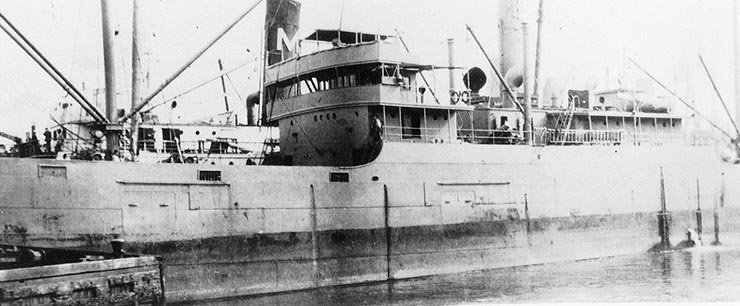
USS Atik (AK-101) was a Q-ship of the United States Navy named for al-Atik, a double star in the constellation Perseus. Her twin sister ship was Asterion.
The steel-hulled, single-screw steamer Carolyn was laid down on 15 March 1912 at Newport News, Virginia, by the Newport News Shipbuilding and Dry Dock Company, for the A. H. Bull Steamship Lines; launched on 3 July 1912, sponsored by Ms. Carolyn Bull, a granddaughter of the shipping firm's owner, Archibald Hilton Bull (1847–1920), and delivered on 20 July 1912.
For the next 30 years, Carolyn carried freight and passengers between the West Indies and ports on the eastern seaboard of the U.S. During World War I, she received a main battery of one 3 in (76 mm) and one 5 in (130 mm) gun, and a Navy armed guard detachment served on the ship from 28 June 1917–11 November 1918. During that time, the Navy gave her the identification Id. No. 1608, but did not take her over for naval service.
Carolyn operated under the house flag of the Bull Line during the Japanese attack on Pearl Harbor. A dispatch dated 31 January 1941 expressed the Chief of Naval Operations' desire that Evelyn and Carolyn "be given a preliminary conversion to AK (cargo ship) in the shortest possible time." A letter from the chief of the Bureau of Ships elaborated on the "shortest possible time" when it stated on 12 February that the conversion and outfitting of the vessels was desired "by 1 March 1942." Acquired by the Navy from the Maritime Commission, Carolyn steamed to Portsmouth, New Hampshire, where she was turned over to the Navy under a bareboat charter at 15:30 on 12 February 1942.
Over the next few weeks the two erstwhile "tramps" were given their main and secondary batteries as well as sound gear; nevertheless, they appeared to be mere cargo ships. Carolyn became Atik, and was given a cargo ship hull number, AK-101; Evelyn became Asterion (AK-100). They were to use their old identities when communicating with friendly vessels and stations; if enemy ships should challenge, reply should be made in accordance with International Procedure, using the identification SS Vill Franca, of Portuguese Registry, callsign CSBT.
Atik (AK-101) was commissioned at 16:45 on 5 March 1942, at the Portsmouth Navy Yard.
At the outset, all connected with the program apparently harbored the view that neither ship "was expected to last longer than a month after commencement of [her] assigned duty." Atik's holds were packed with pulpwood, a somewhat mercurial material. If dry, "an explosive condition might well develop," and, if wet, "rot, with resultant fire, might well take place." Despite these disadvantages, pulpwood was selected as the best obtainable material to assure "floatability."
Atik's mission was to lure some unsuspecting U-boat into making a torpedo attack. According to the projected scenario, the submarine, having deemed the tramp unworthy of the expenditure of more torpedoes, would surface to sink the crippled foe with gunfire. The plan presupposed that supporting forces would come to the rescue whenever a Q-ship ran into difficulties. In March 1942, though, there was no such reserve available. The commanding officers of the two ships were told that they could expect little help if they got into trouble. Every available combatant ship and plane was employed in convoy and patrol duties.
Hub AI
USS Atik AI simulator
(@USS Atik_simulator)
USS Atik
USS Atik (AK-101) was a Q-ship of the United States Navy named for al-Atik, a double star in the constellation Perseus. Her twin sister ship was Asterion.
The steel-hulled, single-screw steamer Carolyn was laid down on 15 March 1912 at Newport News, Virginia, by the Newport News Shipbuilding and Dry Dock Company, for the A. H. Bull Steamship Lines; launched on 3 July 1912, sponsored by Ms. Carolyn Bull, a granddaughter of the shipping firm's owner, Archibald Hilton Bull (1847–1920), and delivered on 20 July 1912.
For the next 30 years, Carolyn carried freight and passengers between the West Indies and ports on the eastern seaboard of the U.S. During World War I, she received a main battery of one 3 in (76 mm) and one 5 in (130 mm) gun, and a Navy armed guard detachment served on the ship from 28 June 1917–11 November 1918. During that time, the Navy gave her the identification Id. No. 1608, but did not take her over for naval service.
Carolyn operated under the house flag of the Bull Line during the Japanese attack on Pearl Harbor. A dispatch dated 31 January 1941 expressed the Chief of Naval Operations' desire that Evelyn and Carolyn "be given a preliminary conversion to AK (cargo ship) in the shortest possible time." A letter from the chief of the Bureau of Ships elaborated on the "shortest possible time" when it stated on 12 February that the conversion and outfitting of the vessels was desired "by 1 March 1942." Acquired by the Navy from the Maritime Commission, Carolyn steamed to Portsmouth, New Hampshire, where she was turned over to the Navy under a bareboat charter at 15:30 on 12 February 1942.
Over the next few weeks the two erstwhile "tramps" were given their main and secondary batteries as well as sound gear; nevertheless, they appeared to be mere cargo ships. Carolyn became Atik, and was given a cargo ship hull number, AK-101; Evelyn became Asterion (AK-100). They were to use their old identities when communicating with friendly vessels and stations; if enemy ships should challenge, reply should be made in accordance with International Procedure, using the identification SS Vill Franca, of Portuguese Registry, callsign CSBT.
Atik (AK-101) was commissioned at 16:45 on 5 March 1942, at the Portsmouth Navy Yard.
At the outset, all connected with the program apparently harbored the view that neither ship "was expected to last longer than a month after commencement of [her] assigned duty." Atik's holds were packed with pulpwood, a somewhat mercurial material. If dry, "an explosive condition might well develop," and, if wet, "rot, with resultant fire, might well take place." Despite these disadvantages, pulpwood was selected as the best obtainable material to assure "floatability."
Atik's mission was to lure some unsuspecting U-boat into making a torpedo attack. According to the projected scenario, the submarine, having deemed the tramp unworthy of the expenditure of more torpedoes, would surface to sink the crippled foe with gunfire. The plan presupposed that supporting forces would come to the rescue whenever a Q-ship ran into difficulties. In March 1942, though, there was no such reserve available. The commanding officers of the two ships were told that they could expect little help if they got into trouble. Every available combatant ship and plane was employed in convoy and patrol duties.
Recent media