



Community hub
Recent from talks
Knowledge base stats:
Talk channels stats:
Members stats:
USS Finch (AM-9)
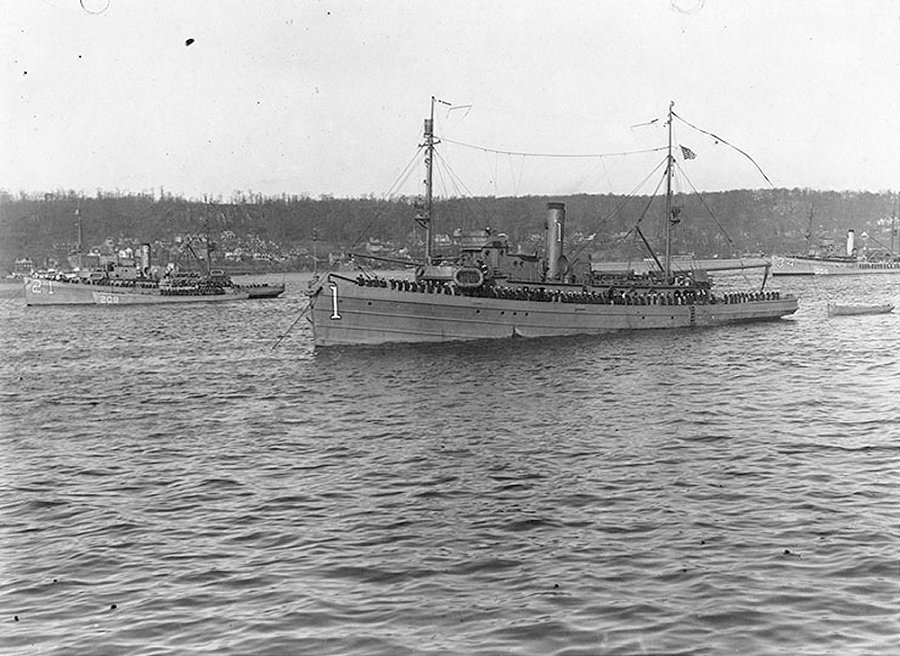
USS Finch (AM-9) was a Lapwing-class minesweeper acquired by the U.S. Navy for the dangerous task of removing mines from minefields laid in the water to prevent ships from passing. During World War II, Finch was sunk and later salvaged by the Japanese and commissioned as Patrol Boat No. 103.
Finch was named for the finch, and is strictly speaking the only U.S. vessel named for such.
Finch was launched 30 March 1918 by Standard Shipbuilding Co., New York; sponsored by Mrs. F. G. Peabody; and commissioned 10 September 1918.
After training and operations with a submarine bell, Finch sailed from New York 9 August 1919 for Kirkwall, Orkney Islands, Scotland. Here she based for two months of duty removing the vast number of mines laid in the North Sea during World War I. Finch returned to Charleston on 29 November 1920, and on 3 January 1920 sailed for San Pedro, California, where from 1 March to 29 August she was in reduced commission.
Modernized, she sailed from San Francisco on 20 August 1921 for duty with the Asiatic Fleet, and for the next 20 years, served in the Philippines in the winter and out of the China base at Chefoo in the summer. Her duties were varied, and included towing and salvage work, as well as participation in the Yangtze River Patrol. She joined in fleet exercises, and as war tension heightened, played a part in protecting American citizens and interests in the Far East.
In 1937, Finch was commanded briefly by LCDR (later VADM, permanent rank) Hyman G. Rickover, future commander of Naval Reactors and the longest-serving active duty U.S. Naval officer. Rickover commanded Finch from 17 July to 5 October 1937 and it was the only command at sea Rickover ever held. The ship was primarily operating at Shanghai, China, to protect American interests during the Battle of Shanghai.
In 1941, she began work in intensive development exercises with submarine and mine groups in the Philippines, and as war came closer, spent December on patrol in the Taiwan Straits. According to an account given by Yeoman 3C A. Glenn Pratt, a crewmember aboard the Finch, she was assigned, along with the Heron, a sister vessel with a diving bell, to escort two US Navy river gunboats back to Manila Harbor from their station in China since the Japanese had sunk one such vessel, the Panay, in 1937. During the return leg of this mission, the vessels were temporarily surrounded by Japanese naval vessels headed toward the Philippines. The gunboats scouted the Japanese column, then pulled ahead to report the naval activity to Washington, while the Finch and Heron stayed behind, eventually being left by the Japanese as well. The two vessels returned to Manila Bay on 6 December 1941.
As the Japanese began aerial bombardment of bases in the Philippines, the Finch continued her task of sweeping for mines to keep the channel into the harbor open for incoming shipping. Yeoman Pratt reported that machine gunners on board the Finch downed one Japanese aircraft during an air raid, and though the Captain congratulated them, he asked them not to repeat the feat so that they would not become a special target and be able to continue mine sweeping operations. After running out of fuel in March, Finch was anchored in shallow water and her crew taken to shore defense positions.
Hub AI
USS Finch (AM-9) AI simulator
(@USS Finch (AM-9)_simulator)
USS Finch (AM-9)
USS Finch (AM-9) was a Lapwing-class minesweeper acquired by the U.S. Navy for the dangerous task of removing mines from minefields laid in the water to prevent ships from passing. During World War II, Finch was sunk and later salvaged by the Japanese and commissioned as Patrol Boat No. 103.
Finch was named for the finch, and is strictly speaking the only U.S. vessel named for such.
Finch was launched 30 March 1918 by Standard Shipbuilding Co., New York; sponsored by Mrs. F. G. Peabody; and commissioned 10 September 1918.
After training and operations with a submarine bell, Finch sailed from New York 9 August 1919 for Kirkwall, Orkney Islands, Scotland. Here she based for two months of duty removing the vast number of mines laid in the North Sea during World War I. Finch returned to Charleston on 29 November 1920, and on 3 January 1920 sailed for San Pedro, California, where from 1 March to 29 August she was in reduced commission.
Modernized, she sailed from San Francisco on 20 August 1921 for duty with the Asiatic Fleet, and for the next 20 years, served in the Philippines in the winter and out of the China base at Chefoo in the summer. Her duties were varied, and included towing and salvage work, as well as participation in the Yangtze River Patrol. She joined in fleet exercises, and as war tension heightened, played a part in protecting American citizens and interests in the Far East.
In 1937, Finch was commanded briefly by LCDR (later VADM, permanent rank) Hyman G. Rickover, future commander of Naval Reactors and the longest-serving active duty U.S. Naval officer. Rickover commanded Finch from 17 July to 5 October 1937 and it was the only command at sea Rickover ever held. The ship was primarily operating at Shanghai, China, to protect American interests during the Battle of Shanghai.
In 1941, she began work in intensive development exercises with submarine and mine groups in the Philippines, and as war came closer, spent December on patrol in the Taiwan Straits. According to an account given by Yeoman 3C A. Glenn Pratt, a crewmember aboard the Finch, she was assigned, along with the Heron, a sister vessel with a diving bell, to escort two US Navy river gunboats back to Manila Harbor from their station in China since the Japanese had sunk one such vessel, the Panay, in 1937. During the return leg of this mission, the vessels were temporarily surrounded by Japanese naval vessels headed toward the Philippines. The gunboats scouted the Japanese column, then pulled ahead to report the naval activity to Washington, while the Finch and Heron stayed behind, eventually being left by the Japanese as well. The two vessels returned to Manila Bay on 6 December 1941.
As the Japanese began aerial bombardment of bases in the Philippines, the Finch continued her task of sweeping for mines to keep the channel into the harbor open for incoming shipping. Yeoman Pratt reported that machine gunners on board the Finch downed one Japanese aircraft during an air raid, and though the Captain congratulated them, he asked them not to repeat the feat so that they would not become a special target and be able to continue mine sweeping operations. After running out of fuel in March, Finch was anchored in shallow water and her crew taken to shore defense positions.