
Recent from talks
UTVA 75
Knowledge base stats:
Talk channels stats:
Members stats:
UTVA 75
The UTVA 75 is a light utility aircraft produced by the Serbian aircraft manufacturer UTVA. It was first introduced in the late 1970s and has since been used primarily for training, reconnaissance, and light transport roles. Known for its reliability and versatility, the UTVA 75 has been adopted by several military and civilian operators around the world.
The development of the UTVA 75 began in the early 1970s in response to a need for a new primary trainer aircraft for the Yugoslav Air Force. The first prototype took to the skies in 1976, and following successful testing, the aircraft entered production in 1978. Over the years, the UTVA 75 has seen various upgrades and modifications to enhance its performance and capabilities.
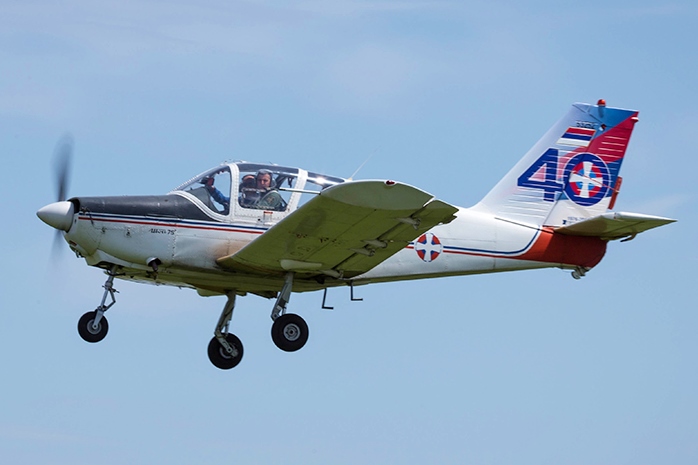
Designed in 1975 to replace the UTVA Aero 3 as the primary basic trainer in the Yugoslav Air Force. It features upward opening gull-wingtype access doors to the two-seat side-by-side cockpit. Another characteristic is a row of air scoops, presumably for cockpit ventilation, in the central front frame of the cockpit. The Utva 75 made its maiden flight in 1976. Between 1978 and 1985, a total of 136 UTVA 75s were produced for the former Yugoslav Air Force. Following the breakup of Yugoslavia, many were passed on to successor states such as Serbia, Slovenia, Croatia, Montenegro.
The UTVA 75 features a fully metallic, semi-monocoque airframe, which provides structural strength and durability. The aircraft is powered by a Lycoming O-360 engine, capable of delivering 210 horsepower. This engine configuration allows the aircraft to achieve a maximum speed of 209 km/h (113 knots) and a service ceiling of 4,178 meters (13,708 feet).
The low-wing design of the UTVA 75 contributes to its stability and maneuverability, which are essential for training and acrobatic maneuvers. The fixed landing gear ensures reliability and reduces maintenance complexity, making it easier for training operations. The cabin is ergonomically designed, featuring adjustable seats and pedals, and provides ample room for both pilots, enhancing comfort during long training sessions.
The UTVA 75 is designed as a low-wing monoplane, emphasizing simplicity and robustness, ideal for training and light utility roles. Here are some detailed aspects of its design and development:
The UTVA 75 features an all-metal construction, primarily using aluminum alloys, which provides a good balance between strength and weight. The low-wing configuration offers excellent visibility for the pilots, which is particularly beneficial during training flights and reconnaissance missions. The aircraft's fixed tricycle landing gear is designed to be sturdy and reliable, capable of operating from both paved runways and rough airstrips.
The aircraft is powered by a single Lycoming IO-360 engine, a four-cylinder, air-cooled, horizontally opposed piston engine. This engine produces 180 horsepower, providing the UTVA 75 with sufficient power for its various roles. The engine is equipped with a two-blade fixed-pitch propeller, which is simple to maintain and operate.
Hub AI
UTVA 75 AI simulator
(@UTVA 75_simulator)
UTVA 75
The UTVA 75 is a light utility aircraft produced by the Serbian aircraft manufacturer UTVA. It was first introduced in the late 1970s and has since been used primarily for training, reconnaissance, and light transport roles. Known for its reliability and versatility, the UTVA 75 has been adopted by several military and civilian operators around the world.
The development of the UTVA 75 began in the early 1970s in response to a need for a new primary trainer aircraft for the Yugoslav Air Force. The first prototype took to the skies in 1976, and following successful testing, the aircraft entered production in 1978. Over the years, the UTVA 75 has seen various upgrades and modifications to enhance its performance and capabilities.
Designed in 1975 to replace the UTVA Aero 3 as the primary basic trainer in the Yugoslav Air Force. It features upward opening gull-wingtype access doors to the two-seat side-by-side cockpit. Another characteristic is a row of air scoops, presumably for cockpit ventilation, in the central front frame of the cockpit. The Utva 75 made its maiden flight in 1976. Between 1978 and 1985, a total of 136 UTVA 75s were produced for the former Yugoslav Air Force. Following the breakup of Yugoslavia, many were passed on to successor states such as Serbia, Slovenia, Croatia, Montenegro.
The UTVA 75 features a fully metallic, semi-monocoque airframe, which provides structural strength and durability. The aircraft is powered by a Lycoming O-360 engine, capable of delivering 210 horsepower. This engine configuration allows the aircraft to achieve a maximum speed of 209 km/h (113 knots) and a service ceiling of 4,178 meters (13,708 feet).
The low-wing design of the UTVA 75 contributes to its stability and maneuverability, which are essential for training and acrobatic maneuvers. The fixed landing gear ensures reliability and reduces maintenance complexity, making it easier for training operations. The cabin is ergonomically designed, featuring adjustable seats and pedals, and provides ample room for both pilots, enhancing comfort during long training sessions.
The UTVA 75 is designed as a low-wing monoplane, emphasizing simplicity and robustness, ideal for training and light utility roles. Here are some detailed aspects of its design and development:
The UTVA 75 features an all-metal construction, primarily using aluminum alloys, which provides a good balance between strength and weight. The low-wing configuration offers excellent visibility for the pilots, which is particularly beneficial during training flights and reconnaissance missions. The aircraft's fixed tricycle landing gear is designed to be sturdy and reliable, capable of operating from both paved runways and rough airstrips.
The aircraft is powered by a single Lycoming IO-360 engine, a four-cylinder, air-cooled, horizontally opposed piston engine. This engine produces 180 horsepower, providing the UTVA 75 with sufficient power for its various roles. The engine is equipped with a two-blade fixed-pitch propeller, which is simple to maintain and operate.
Recent media