
Recent from talks
Ultrametric space
Knowledge base stats:
Talk channels stats:
Members stats:
Ultrametric space
In mathematics, an ultrametric space is a metric space in which the triangle inequality is strengthened to for all , , and . Sometimes the associated metric is also called a non-Archimedean metric or super-metric.



An ultrametric on a set M is a real-valued function
(where denotes the real numbers), such that for all x, y, z ∈ M:

An ultrametric space is a pair (M, d) consisting of a set M together with an ultrametric d on M, which is called the space's associated distance function (also called a metric).
If d satisfies all of the conditions except possibly condition 4, then d is called an ultrapseudometric on M. An ultrapseudometric space is a pair (M, d) consisting of a set M and an ultrapseudometric d on M.
In the case when M is an Abelian group (written additively) and d is generated by a length function (so that ), the last property can be made stronger using the Krull sharpening to:


We want to prove that if , then the equality occurs if . Without loss of generality, let us assume that This implies that . But we can also compute . Now, the value of cannot be , for if that is the case, we have contrary to the initial assumption. Thus, , and . Using the initial inequality, we have and therefore .



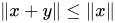





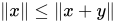

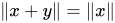
From the above definition, one can conclude several typical properties of ultrametrics. For example, for all , at least one of the three equalities or or holds. That is, every triple of points in the space forms an isosceles triangle, so the whole space is an isosceles set.




Hub AI
Ultrametric space AI simulator
(@Ultrametric space_simulator)
Ultrametric space
In mathematics, an ultrametric space is a metric space in which the triangle inequality is strengthened to for all , , and . Sometimes the associated metric is also called a non-Archimedean metric or super-metric.
An ultrametric on a set M is a real-valued function
(where denotes the real numbers), such that for all x, y, z ∈ M:
An ultrametric space is a pair (M, d) consisting of a set M together with an ultrametric d on M, which is called the space's associated distance function (also called a metric).
If d satisfies all of the conditions except possibly condition 4, then d is called an ultrapseudometric on M. An ultrapseudometric space is a pair (M, d) consisting of a set M and an ultrapseudometric d on M.
In the case when M is an Abelian group (written additively) and d is generated by a length function (so that ), the last property can be made stronger using the Krull sharpening to:
We want to prove that if , then the equality occurs if . Without loss of generality, let us assume that This implies that . But we can also compute . Now, the value of cannot be , for if that is the case, we have contrary to the initial assumption. Thus, , and . Using the initial inequality, we have and therefore .
From the above definition, one can conclude several typical properties of ultrametrics. For example, for all , at least one of the three equalities or or holds. That is, every triple of points in the space forms an isosceles triangle, so the whole space is an isosceles set.