



Community hub
Recent from talks
Knowledge base stats:
Talk channels stats:
Members stats:
Underground nuclear weapons testing
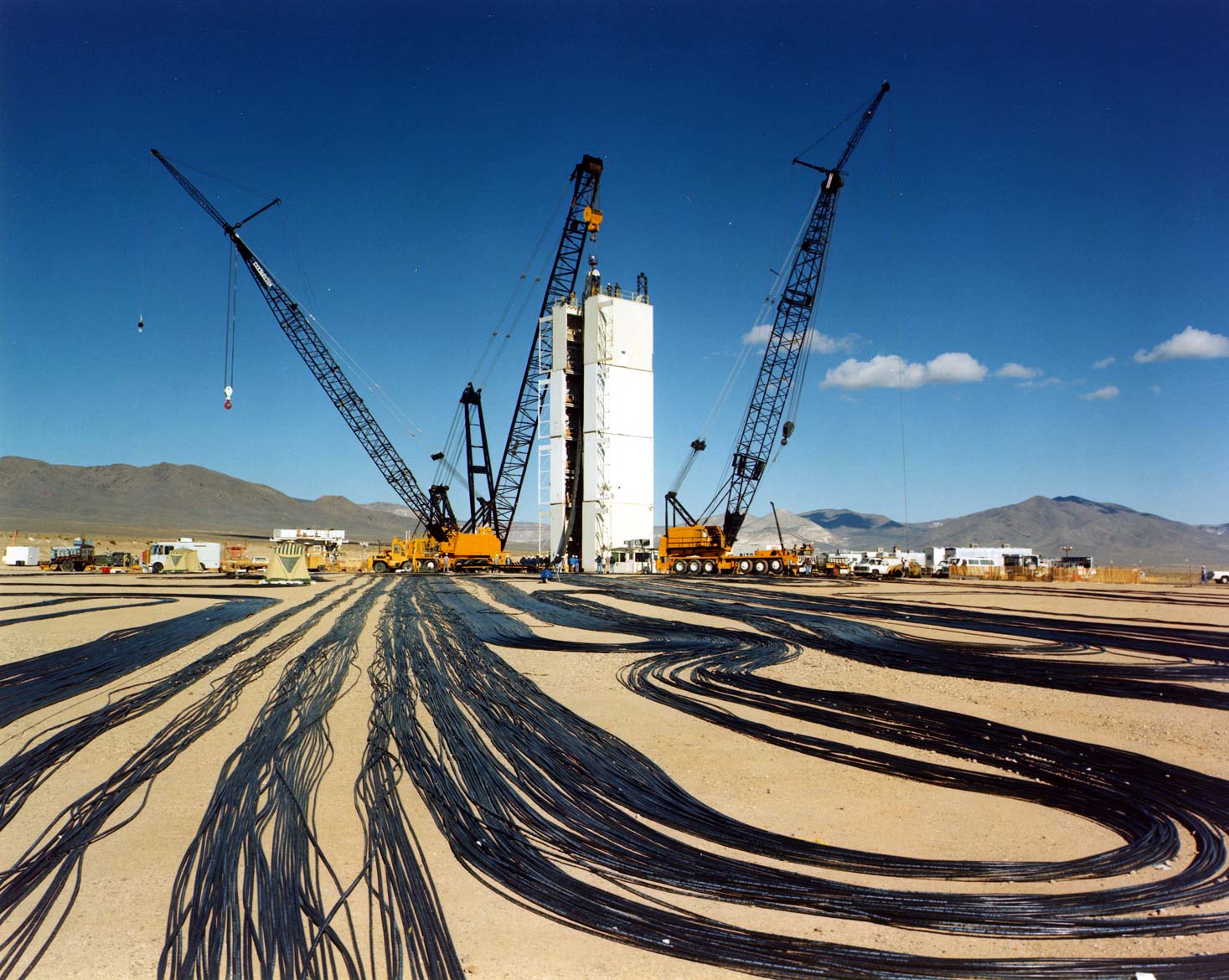
Underground nuclear testing is the test detonation of nuclear weapons that is performed underground. When the device being tested is buried at sufficient depth, the nuclear explosion may be contained, with no release of radioactive materials to the atmosphere.
The extreme heat and pressure of an underground nuclear explosion cause changes in the surrounding rock. The rock closest to the location of the test is vaporised, forming a cavity. Farther away, there are zones of crushed, cracked, and irreversibly strained rock. Following the explosion, the rock above the cavity may collapse, forming a rubble chimney. If this chimney reaches the surface, a bowl-shaped subsidence crater may form.
The first underground test took place in 1951. Further tests soon led scientists to conclude that even notwithstanding environmental and diplomatic considerations, underground testing was of far greater scientific value than all other forms of testing. This understanding strongly influenced the governments of the first three nuclear powers to sign of the Limited Test Ban Treaty in 1963, which banned all nuclear tests except for those performed underground. From then until the signing of the Comprehensive Nuclear-Test-Ban Treaty in 1996, most nuclear tests were performed underground, which prevented additional nuclear fallout from entering into the atmosphere.
Public concern about fallout from nuclear testing grew in the early 1950s. Fallout was discovered after the Trinity test, the first ever atomic bomb test, in 1945. Photographic film manufacturers later reported 'fogged' films; this was traced to packaging materials sourced from Indiana crops, contaminated by Trinity and later tests at the Nevada Test Site, over 1,000 miles (1,600 km) away. Intense fallout from the 1953 Simon test was documented as far as Albany, New York.
The fallout from the March 1954 Bravo test in the Pacific Ocean had "scientific, political and social implications that have continued for more than 40 years". The multi-megaton test caused fallout to occur on the islands of the Rongerik and Rongelap atolls, and a Japanese fishing boat known as the Daigo Fukuryū Maru (Lucky Dragon). Prior to this test, there was "insufficient" appreciation of the dangers of fallout.
The test became an international incident. In a Public Broadcasting Service (PBS) interview, the historian Martha Smith argued: "In Japan, it becomes a huge issue in terms of not just the government and its protest against the United States, but all different groups and all different peoples in Japan start to protest. It becomes a big issue in the media. There are all kinds of letters and protests that come from, not surprisingly, Japanese fishermen, the fishermen's wives; there are student groups, all different types of people; that protest against the Americans' use of the Pacific for nuclear testing. They're very concerned about, first of all, why the United States even has the right to be carrying out those kinds of tests in the Pacific. They're also concerned about the health and environmental impact." The Prime Minister of India "voiced the heightened international concern" when he called for the elimination of all nuclear testing worldwide.[who?]
Knowledge about fallout and its effects grew, and with it concern about the global environment and long-term genetic damage. Talks between the United States, the United Kingdom, Canada, France, and the Soviet Union began in May 1955 on the subject of an international agreement to end nuclear tests. On August 5, 1963, representatives of the United States, the Soviet Union, and the United Kingdom signed the Limited Test Ban Treaty, forbidding testing of nuclear weapons in the atmosphere, in space, and underwater. Agreement was facilitated by the decision to allow underground testing, eliminating the need for on-site inspections that concerned the Soviets. Underground testing was allowed, provided that it does not cause "radioactive debris to be present outside the territorial limits of the State under whose jurisdiction or control such explosion is conducted".
Following analysis of underwater detonations that were part of Operation Crossroads in 1946, inquiries were made regarding the possible military value of an underground explosion. The US Joint Chiefs of Staff thus obtained the agreement of the United States Atomic Energy Commission (AEC) to perform experiments on both surface and sub-surface detonations. The Alaskan island of Amchitka was initially selected for these tests in 1950, but the site was later deemed unsuitable and the tests were moved to the Nevada Test Site.
Hub AI
Underground nuclear weapons testing AI simulator
(@Underground nuclear weapons testing_simulator)
Underground nuclear weapons testing
Underground nuclear testing is the test detonation of nuclear weapons that is performed underground. When the device being tested is buried at sufficient depth, the nuclear explosion may be contained, with no release of radioactive materials to the atmosphere.
The extreme heat and pressure of an underground nuclear explosion cause changes in the surrounding rock. The rock closest to the location of the test is vaporised, forming a cavity. Farther away, there are zones of crushed, cracked, and irreversibly strained rock. Following the explosion, the rock above the cavity may collapse, forming a rubble chimney. If this chimney reaches the surface, a bowl-shaped subsidence crater may form.
The first underground test took place in 1951. Further tests soon led scientists to conclude that even notwithstanding environmental and diplomatic considerations, underground testing was of far greater scientific value than all other forms of testing. This understanding strongly influenced the governments of the first three nuclear powers to sign of the Limited Test Ban Treaty in 1963, which banned all nuclear tests except for those performed underground. From then until the signing of the Comprehensive Nuclear-Test-Ban Treaty in 1996, most nuclear tests were performed underground, which prevented additional nuclear fallout from entering into the atmosphere.
Public concern about fallout from nuclear testing grew in the early 1950s. Fallout was discovered after the Trinity test, the first ever atomic bomb test, in 1945. Photographic film manufacturers later reported 'fogged' films; this was traced to packaging materials sourced from Indiana crops, contaminated by Trinity and later tests at the Nevada Test Site, over 1,000 miles (1,600 km) away. Intense fallout from the 1953 Simon test was documented as far as Albany, New York.
The fallout from the March 1954 Bravo test in the Pacific Ocean had "scientific, political and social implications that have continued for more than 40 years". The multi-megaton test caused fallout to occur on the islands of the Rongerik and Rongelap atolls, and a Japanese fishing boat known as the Daigo Fukuryū Maru (Lucky Dragon). Prior to this test, there was "insufficient" appreciation of the dangers of fallout.
The test became an international incident. In a Public Broadcasting Service (PBS) interview, the historian Martha Smith argued: "In Japan, it becomes a huge issue in terms of not just the government and its protest against the United States, but all different groups and all different peoples in Japan start to protest. It becomes a big issue in the media. There are all kinds of letters and protests that come from, not surprisingly, Japanese fishermen, the fishermen's wives; there are student groups, all different types of people; that protest against the Americans' use of the Pacific for nuclear testing. They're very concerned about, first of all, why the United States even has the right to be carrying out those kinds of tests in the Pacific. They're also concerned about the health and environmental impact." The Prime Minister of India "voiced the heightened international concern" when he called for the elimination of all nuclear testing worldwide.[who?]
Knowledge about fallout and its effects grew, and with it concern about the global environment and long-term genetic damage. Talks between the United States, the United Kingdom, Canada, France, and the Soviet Union began in May 1955 on the subject of an international agreement to end nuclear tests. On August 5, 1963, representatives of the United States, the Soviet Union, and the United Kingdom signed the Limited Test Ban Treaty, forbidding testing of nuclear weapons in the atmosphere, in space, and underwater. Agreement was facilitated by the decision to allow underground testing, eliminating the need for on-site inspections that concerned the Soviets. Underground testing was allowed, provided that it does not cause "radioactive debris to be present outside the territorial limits of the State under whose jurisdiction or control such explosion is conducted".
Following analysis of underwater detonations that were part of Operation Crossroads in 1946, inquiries were made regarding the possible military value of an underground explosion. The US Joint Chiefs of Staff thus obtained the agreement of the United States Atomic Energy Commission (AEC) to perform experiments on both surface and sub-surface detonations. The Alaskan island of Amchitka was initially selected for these tests in 1950, but the site was later deemed unsuitable and the tests were moved to the Nevada Test Site.