



Community hub
Recent from talks
Knowledge base stats:
Talk channels stats:
Members stats:
Unhappy triad
The unhappy triad, also known as a blown knee among other names, is an injury to the anterior cruciate ligament, medial collateral ligament, and meniscus. Analysis during the 1990s indicated that this 'classic' O'Donoghue triad is actually an unusual clinical entity among athletes with knee injuries. Some authors mistakenly believe that in this type of injury, "combined anterior cruciate and medial collateral ligament (ACL- MCL) disruptions that were incurred during athletic endeavors" always present with concomitant medial meniscus injury. However, the 1990 analysis showed that lateral meniscus tears are more common than medial meniscus tears in conjunction with sprains of the ACL.
The unhappy triad occurs due to a lateral blow to the knee causing a rupture in the anterior cruciate ligament, medial collateral ligament, and meniscus. Injury is most often sustained when a lateral (from the outside) force impacts the knee while the foot is fixed on the ground. The strong valgus or rotary force to the knee tears the ACL, MCL, and medial meniscus all together. This type of injury occurs often in contact sports such as football, rugby, or motocross. During the injury, the leg is laterally rotated and over-abducted. In about 10% of cases, the force is applied to the opposite side of the knee, and the lateral and posterolateral ligaments are torn.
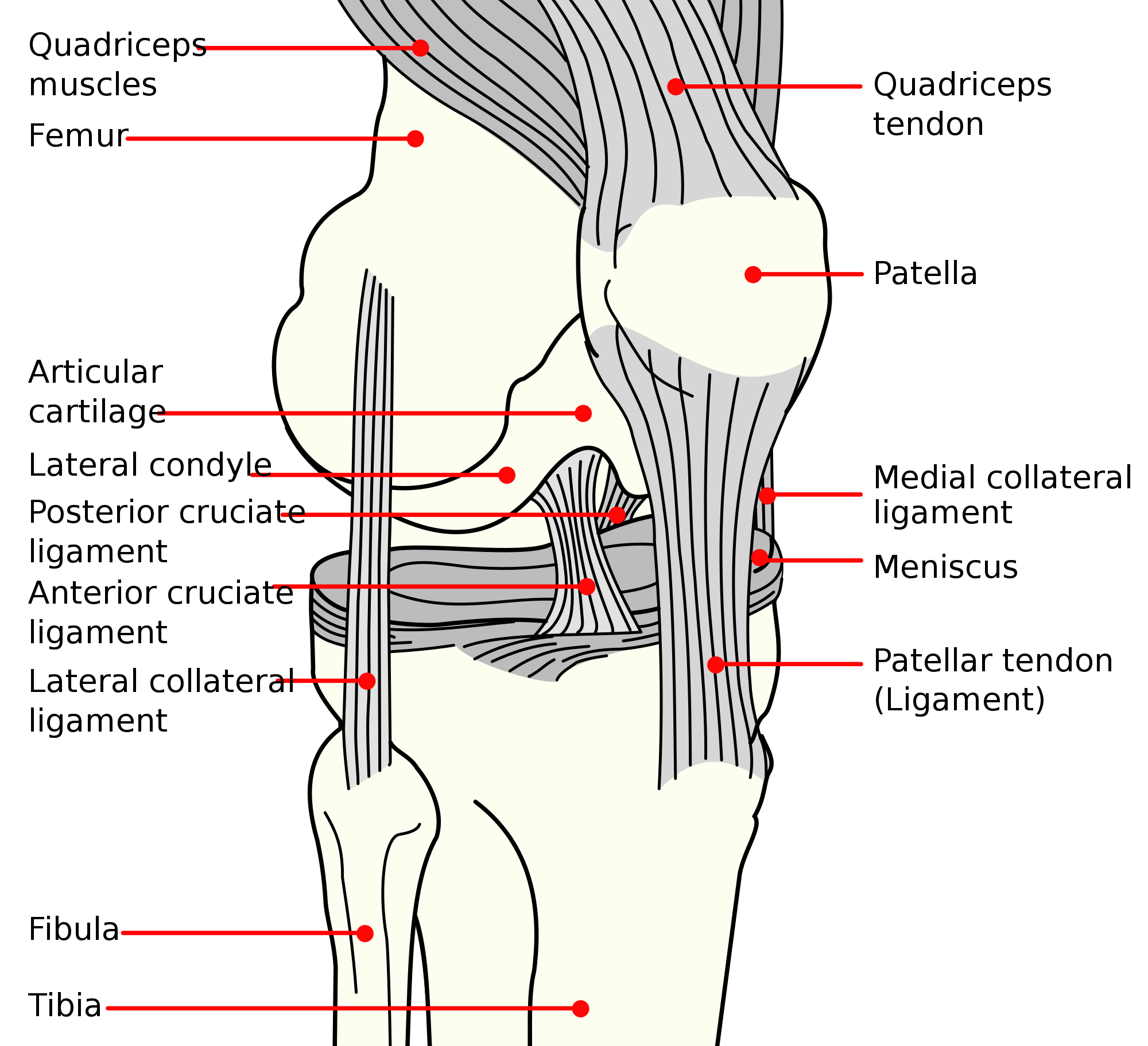
Skeletal components involved in the unhappy triad include: patella, femur, tibia. No muscles are directly involved in this injury, only ligaments; However, strengthening the hip flexor and hip extensor muscles may help alleviate the injury.
The medial collateral ligament, posterior cruciate ligament, anterior cruciate ligament, and lateral collateral ligament are the four primary ligaments of the knee. The medial and lateral collateral ligaments primarily provide support to varus and valgus forces whereas the anterior and posterior cruciate ligaments prevent anterior and posterior translation of the tibia on the femur.
The classic O'Donoghue triad is characterized by an injury to three knee structures (in order):
The anterior cruciate ligament is one of the four crucial ligaments in the knee. It originates from the lateral condyle of the femur and goes to the intercondyloid eminence of the tibia. Its function is to provide stability in the knee and minimize stress across the knee joint. It also restrains excessive forward movement in the leg and limits rotational movements in the knee.
Injury
An anterior cruciate ligament injury results from excess tension on the ligament. This can come from a sudden stop or twisting motion of the knee. A few initial symptoms include swelling, knee instability, and pain. A popping sound or sensation may or may not be heard when the ACL first tears. A following symptom usually includes the feeling of the knee "giving out". Tearing of the ACL is the most significant injury because it leaves the knee unstable, which also causes the knee to lose its normal function.
Hub AI
Unhappy triad AI simulator
(@Unhappy triad_simulator)
Unhappy triad
The unhappy triad, also known as a blown knee among other names, is an injury to the anterior cruciate ligament, medial collateral ligament, and meniscus. Analysis during the 1990s indicated that this 'classic' O'Donoghue triad is actually an unusual clinical entity among athletes with knee injuries. Some authors mistakenly believe that in this type of injury, "combined anterior cruciate and medial collateral ligament (ACL- MCL) disruptions that were incurred during athletic endeavors" always present with concomitant medial meniscus injury. However, the 1990 analysis showed that lateral meniscus tears are more common than medial meniscus tears in conjunction with sprains of the ACL.
The unhappy triad occurs due to a lateral blow to the knee causing a rupture in the anterior cruciate ligament, medial collateral ligament, and meniscus. Injury is most often sustained when a lateral (from the outside) force impacts the knee while the foot is fixed on the ground. The strong valgus or rotary force to the knee tears the ACL, MCL, and medial meniscus all together. This type of injury occurs often in contact sports such as football, rugby, or motocross. During the injury, the leg is laterally rotated and over-abducted. In about 10% of cases, the force is applied to the opposite side of the knee, and the lateral and posterolateral ligaments are torn.
Skeletal components involved in the unhappy triad include: patella, femur, tibia. No muscles are directly involved in this injury, only ligaments; However, strengthening the hip flexor and hip extensor muscles may help alleviate the injury.
The medial collateral ligament, posterior cruciate ligament, anterior cruciate ligament, and lateral collateral ligament are the four primary ligaments of the knee. The medial and lateral collateral ligaments primarily provide support to varus and valgus forces whereas the anterior and posterior cruciate ligaments prevent anterior and posterior translation of the tibia on the femur.
The classic O'Donoghue triad is characterized by an injury to three knee structures (in order):
The anterior cruciate ligament is one of the four crucial ligaments in the knee. It originates from the lateral condyle of the femur and goes to the intercondyloid eminence of the tibia. Its function is to provide stability in the knee and minimize stress across the knee joint. It also restrains excessive forward movement in the leg and limits rotational movements in the knee.
Injury
An anterior cruciate ligament injury results from excess tension on the ligament. This can come from a sudden stop or twisting motion of the knee. A few initial symptoms include swelling, knee instability, and pain. A popping sound or sensation may or may not be heard when the ACL first tears. A following symptom usually includes the feeling of the knee "giving out". Tearing of the ACL is the most significant injury because it leaves the knee unstable, which also causes the knee to lose its normal function.