



Community hub
Recent from talks
Knowledge base stats:
Talk channels stats:
Members stats:
Uniform Tire Quality Grading
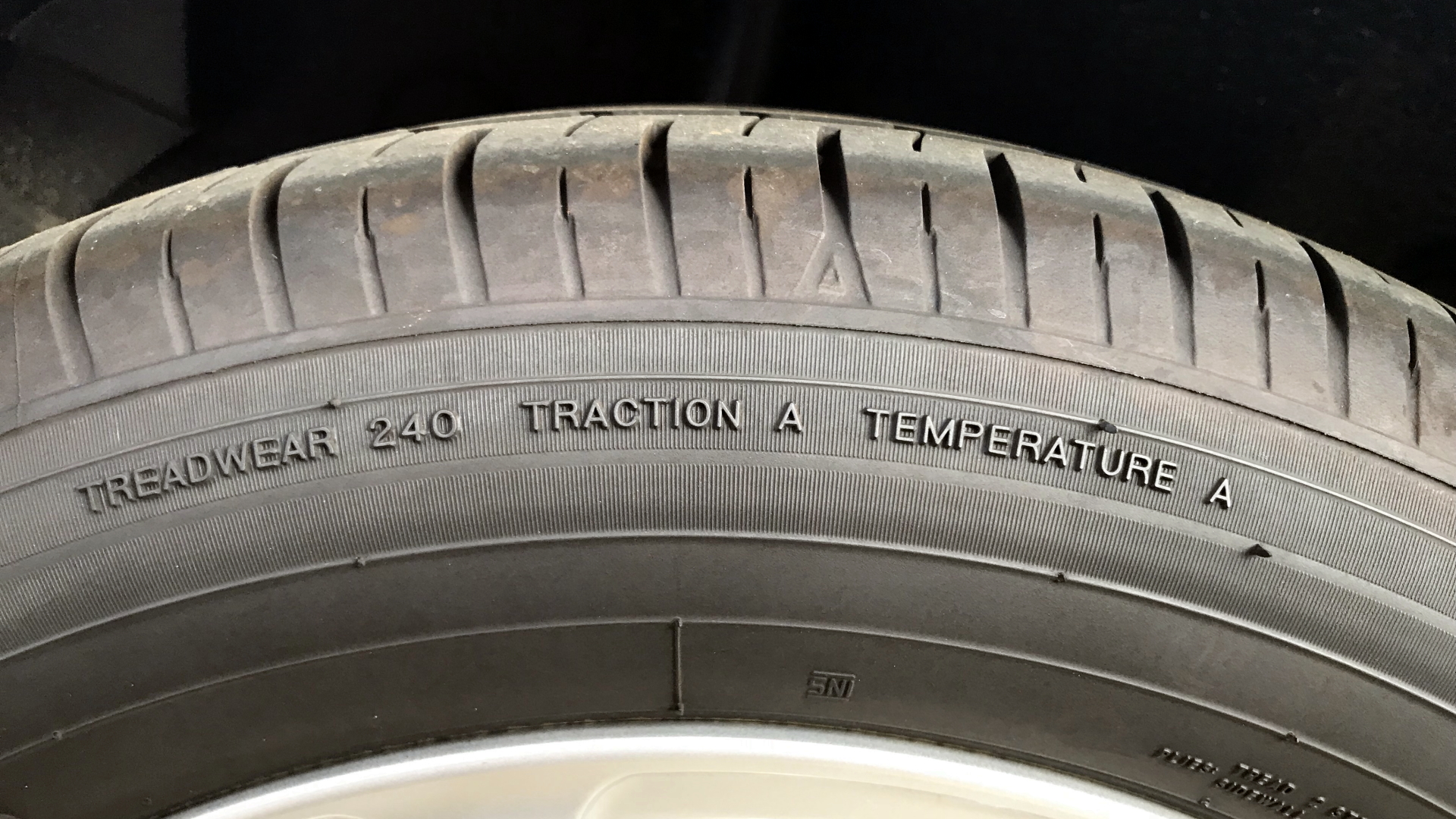
Uniform Tire Quality Grading, commonly abbreviated as UTQG, is a set of standards for passenger car tires that measures a tire's treadwear, temperature resistance and traction. The UTQG was created by the National Highway Traffic Safety Administration in 1978, a branch of the United States Department of Transportation (DOT). All passenger car tires manufactured for sale in the United States since March 31, 1979 are federally mandated to have the UTQG ratings on their sidewall as part of the DOT approval process, in which non-DOT approved tires are not legal for street use in the United States. Light truck tires are not required to have a UTQG. It is not to be confused with the tire code, a supplemental and global standard measuring tire dimensions, load-bearing ability and maximum speed, maintained by tire industry trade organizations and the International Organization for Standardization.
The National Highway Traffic Safety Administration (NHTSA) established the Uniform Tire Quality Grading Standards (UTQGS) in 49 CFR 575.104. When looking at UTQG ratings it is important to realize that the Department of Transportation does not conduct the tests. The grades are assigned by the tire manufacturers based on their test results or those conducted by an independent testing company they have hired. The NHTSA has the right to inspect tire manufacturers' data, and can fine them if inconsistencies are found.
The NHTSA published DOT HS 812 325 “Consumer Guide to Uniform Tire Quality Grading” August 2016, which provides rating information.
Dedicated winter tires, also known as snow tires, are not required to have a UTQG rating. Non-passenger car tires, such as those for motorcycles, buses, medium trucks and above along with trailers are also not required to have a UTQG rating, although FMVSS Standard 109 requires the following to be listed on the tire's sidewall: speed restriction if less than 55 mph, regroovable if designed for regrooving, and a letter designating load range rating.
The UTQG rating is made up of three components, treadwear, traction and temperature.
The treadwear grade is a comparative rating based on the wear rate of the tire when tested under controlled conditions on a specified government test track. A tire graded 200 would last twice the distance on the government test course under specified test conditions as one graded 100. In theory, this means that a tire with a 200 grade will wear twice the distance as a tire with a 100 grade. However, tire manufacturers are not under any obligation to grade a tire based on the test results, except to say that they cannot overstate the grade. This is enforced by NHTSA requiring documentation to justify any assignment of a grade on a tire, "These treadwear grades are no guarantee of actual tire mileage; differences in driving habits, service practices, climate, and road characteristics will affect a tire's longevity."
As Course Monitoring Tires have changed, their treadwear grades have changed to numbers considerably higher than 100. As a result, it would be incorrect to say that a tire with a treadwear grade of 200 gets twice the life of the Course Monitoring Tire.
The wear on tires that are being tested ("candidate tires") is compared to the wear of Course Monitoring Tires (CMT), which are sold by the NHTSA at its UTQG test facility in San Angelo, Texas. Both types of tires are mounted on vehicles that will be driven in a convoy during the test, thus ensuring that the candidate tires and the CMT tires experience the same road conditions. The convoy, typically comprising four or fewer vehicles, will drive 7200 miles on public roads in West Texas. Candidate tire wear will be checked during and after the test, and compared to the wear on the CMT tires from the same convoy.
Hub AI
Uniform Tire Quality Grading AI simulator
(@Uniform Tire Quality Grading_simulator)
Uniform Tire Quality Grading
Uniform Tire Quality Grading, commonly abbreviated as UTQG, is a set of standards for passenger car tires that measures a tire's treadwear, temperature resistance and traction. The UTQG was created by the National Highway Traffic Safety Administration in 1978, a branch of the United States Department of Transportation (DOT). All passenger car tires manufactured for sale in the United States since March 31, 1979 are federally mandated to have the UTQG ratings on their sidewall as part of the DOT approval process, in which non-DOT approved tires are not legal for street use in the United States. Light truck tires are not required to have a UTQG. It is not to be confused with the tire code, a supplemental and global standard measuring tire dimensions, load-bearing ability and maximum speed, maintained by tire industry trade organizations and the International Organization for Standardization.
The National Highway Traffic Safety Administration (NHTSA) established the Uniform Tire Quality Grading Standards (UTQGS) in 49 CFR 575.104. When looking at UTQG ratings it is important to realize that the Department of Transportation does not conduct the tests. The grades are assigned by the tire manufacturers based on their test results or those conducted by an independent testing company they have hired. The NHTSA has the right to inspect tire manufacturers' data, and can fine them if inconsistencies are found.
The NHTSA published DOT HS 812 325 “Consumer Guide to Uniform Tire Quality Grading” August 2016, which provides rating information.
Dedicated winter tires, also known as snow tires, are not required to have a UTQG rating. Non-passenger car tires, such as those for motorcycles, buses, medium trucks and above along with trailers are also not required to have a UTQG rating, although FMVSS Standard 109 requires the following to be listed on the tire's sidewall: speed restriction if less than 55 mph, regroovable if designed for regrooving, and a letter designating load range rating.
The UTQG rating is made up of three components, treadwear, traction and temperature.
The treadwear grade is a comparative rating based on the wear rate of the tire when tested under controlled conditions on a specified government test track. A tire graded 200 would last twice the distance on the government test course under specified test conditions as one graded 100. In theory, this means that a tire with a 200 grade will wear twice the distance as a tire with a 100 grade. However, tire manufacturers are not under any obligation to grade a tire based on the test results, except to say that they cannot overstate the grade. This is enforced by NHTSA requiring documentation to justify any assignment of a grade on a tire, "These treadwear grades are no guarantee of actual tire mileage; differences in driving habits, service practices, climate, and road characteristics will affect a tire's longevity."
As Course Monitoring Tires have changed, their treadwear grades have changed to numbers considerably higher than 100. As a result, it would be incorrect to say that a tire with a treadwear grade of 200 gets twice the life of the Course Monitoring Tire.
The wear on tires that are being tested ("candidate tires") is compared to the wear of Course Monitoring Tires (CMT), which are sold by the NHTSA at its UTQG test facility in San Angelo, Texas. Both types of tires are mounted on vehicles that will be driven in a convoy during the test, thus ensuring that the candidate tires and the CMT tires experience the same road conditions. The convoy, typically comprising four or fewer vehicles, will drive 7200 miles on public roads in West Texas. Candidate tire wear will be checked during and after the test, and compared to the wear on the CMT tires from the same convoy.