Uniform integrability
Main page

Uniform integrability

logo
Community Hub0 subscribers
Read side by side
from Wikipedia

In mathematics, uniform integrability is an important concept in real analysis, functional analysis and measure theory, and plays a vital role in the theory of martingales.

Measure-theoretic definition

[edit]

Uniform integrability is an extension to the notion of a family of functions being dominated in which is central in dominated convergence. Several textbooks on real analysis and measure theory use the following definition:[1]

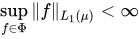
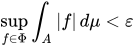
Definition A: Let be a positive measure space. A set is called uniformly integrable if , and to each there corresponds a such that

whenever and

Definition A is rather restrictive for infinite measure spaces. A more general definition[2] of uniform integrability that works well in general measure spaces was introduced by G. A. Hunt.

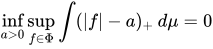
Definition H: Let be a positive measure space. A set is called uniformly integrable if and only if

where .
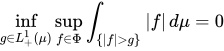

Since Hunt's definition is equivalent to Definition A when the underlying measure space is finite (see Theorem 2 below), Definition H is widely adopted in Mathematics.

The following result[3] provides another equivalent notion to Hunt's. This equivalency is sometimes given as definition for uniform integrability.

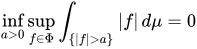
Theorem 1: If is a (positive) finite measure space, then a set is uniformly integrable if and only if

If in addition , then uniform integrability is equivalent to either of the following conditions

1. .

2.
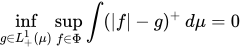
When the underlying space is -finite, Hunt's definition is equivalent to the following:

Theorem 2: Let be a -finite measure space, and be such that almost everywhere. A set is uniformly integrable if and only if , and for any , there exits such that

whenever .

A consequence of Theorems 1 and 2 is that equivalence of Definitions A and H for finite measures follows. Indeed, the statement in Definition A is obtained by taking in Theorem 2.

Probability definition

[edit]

In the theory of probability, Definition A or the statement of Theorem 1 are often presented as definitions of uniform integrability using the notation expectation of random variables.,[4][5][6] that is,

1. A class of random variables is called uniformly integrable if:

  • There exists a finite such that, for every in , and
  • For every there exists such that, for every measurable such that and every in , .

or alternatively

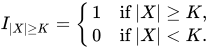
2. A class of random variables is called uniformly integrable (UI) if for every there exists such that , where is the indicator function .


Tightness and uniform integrability

[edit]

Another concept associated with uniform integrability is that of tightness. In this article tightness is taken in a more general setting.

Definition: Suppose measurable space is a measure space. Let be a collection of sets of finite measure. A family is tight with respect to if

A tight family with respect to is just said to be tight.

When the measure space is a metric space equipped with the Borel algebra, is a regular measure, and is the collection of all compact subsets of , the notion of -tightness discussed above coincides with the well known concept of tightness used in the analysis of regular measures in metric spaces

For -finite measure spaces, it can be shown that if a family is uniformly integrable, then is tight. This is capture by the following result which is often used as definition of uniform integrabiliy in the Analysis literature:

Theorem 3: Suppose is a finite measure space. A family is uniformly integrable if and only if

  1. .
  2. is tight.

When , condition 3 is redundant (see Theorem 1 above).

Uniform absolute continuity

[edit]

There is another notion of uniformity, slightly different than uniform integrability, which also has many applications in probability and measure theory, and which does not require random variables to have a finite integral[7]

Definition: Suppose is a probability space. A class of random variables is uniformly absolutely continuous with respect to if for any , there is such that whenever .

It is equivalent to uniform integrability if the measure is finite and has no atoms.

The term "uniform absolute continuity" is not standard,[citation needed] but is used by some authors.[8][9]

[edit]

The following results apply to the probabilistic definition.[10]

  • Definition 1 could be rewritten by taking the limits as
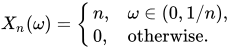
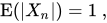
  • A non-UI sequence. Let , and define Clearly , and indeed for all n. However, and comparing with definition 1, it is seen that the sequence is not uniformly integrable.

Non-UI sequence of RVs. The area under the strip is always equal to 1, but pointwise.
  • By using Definition 2 in the above example, it can be seen that the first clause is satisfied as norm of all s are 1 i.e., bounded. But the second clause does not hold as given any positive, there is an interval with measure less than and for all .
  • If is a UI random variable, by splitting and bounding each of the two, it can be seen that a uniformly integrable random variable is always bounded in .
  • If any sequence of random variables is dominated by an integrable, non-negative : that is, for all ω and n, then the class of random variables is uniformly integrable.
  • A class of random variables bounded in () is uniformly integrable.

Relevant theorems

[edit]

In the following we use the probabilistic framework, but regardless of the finiteness of the measure, by adding the boundedness condition on the chosen subset of .

  • DunfordPettis theorem[11][12]
    A class[clarification needed] of random variables is uniformly integrable if and only if it is relatively compact for the weak topology .[clarification needed][citation needed]
  • de la Vallée-Poussin theorem[13][14]
    The family is uniformly integrable if and only if there exists a non-negative increasing convex function such that

Uniform integrability and stochastic ordering

[edit]

A family of random variables is uniformly integrable if and only if[15] there exists a random variable such that and for all , where denotes the increasing convex stochastic order defined by if for all nondecreasing convex real functions .

Relation to convergence of random variables

[edit]

A sequence converges to in the norm if and only if it converges in measure to and it is uniformly integrable. In probability terms, a sequence of random variables converging in probability also converge in the mean if and only if they are uniformly integrable.[16] This is a generalization of Lebesgue's dominated convergence theorem, see Vitali convergence theorem.

Citations

[edit]
  1. ^ Royden, H.L. & Fitzpatrick, P.M. (2010). Real Analysis (4 ed.). Boston: Prentice Hall. p. 93. ISBN 978-0-13-143747-0.
  2. ^ Hunt, G. A. (1966). Martingales et Processus de Markov. Paris: Dunod. p. 254.
  3. ^ Klenke, A. (2008). Probability Theory: A Comprehensive Course. Berlin: Springer Verlag. pp. 134–137. ISBN 978-1-84800-047-6.
  4. ^ Williams, David (1997). Probability with Martingales (Repr. ed.). Cambridge: Cambridge Univ. Press. pp. 126–132. ISBN 978-0-521-40605-5.
  5. ^ Gut, Allan (2005). Probability: A Graduate Course. Springer. pp. 214–218. ISBN 0-387-22833-0.
  6. ^ Bass, Richard F. (2011). Stochastic Processes. Cambridge: Cambridge University Press. pp. 356–357. ISBN 978-1-107-00800-7.
  7. ^ Bass 2011, p. 356.
  8. ^ Benedetto, J. J. (1976). Real Variable and Integration. Stuttgart: B. G. Teubner. p. 89. ISBN 3-519-02209-5.
  9. ^ Burrill, C. W. (1972). Measure, Integration, and Probability. McGraw-Hill. p. 180. ISBN 0-07-009223-0.
  10. ^ Gut 2005, pp. 215–216.
  11. ^ Dunford, Nelson (1938). "Uniformity in linear spaces". Transactions of the American Mathematical Society. 44 (2): 305–356. doi:10.1090/S0002-9947-1938-1501971-X. ISSN 0002-9947.
  12. ^ Dunford, Nelson (1939). "A mean ergodic theorem". Duke Mathematical Journal. 5 (3): 635–646. doi:10.1215/S0012-7094-39-00552-1. ISSN 0012-7094.
  13. ^ Meyer, P.A. (1966). Probability and Potentials, Blaisdell Publishing Co, N. Y. (p.19, Theorem T22).
  14. ^ Poussin, C. De La Vallee (1915). "Sur L'Integrale de Lebesgue". Transactions of the American Mathematical Society. 16 (4): 435–501. doi:10.2307/1988879. hdl:10338.dmlcz/127627. JSTOR 1988879.
  15. ^ Leskelä, L.; Vihola, M. (2013). "Stochastic order characterization of uniform integrability and tightness". Statistics and Probability Letters. 83 (1): 382–389. arXiv:1106.0607. doi:10.1016/j.spl.2012.09.023.
  16. ^ Bogachev, Vladimir I. (2007). "The spaces Lp and spaces of measures". Measure Theory Volume I. Berlin Heidelberg: Springer-Verlag. p. 268. doi:10.1007/978-3-540-34514-5_4. ISBN 978-3-540-34513-8.

References

[edit]
Revisions and contributorsEdit on WikipediaRead on Wikipedia
from Grokipedia
Uniform integrability is a fundamental concept in measure theory and probability theory that describes a collection of integrable functions or random variables whose integrals over sets of small measure (or whose tails) can be controlled uniformly across the collection.[1] Specifically, a family F\mathcal{F} of measurable functions on a probability space (Ω,F,P)(\Omega, \mathcal{F}, P) is uniformly integrable if for every ϵ>0\epsilon > 0, there exists δ>0\delta > 0 such that for any measurable set AΩA \subset \Omega with P(A)<δP(A) < \delta, supfFAfdP<ϵ\sup_{f \in \mathcal{F}} \int_A |f| \, dP < \epsilon; equivalently, limKsupfF{fK}fdP=0\lim_{K \to \infty} \sup_{f \in \mathcal{F}} \int_{\{|f| \geq K\}} |f| \, dP = 0.[2][1] This property strengthens the conditions for convergence theorems, ensuring that pointwise or probabilistic convergence implies convergence in the L1L^1 norm, as seen in the Vitali convergence theorem: if {fn}\{f_n\} is uniformly integrable, converges pointwise almost everywhere to an integrable ff, and the measure space has finite measure, then limnfnfdμ=0\lim_{n \to \infty} \int |f_n - f| \, d\mu = 0.[2] In probability theory, uniform integrability is essential for martingale convergence; for instance, a uniformly integrable martingale converges almost surely and in L1L^1 to a limit in the same L1L^1 space, as established in Doob's upcrossing lemma and related results.[1][3] Key equivalent characterizations include L1L^1-boundedness combined with uniform absolute continuity, or the existence of a convex increasing function ϕ\phi with limxϕ(x)/x=\lim_{x \to \infty} \phi(x)/x = \infty such that supfFϕ(f)dP<\sup_{f \in \mathcal{F}} \int \phi(|f|) \, dP < \infty.[1] Examples of uniformly integrable families include LpL^p-bounded families for p>1p > 1, families dominated by an integrable function, or conditional expectations of an integrable random variable, while counterexamples like Xn=n1{U1/n}X_n = n \mathbf{1}_{\{U \leq 1/n\}} for uniform UU on (0,1) illustrate failure, as the expectations remain 1 but tails do not vanish uniformly.[3] The concept extends to more general measures and plays a vital role in functional analysis, compactness in L1L^1, and applications in stochastic processes.[1]

Definitions

Measure-theoretic definition

In the measure-theoretic framework, a family of measurable functions {fα:αA}\{f_\alpha : \alpha \in A\} on a measure space (X,Σ,μ)(X, \Sigma, \mu) is uniformly integrable if
limKsupαA{xX:fα(x)>K}fα(x)dμ(x)=0. \lim_{K \to \infty} \sup_{\alpha \in A} \int_{\{x \in X : |f_\alpha(x)| > K\}} |f_\alpha(x)| \, d\mu(x) = 0.
This condition requires that the supremum over the family of the integrals of fα|f_\alpha| over the sets where fα|f_\alpha| exceeds any large threshold KK tends to zero as KK increases, thereby uniformly controlling the contribution from regions of large function values and preventing the integral mass from concentrating at infinity across the entire family.[4][5] A basic example of a uniformly integrable family is the collection of all measurable functions bounded in absolute value by a fixed constant M>0M > 0, since the integral over fα>K|f_\alpha| > K vanishes for all K>MK > M.[4] In contrast, the family {fα:α>0}\{f_\alpha : \alpha > 0\} where fα(x)=α1[0,1/α](x)f_\alpha(x) = \alpha \cdot \mathbf{1}_{[0, 1/\alpha]}(x) on the unit interval [0,1][0,1] with Lebesgue measure is not uniformly integrable, as each fαf_\alpha has integral 1 but supα{fα>1}fαdμ=1↛0\sup_\alpha \int_{\{|f_\alpha| > 1\}} |f_\alpha| \, d\mu = 1 \not\to 0.[5] The concept was developed by Charles-Jean de la Vallée Poussin in 1915, building on earlier work in analysis to generalize convergence theorems in real analysis and measure theory.[4] In finite measure spaces, bounded subsets of Lp(X,Σ,μ)L^p(X, \Sigma, \mu) for 1<p1 < p \leq \infty form uniformly integrable families.[5]

Probabilistic definition

In probability theory, uniform integrability concerns families of random variables defined on a probability space (Ω,F,P)(\Omega, \mathcal{F}, P). A family {Xα}αA\{X_\alpha\}_{\alpha \in A} of random variables is said to be uniformly integrable if
limKsupαAE[Xα1{Xα>K}]=0. \lim_{K \to \infty} \sup_{\alpha \in A} \mathbb{E}\left[ |X_\alpha| \mathbf{1}_{\{|X_\alpha| > K\}} \right] = 0.
This condition ensures that the contributions to the expectations from the tails beyond any large threshold KK become negligible uniformly across the family.[6][1] This probabilistic definition is equivalent to the measure-theoretic notion of uniform integrability when the underlying measure μ\mu is a probability measure, i.e., μ(Ω)=1\mu(\Omega) = 1, as the total mass being finite aligns the tail control directly with expectation bounds in stochastic settings.[1] A simple example of a uniformly integrable family arises when the random variables are uniformly essentially bounded. Specifically, if there exists a constant M<M < \infty such that XαM|X_\alpha| \leq M almost surely for all αA\alpha \in A, then the indicator 1{Xα>K}\mathbf{1}_{\{|X_\alpha| > K\}} vanishes for all K>MK > M, making the supremum zero and thus satisfying the definition trivially.[7] As a counterexample, consider a family of Pareto-distributed random variables with fixed scale parameter xm=1x_m = 1 and shape parameters α>1\alpha > 1 decreasing to 1. Each individual XαX_\alpha is integrable since E[Xα]=α/(α1)<\mathbb{E}[X_\alpha] = \alpha / (\alpha - 1) < \infty, but the family fails uniform integrability because the increasingly heavy tails—characteristic of the Pareto distribution with shape approaching the boundary of integrability—prevent the supremum of the tail expectations from tending to zero as KK \to \infty. For tails behaving like F(x)=C/xkF(x) = C / x^k with k1+k \to 1^+, the condition breaks down uniformly.[6]

Characterizations and Properties

Uniform absolute continuity

In measure theory, a family of integrable functions {fα}αA\{f_\alpha\}_{\alpha \in A} on a measure space (X,A,μ)(X, \mathcal{A}, \mu) is uniformly absolutely continuous if for every ε>0\varepsilon > 0, there exists δ>0\delta > 0 such that supαAEfαdμ<ε\sup_{\alpha \in A} \int_E |f_\alpha| \, d\mu < \varepsilon for every measurable set EAE \in \mathcal{A} with μ(E)<δ\mu(E) < \delta. This condition ensures a uniform control over the integrals of the functions across the family on sets of arbitrarily small measure. When the measure space has finite total measure and is atomless (i.e., μ(X)<\mu(X) < \infty and the measure is atomless), uniform absolute continuity is equivalent to the standard tail-integral definition of uniform integrability, which requires that supαA{fα>K}fαdμ0\sup_{\alpha \in A} \int_{\{|f_\alpha| > K\}} |f_\alpha| \, d\mu \to 0 as KK \to \infty. To sketch the proof in one direction, assume uniform integrability via the tail condition. For given ε>0\varepsilon > 0, choose K>0K > 0 such that supα{fα>K}fαdμ<ε/2\sup_{\alpha} \int_{\{|f_\alpha| > K\}} |f_\alpha| \, d\mu < \varepsilon/2. On the set where fαK|f_\alpha| \leq K, the integral over any EE with μ(E)<δ=ε/(2K)\mu(E) < \delta = \varepsilon/(2K) is at most Kμ(E)<ε/2K \mu(E) < \varepsilon/2, so the total integral over EE is less than ε\varepsilon uniformly. For the converse direction, uniform absolute continuity first implies the family is bounded in L1(μ)L^1(\mu) (since μ(X)<\mu(X) < \infty, X can be covered by finitely many sets of measure less than δ\delta, each contributing less than ε\varepsilon to the sup integral, yielding a uniform bound), and then the small-set control can be applied to the sets {fα>K}\{|f_\alpha| > K\}, whose measures can be bounded using Markov's inequality uniformly; choosing KK large ensures these sets have small measure, yielding the tail control. In the context of L1L^1 spaces over finite measure spaces, uniform absolute continuity directly implies uniform integrability for the family, as the equivalence holds without additional assumptions on the functions beyond integrability. This makes it a practical characterization in spaces like L1([0,1])L^1([0,1]), where families satisfying the ε\varepsilon-δ\delta condition for small intervals inherit the uniform integrability property essential for convergence results. Uniform absolute continuity differs from the absolute continuity of individual functions, where for each fixed fαf_\alpha, one has Efαdμ0\int_E |f_\alpha| \, d\mu \to 0 as μ(E)0\mu(E) \to 0, but the corresponding δ\delta may depend on α\alpha and fail to be uniform across the family. Without uniformity, the family may not be integrable in a controlled manner, even if each member is.

Relation to tightness

In probability theory, a family of probability measures {μα}\{\mu_\alpha\} on a metric space (S,S)(S, \mathcal{S}) is said to be tight if, for every ϵ>0\epsilon > 0, there exists a compact set KSK \subseteq S such that supαμα(SK)<ϵ\sup_\alpha \mu_\alpha(S \setminus K) < \epsilon.[8] A key relation between uniform integrability and tightness arises when considering families of random variables on a probability space. Specifically, if {Xα}\{X_\alpha\} is a uniformly integrable family of random variables (in the probabilistic sense), then the family of their induced laws {L(Xα)}\{\mathcal{L}(X_\alpha)\} is tight. This follows because uniform integrability implies that supαE[Xα]<\sup_\alpha \mathbb{E}[|X_\alpha|] < \infty, and by Markov's inequality, supαP(Xα>t)supαE[Xα]/t0\sup_\alpha \mathbb{P}(|X_\alpha| > t) \leq \sup_\alpha \mathbb{E}[|X_\alpha|]/t \to 0 as tt \to \infty, yielding tightness on R\mathbb{R}.[9] This implication plays a role in Prokhorov's theorem, which states that tightness is necessary and sufficient for relative compactness in the space of probability measures endowed with weak convergence (on Polish spaces), thus facilitating weak convergence results for uniformly integrable families.[8] An illustrative example occurs with martingales. If {Mt}t0\{M_t\}_{t \geq 0} is a uniformly integrable martingale, then the family of distributions {L(Mt)}t0\{\mathcal{L}(M_t)\}_{t \geq 0} is tight, as uniform integrability ensures the required L1L^1-boundedness for the Markov inequality application.[9] However, the converse does not hold: tightness does not imply uniform integrability. A counterexample is the family of measures μn=(11/n)δ0+(1/n)δn\mu_n = (1 - 1/n) \delta_0 + (1/n) \delta_n on R\mathbb{R}, where δx\delta_x denotes the Dirac measure at xx. This family is tight, since for any ϵ>0\epsilon > 0, choosing the compact interval [A,A][-A, A] with A>1/ϵA > 1/\epsilon ensures supnμn(R[A,A])=supn>A1/n<ϵ\sup_n \mu_n(\mathbb{R} \setminus [-A, A]) = \sup_{n > A} 1/n < \epsilon. Yet, the corresponding random variables XnX_n (taking value nn with probability 1/n1/n and 00 otherwise) satisfy E[Xn]=1\mathbb{E}[|X_n|] = 1 but supnE[Xn1Xn>K]=1\sup_n \mathbb{E}[|X_n| \mathbf{1}_{|X_n| > K}] = 1 for any fixed KK, so {Xn}\{X_n\} is not uniformly integrable.[1] Uniform absolute continuity, a characterization of uniform integrability, aids in proving the implication to tightness by ensuring tail probabilities are uniformly small.[9]

Key Theorems

Vitali convergence theorem

The Vitali convergence theorem provides a fundamental condition for interchanging limits and integrals in measure theory. Specifically, let (X,M,μ)(X, \mathcal{M}, \mu) be a finite measure space. If a sequence of measurable functions {fn}\{f_n\} converges pointwise almost everywhere to a function fL1(X,M,μ)f \in L^1(X, \mathcal{M}, \mu), and the family {fn:nN}\{|f_n| : n \in \mathbb{N}\} is uniformly integrable, then XfndμXfdμ\int_X f_n \, d\mu \to \int_X f \, d\mu as nn \to \infty, or equivalently, Xfnfdμ0\int_X |f_n - f| \, d\mu \to 0.[10] This result holds more generally if the convergence is in measure rather than pointwise, and extends to σ\sigma-finite measure spaces under suitable conditions.[11] The theorem was developed by the Italian mathematician Giuseppe Vitali in 1907, building on Henri Lebesgue's foundational work on integration by addressing limitations in interchanging limits for non-dominated sequences.[12] Vitali's contribution appeared in his paper "Sull'integrazione per serie," where he established the role of uniform integrability in ensuring convergence of integrals for series expansions, extending earlier ideas on absolute continuity.[12] A proof outline relies on the uniform absolute continuity property of uniformly integrable families. First, by Egoroff's theorem, the pointwise convergence is almost uniform on sets of finite measure, allowing control of the integrals there via bounded convergence. For the remainder, uniform integrability bounds the contribution from sets of small measure: for any ϵ>0\epsilon > 0, there exists δ>0\delta > 0 such that μ(E)<δ\mu(E) < \delta implies supnEfndμ<ϵ\sup_n \int_E |f_n| \, d\mu < \epsilon. Combining this with Fatou's lemma on the difference fnf|f_n - f| yields the L1L^1 convergence.[10] The uniform integrability condition is necessary for the theorem, as demonstrated by counterexamples where it fails. Consider the probability space ([0,1],B,λ)([0,1], \mathcal{B}, \lambda), where λ\lambda is Lebesgue measure, and define fn(x)=n1(0,1/n)(x)f_n(x) = n \cdot \mathbf{1}_{(0,1/n)}(x). Then fn0f_n \to 0 pointwise almost everywhere, but 01fndλ=1↛0\int_0^1 f_n \, d\lambda = 1 \not\to 0, since the family {fn}\{f_n\} is not uniformly integrable—the integrals over intervals of length δ>0\delta > 0 do not uniformly approach 0 as δ0\delta \to 0.[6] This theorem is closely related to the dominated convergence theorem, replacing pointwise domination by the weaker uniform integrability condition to handle a broader class of sequences.[10]

de la Vallée Poussin theorem

The de la Vallée Poussin theorem provides a sufficient condition for uniform integrability of a family of measurable functions on a measure space, utilizing the growth properties of a convex dominating function. This criterion, originally developed in the context of Lebesgue integration theory during the early 20th century, offers a practical tool for verifying uniform integrability without directly estimating tail integrals. Named after the Belgian mathematician Charles-Jean de la Vallée Poussin, the theorem stems from his 1915 memoir on Lebesgue integrals, where he explored conditions for boundedness and convergence of integrals. In this work, de la Vallée Poussin introduced ideas that evolved into the modern formulation, emphasizing control over the behavior of functions at infinity through auxiliary growth functions. The theorem states that a family {fα}\{f_\alpha\} of integrable functions on a measure space (Ω,A,μ)(\Omega, \mathcal{A}, \mu) is uniformly integrable if there exists a convex function ϕ:[0,)[0,)\phi: [0, \infty) \to [0, \infty) such that ϕ(x)/x\phi(x)/x \to \infty as xx \to \infty and supαΩϕ(fα)dμ<\sup_\alpha \int_\Omega \phi(|f_\alpha|) \, d\mu < \infty. This condition ensures that the family is bounded in L1(μ)L^1(\mu) and that the integrals over sets where fα|f_\alpha| is large are uniformly controlled. The proof relies on the convexity of ϕ\phi to derive tail estimates. Specifically, for any M>0M > 0, the integral {fα>M}fαdμ\int_{\{|f_\alpha| > M\}} |f_\alpha| \, d\mu can be bounded using the fact that ϕ(fα)ϕ(M)+ϕ(M)(fαM)\phi(|f_\alpha|) \geq \phi(M) + \phi'(M) (|f_\alpha| - M) on {fα>M}\{|f_\alpha| > M\}, which implies that the tail contributions decay uniformly as MM \to \infty due to the growth condition on ϕ\phi. This approach avoids explicit computation of absolute continuity while leveraging the superlinear growth of ϕ\phi to dominate potential outliers in the family. A classic example arises in LpL^p spaces for p>1p > 1, where ϕ(x)=xp\phi(x) = x^p satisfies the conditions since ϕ(x)/x=xp1\phi(x)/x = x^{p-1} \to \infty as xx \to \infty, and boundedness in Lp(μ)L^p(\mu) implies supαfαpdμ<\sup_\alpha \int |f_\alpha|^p \, d\mu < \infty, hence uniform integrability in L1(μ)L^1(\mu). In Orlicz spaces, functions like ϕ(x)=xlog(1+x)\phi(x) = x \log(1 + x) (or more precisely, variants ensuring the growth) characterize uniform integrability for families bounded in the Orlicz norm, connecting to broader convex analysis frameworks.

Applications in Convergence

Convergence of integrals

Uniform integrability plays a crucial role in establishing convergence of integrals in L1L^1 spaces. Specifically, if a sequence of functions {fn}\{f_n\} in L1(μ)L^1(\mu) converges pointwise almost everywhere to fL1(μ)f \in L^1(\mu) on a finite measure space and the family {fn}\{f_n\} is uniformly integrable, then fnfdμ0\int |f_n - f| \, d\mu \to 0, ensuring convergence in the L1L^1 norm. This preservation of L1L^1 convergence under pointwise limits highlights how uniform integrability controls the tails of the functions, preventing mass escape that could undermine integral equality.[13] This property extends to weak convergence in L1L^1. The Dunford-Pettis theorem states that a subset of L1(μ)L^1(\mu) is relatively weakly compact if and only if it is uniformly integrable. Thus, every sequence in a uniformly integrable subset has a weakly convergent subsequence, with implications for the convergence of integrals against bounded continuous functions. This compactness criterion is fundamental in functional analysis for studying bounded sequences in L1L^1.[14] An illustrative application appears in Fourier analysis, where uniform integrability ensures integral convergence for approximations via Fourier transforms. For instance, conditions involving uniform convergence of cosine and sine Fourier transforms, tied to uniform integrability of the underlying functions, lead to LpL^p-integrability results for weighted Fourier integrals, facilitating the analysis of approximation errors in integral norms.[15] Uniform integrability also underlies the necessity for L1L^1 convergence in Scheffé's lemma concerning densities. Scheffé's lemma asserts that if a sequence of probability densities {fn}\{f_n\} converges pointwise almost everywhere to a density ff and fndμfdμ=1\int f_n \, d\mu \to \int f \, d\mu = 1, then fnfdμ0\int |f_n - f| \, d\mu \to 0. The resulting L1L^1 convergence implies that {fn}\{f_n\} is uniformly integrable, making uniform integrability a necessary condition for such density convergence in the L1L^1 sense. This is a special case of the Vitali convergence theorem.[16]

Stochastic ordering implications

Uniform integrability of a family of random variables {Xα}\{X_\alpha\} on a probability space implies specific stochastic ordering properties, particularly in terms of the increasing convex order (icx-order). Specifically, the family is stochastically bounded above in the icx-order by an integrable random variable YY, meaning XαicxYX_\alpha \leq_{\text{icx}} Y for all α\alpha with E[Y]<\mathbb{E}[Y] < \infty. This characterization establishes that uniform integrability is equivalent to such boundedness in the icx-order.[17] Conversely, if a family is bounded in the icx-order by an integrable random variable, it is uniformly integrable. This equivalence highlights how uniform integrability constrains the tail behavior of the family in a stochastic ordering sense, ensuring that expectations of increasing convex functions remain controlled. For instance, if {Xα}\{X_\alpha\} and {Yα}\{Y_\alpha\} are both uniformly integrable and XαicxYαX_\alpha \leq_{\text{icx}} Y_\alpha pointwise in the index α\alpha, the ordering is maintained uniformly across the family due to the shared integrable bound.[17] In financial applications, this stochastic ordering implication ensures the stability of risk measures such as expected shortfall (ES), which is a law-invariant convex risk measure. Uniform integrability of a set of loss distributions guarantees that ES remains robust under perturbations within sets dominated in the convex order, preserving monotonicity and continuity properties essential for risk aggregation and portfolio analysis.[18] As an example, consider two families of loss distributions: one for a baseline portfolio XαX_\alpha and another for a riskier portfolio YαY_\alpha where XαicxYαX_\alpha \leq_{\text{icx}} Y_\alpha for each α\alpha. If both families are uniformly integrable, the icx-ordering implies that ES applied to XαX_\alpha is less than or equal to ES for YαY_\alpha uniformly, ensuring that the risk comparison remains valid even as α\alpha varies, such as across different market scenarios.[18]
User Avatar
No comments yet.