Hubbry Logo
Indicator functionIndicator functionMain
Open search
Indicator function
Community hub
Indicator function
logo
8 pages, 0 posts
0 subscribers
Be the first to start a discussion here.
Contribute something
Indicator function
Indicator function
from Wikipedia

A three-dimensional plot of an indicator function, shown over a square two-dimensional domain (set X): the "raised" portion overlays those two-dimensional points which are members of the "indicated" subset (A).

In mathematics, an indicator function or a characteristic function of a subset of a set is a function that maps elements of the subset to one, and all other elements to zero. That is, if A is a subset of some set X, then the indicator function of A is the function defined by if and otherwise. Other common notations are 𝟙A and [a]

The indicator function of A is the Iverson bracket of the property of belonging to A; that is,

For example, the Dirichlet function is the indicator function of the rational numbers as a subset of the real numbers.

Definition

[edit]

Given an arbitrary set X, the indicator function of a subset A of X is the function defined by

The Iverson bracket provides the equivalent notation or ⟦ xA ⟧, that can be used instead of

The function is sometimes denoted 𝟙A, IA, χA[a] or even just A.[b]

Notation and terminology

[edit]

The notation is also used to denote the characteristic function in convex analysis, which is defined as if using the reciprocal of the standard definition of the indicator function.

A related concept in statistics is that of a dummy variable. (This must not be confused with "dummy variables" as that term is usually used in mathematics, also called a bound variable.)

The term "characteristic function" has an unrelated meaning in classic probability theory. For this reason, traditional probabilists use the term indicator function for the function defined here almost exclusively, while mathematicians in other fields are more likely to use the term characteristic function to describe the function that indicates membership in a set.

In fuzzy logic and modern many-valued logic, predicates are the characteristic functions of a probability distribution. That is, the strict true/false valuation of the predicate is replaced by a quantity interpreted as the degree of truth.

Basic properties

[edit]

The indicator or characteristic function of a subset A of some set X maps elements of X to the codomain

This mapping is surjective only when A is a non-empty proper subset of X. If then By a similar argument, if then

If and are two subsets of then

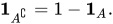
and the indicator function of the complement of i.e. is:

More generally, suppose is a collection of subsets of X. For any

is a product of 0s and 1s. This product has the value 1 at precisely those that belong to none of the sets and is 0 otherwise. That is

Expanding the product on the left hand side,

where is the cardinality of F. This is one form of the principle of inclusion-exclusion.

As suggested by the previous example, the indicator function is a useful notational device in combinatorics. The notation is used in other places as well, for instance in probability theory: if X is a probability space with probability measure and A is a measurable set, then becomes a random variable whose expected value is equal to the probability of A:

This identity is used in a simple proof of Markov's inequality.

In many cases, such as order theory, the inverse of the indicator function may be defined. This is commonly called the generalized Möbius function, as a generalization of the inverse of the indicator function in elementary number theory, the Möbius function. (See paragraph below about the use of the inverse in classical recursion theory.)

Mean, variance and covariance

[edit]

Given a probability space with the indicator random variable is defined by if otherwise

Mean
(also called "Fundamental Bridge").
Variance
Covariance

Characteristic function in recursion theory, Gödel's and Kleene's representing function

[edit]

Kurt Gödel described the representing function in his 1934 paper "On undecidable propositions of formal mathematical systems" (the symbol "¬" indicates logical inversion, i.e. "NOT"):[1]: 42 

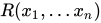
There shall correspond to each class or relation R a representing function if and if

Kleene offers up the same definition in the context of the primitive recursive functions as a function φ of a predicate P takes on values 0 if the predicate is true and 1 if the predicate is false.[2]

For example, because the product of characteristic functions whenever any one of the functions equals 0, it plays the role of logical OR: IF OR OR ... OR THEN their product is 0. What appears to the modern reader as the representing function's logical inversion, i.e. the representing function is 0 when the function R is "true" or satisfied", plays a useful role in Kleene's definition of the logical functions OR, AND, and IMPLY,[2]: 228  the bounded-[2]: 228  and unbounded-[2]: 279 ff  mu operators and the CASE function.[2]: 229 

Characteristic function in fuzzy set theory

[edit]

In classical mathematics, characteristic functions of sets only take values 1 (members) or 0 (non-members). In fuzzy set theory, characteristic functions are generalized to take value in the real unit interval [0, 1], or more generally, in some algebra or structure (usually required to be at least a poset or lattice). Such generalized characteristic functions are more usually called membership functions, and the corresponding "sets" are called fuzzy sets. Fuzzy sets model the gradual change in the membership degree seen in many real-world predicates like "tall", "warm", etc.

Smoothness

[edit]

In general, the indicator function of a set is not smooth; it is continuous if and only if its support is a connected component. In the algebraic geometry of finite fields, however, every affine variety admits a (Zariski) continuous indicator function.[3] Given a finite set of functions let be their vanishing locus. Then, the function acts as an indicator function for If then otherwise, for some we have which implies that hence

Although indicator functions are not smooth, they admit weak derivatives. For example, consider Heaviside step function The distributional derivative of the Heaviside step function is equal to the Dirac delta function, i.e. and similarly the distributional derivative of is

Thus the derivative of the Heaviside step function can be seen as the inward normal derivative at the boundary of the domain given by the positive half-line. In higher dimensions, the derivative naturally generalises to the inward normal derivative, while the Heaviside step function naturally generalises to the indicator function of some domain D. The surface of D will be denoted by S. Proceeding, it can be derived that the inward normal derivative of the indicator gives rise to a surface delta function, which can be indicated by : where n is the outward normal of the surface S. This 'surface delta function' has the following property:[4]

By setting the function f equal to one, it follows that the inward normal derivative of the indicator integrates to the numerical value of the surface area S.

See also

[edit]

Notes

[edit]

References

[edit]

Sources

[edit]
Revisions and contributorsEdit on WikipediaRead on Wikipedia
from Grokipedia
The indicator function, also known as the characteristic function in some mathematical contexts, of a AA of a set XX is a function 1A:X{0,1}\mathbf{1}_A: X \to \{0, 1\} (or more generally to R\mathbb{R}) that maps every element xAx \in A to 1 and every element xAx \notin A to 0. This binary-valued function serves as a foundational tool in various branches of mathematics, providing a precise way to encode membership in a set. In and combinatorics, indicator functions enable elegant computations of set cardinalities and intersections; for instance, the size of a set AUA \subseteq U is given by A=xU1A(x)|A| = \sum_{x \in U} \mathbf{1}_A(x), and the 1A1B=1AB\mathbf{1}_A \cdot \mathbf{1}_B = \mathbf{1}_{A \cap B} underpins the inclusion-exclusion principle for unions of sets. They are particularly useful in deriving formulas like Bonferroni inequalities and Jordan's identity for counting elements across multiple sets. In and measure theory, the indicator function 1A\mathbf{1}_A of an event AA in a becomes a , often denoted IAI_A, with expectation E[IA]=P(A)\mathbb{E}[I_A] = P(A), linking probabilities directly to integrals via . Properties such as 1AB=1A+1B1A1B\mathbf{1}_{A \cup B} = \mathbf{1}_A + \mathbf{1}_B - \mathbf{1}_A \cdot \mathbf{1}_B and 1Ac=11A\mathbf{1}_{A^c} = 1 - \mathbf{1}_A facilitate variance calculations, moment-generating functions, and approximations like the for sums of independent indicators, which model binomial distributions. These applications extend to advanced topics, including of indicator functions for convex sets and optimization problems involving 1\ell_1-norm minimization reformulated via indicator constraints.

Fundamentals

Definition

In , the indicator function of a AA of a XX is a function 1A:X{0,1}1_A: X \to \{0,1\} defined by 1A(x)={1if xA,0if xA.1_A(x) = \begin{cases} 1 & \text{if } x \in A, \\ 0 & \text{if } x \notin A. \end{cases} This binary-valued mapping directly encodes set membership, serving as the simplest non-constant function that distinguishes elements of AA from those outside it, thereby providing a foundational tool for representing in functional terms. The concept emerged in the 19th century, with an early explicit use by in his 1829 paper on the convergence of trigonometric series, where he introduced the as the indicator of the rational numbers within the reals to illustrate discontinuities in Fourier representations. It gained further prominence in early 20th-century integration theory, where it formed the basis for defining measurable functions and simple functions in the Lebesgue sense. The indicator function represents the canonical binary step function, taking a constant value of 1 on AA and 0 elsewhere, in contrast to more general step functions, which are finite linear combinations of such indicators over disjoint intervals.

Notation and Terminology

The indicator function of a subset AA of a set XX, which takes the value 1 if xAx \in A and 0 otherwise, is denoted in various ways across mathematical literature. In set theory, the notation χA(x)\chi_A(x) is standard, reflecting its role as the characteristic function that distinguishes membership in AA. This usage dates back to early 20th-century discussions of set-theoretic functions, such as the characteristic function of the rationals in analyses of Baire classes. In contrast, modern analysis and measure theory often employ 1A(x)1_A(x) or IA(x)I_A(x), emphasizing the function's binary output in integration and measurability contexts. A compact alternative notation, the Iverson bracket [P][P], assigns 1 to a PP if true and 0 if false, generalizing the indicator for logical conditions. For instance, the indicator for even integers can be written as [n0(mod2)][n \equiv 0 \pmod{2}], facilitating succinct expressions in sums and identities. Terminologically, "indicator function" predominates in contemporary , while "characteristic function" prevails in , especially in pre-1950s texts where it described membership without modern probabilistic connotations. In measure theory, 1A1_A is a field-specific preference for clarity in integral definitions, as seen in standard references. Researchers should note potential confusion with the unrelated "characteristic function" in , defined as ϕ(t)=E[eitX]\phi(t) = \mathbb{E}[e^{itX}] for a XX.

Properties

Basic Properties

The indicator function 1A1_A of a set AA in a XX evaluates to 1 if the argument xx belongs to AA and to otherwise, taking values exclusively in the set {[0](/page/0),1}\{[0](/page/0), 1\}. This binary nature reflects membership status directly. Furthermore, 1A(x)=11XA(x)1_A(x) = 1 - 1_{X \setminus A}(x) for all xXx \in X, linking the indicator to its complement set. The support of 1A1_A, defined as the set where the function is nonzero, coincides with AA, while it vanishes exactly on the complement XAX \setminus A. This localization property underscores the function's role in identifying set boundaries without additional structure. Logical operations on sets translate to arithmetic operations on their indicators. Specifically, for arbitrary sets AA and BB, 1AB(x)=1A(x)1B(x)1_{A \cap B}(x) = 1_A(x) \cdot 1_B(x) for all xx, since the product yields 1 only when both factors are 1. Similarly, 1AB(x)=1A(x)+1B(x)1A(x)1B(x),1_{A \cup B}(x) = 1_A(x) + 1_B(x) - 1_A(x) \cdot 1_B(x), which equals 1 if at least one input is in the respective set, accounting for overlap via subtraction of the intersection term; equivalently, it is max(1A(x),1B(x))\max(1_A(x), 1_B(x)). These equivalences hold pointwise and mirror Boolean logic for membership. The notation 1A1_A is standard, though χA\chi_A is sometimes used interchangeably. The indicator function exhibits under multiplication: (1A(x))2=1A(x)(1_A(x))^2 = 1_A(x) for all xx, as squaring preserves the values 0 and 1. This algebraic property aligns with the of set , AA=AA \cap A = A.

Arithmetic and Set Operations

The indicator function of the of two sets satisfies 1AB=1A1B1_{A \cap B} = 1_A \cdot 1_B , as the product equals 1 only when both indicators are 1, i.e., when the point lies in both sets. This multiplicative property holds for finite or infinite intersections, reflecting the logical AND operation in arithmetic form. For AiA_i, the indicator of their union is the sum of the indicators: 1Ai=1Ai1_{\cup A_i} = \sum 1_{A_i}, since the sets do not overlap and each point belongs to at most one AiA_i. This additivity extends to finite or countable disjoint unions and underpins the , where the measure of a set AA is μ(A)=1Adμ=xA1\mu(A) = \int 1_A \, d\mu = \sum_{x \in A} 1, equating integration to over points. The inclusion-exclusion principle for the indicator of a union, 1Ai=(1)k+11j=1kAij1_{\cup A_i} = \sum (-1)^{k+1} \sum 1_{\cap_{j=1}^k A_{i_j}} over intersections of kk sets, arises as a special case of on the power set lattice, where the μ(S,T)=(1)TS\mu(S, T) = (-1)^{|T \setminus S|} for STS \subseteq T inverts the zeta function to yield the exact union indicator. Indicator functions form a basis for the of simple functions in LpL^p spaces (1p<1 \leq p < \infty), as any simple function is a finite linear combination cj1Ej\sum c_j 1_{E_j} of indicators of measurable sets EjE_j with finite measure, spanning the dense subspace of step functions used in integration and approximation.

Applications in Probability and Statistics

Expectation, Variance, and Covariance

In probability theory, the indicator function 1A1_A for an event AA in a probability space serves as a simple random variable that takes the value 1 if AA occurs and 0 otherwise. Its expectation is precisely the probability of the event: E[1A]=P(A)\mathbb{E}[1_A] = P(A). This follows directly from the definition of expectation as E[1A]=1P(A)+0(1P(A))=P(A)\mathbb{E}[1_A] = 1 \cdot P(A) + 0 \cdot (1 - P(A)) = P(A). The variance of 1A1_A can be derived using the general formula Var(1A)=E[1A2](E[1A])2\mathrm{Var}(1_A) = \mathbb{E}[1_A^2] - (\mathbb{E}[1_A])^2. Since 1A2=1A1_A^2 = 1_A (as the indicator takes values in {0,1}), it holds that E[1A2]=E[1A]=P(A)\mathbb{E}[1_A^2] = \mathbb{E}[1_A] = P(A), yielding Var(1A)=P(A)[P(A)]2=P(A)(1P(A))\mathrm{Var}(1_A) = P(A) - [P(A)]^2 = P(A)(1 - P(A)). This expression highlights the indicator's Bernoulli-like behavior, with maximum variance at P(A)=1/2P(A) = 1/2. For two events AA and BB, the covariance between their indicators is Cov(1A,1B)=E[1A1B]E[1A]E[1B]\mathrm{Cov}(1_A, 1_B) = \mathbb{E}[1_A 1_B] - \mathbb{E}[1_A] \mathbb{E}[1_B]. Note that 1A1B=1AB1_A 1_B = 1_{A \cap B}, so E[1A1B]=P(AB)\mathbb{E}[1_A 1_B] = P(A \cap B), and thus Cov(1A,1B)=P(AB)P(A)P(B)\mathrm{Cov}(1_A, 1_B) = P(A \cap B) - P(A)P(B). This measures the dependence between events: if AA and BB are independent, then P(AB)=P(A)P(B)P(A \cap B) = P(A)P(B) and Cov(1A,1B)=0\mathrm{Cov}(1_A, 1_B) = 0, implying zero correlation ρ(1A,1B)=0\rho(1_A, 1_B) = 0. Conversely, if AA and BB are mutually exclusive (P(AB)=0P(A \cap B) = 0), the covariance is negative, P(A)P(B)-P(A)P(B), leading to negative correlation, as seen in problems like matching cards where fixed points exhibit repulsion. A key property is the linearity of expectation, which states that for any collection of events A1,,AnA_1, \dots, A_n (possibly dependent), E[i=1n1Ai]=i=1nE[1Ai]=i=1nP(Ai)\mathbb{E}\left[\sum_{i=1}^n 1_{A_i}\right] = \sum_{i=1}^n \mathbb{E}[1_{A_i}] = \sum_{i=1}^n P(A_i). This holds without requiring independence and is particularly useful for approximating inclusion-exclusion probabilities, such as bounding the probability of unions via the expected number of occurrences. For disjoint events, this aligns with basic additivity, where 1Ai=1Ai\sum 1_{A_i} = 1_{\cup A_i}.

Role in Indicator Random Variables

In probability theory, an indicator function serves as the foundation for defining indicator random variables, which model the occurrence of events in a probability space. Given a probability space (Ω,F,P)(\Omega, \mathcal{F}, P) and an event AFA \in \mathcal{F}, the indicator random variable IA:Ω{0,1}I_A: \Omega \to \{0, 1\} is defined by IA(ω)=1I_A(\omega) = 1 if ωA\omega \in A and IA(ω)=0I_A(\omega) = 0 otherwise, thereby capturing whether the event AA occurs for a given sample point ω\omega. This construction allows indicator random variables to represent binary outcomes in stochastic models, such as success or failure in trials. The distribution of an indicator random variable IAI_A is Bernoulli with parameter p=P(A)p = P(A), denoted IABern(p)I_A \sim \operatorname{Bern}(p). The probability mass function is given by P(IA=1)=p,P(IA=0)=1p,P(I_A = 1) = p, \quad P(I_A = 0) = 1 - p, reflecting the probability of the event occurring or not. This Bernoulli structure underscores the role of indicator functions in modeling rare or binary events, where the expected value E[IA]=pE[I_A] = p directly equals the event probability. Indicator random variables are central to the Poisson paradigm, which approximates the distribution of the sum of many rare, weakly dependent indicators by a . If X=i=1nIAiX = \sum_{i=1}^n I_{A_i} where the events AiA_i have small probabilities pi=P(Ai)p_i = P(A_i) and limited dependence, then XPoisson(μ)X \approx \operatorname{Poisson}(\mu) with μ=pi=E[X]\mu = \sum p_i = E[X], providing a useful approximation for counting rare events like defects or mutations. This paradigm extends the classical binomial-to-Poisson limit by handling dependence through bounds on total variation distance. Stein's method enhances these approximations by quantifying the error in Poisson approximations for sums of indicators, even under dependence. The Stein-Chen approach provides explicit bounds on the total variation distance, enabling precise error control in applications like reliability analysis or network traffic modeling. In stochastic processes, sums of indicator random variables define counting processes that track event occurrences over time. For a renewal process, the counting process N(t)N(t) counts the number of renewals up to time tt and can be expressed as N(t)=n=1I{Snt}N(t) = \sum_{n=1}^\infty I_{\{S_n \leq t\}}, where Sn=X1++XnS_n = X_1 + \cdots + X_n are the partial sums of independent, positive interarrival times XiX_i. This representation facilitates analysis in renewal theory, such as deriving the renewal function m(t)=E[N(t)]=n=1P(Snt)m(t) = E[N(t)] = \sum_{n=1}^\infty P(S_n \leq t), which quantifies long-run behavior like the expected number of system repairs.

Specialized Uses in Mathematics

In Recursion Theory and Logic

In the 1930s, amid David Hilbert's program to formalize mathematics and prove the consistency of axiomatic systems using finitary methods, foundational work in recursion theory by Kurt Gödel, Alonzo Church, Stephen Kleene, and Alan Turing revealed profound limits on computability and provability. This era's developments, including Gödel's incompleteness theorems (1931) and Turing's analysis of the halting problem (1936), demonstrated undecidability results that relied on precise encodings and decision predicates, where indicator functions served as binary classifiers for computational and logical properties. These contributions shifted focus from Hilbert's optimism toward understanding the boundaries of effective procedures in logic. In recursion theory, characteristic functions play a central role in defining recursive sets and linking to undecidability. A set ANA \subseteq \mathbb{N} is recursive if and only if its characteristic function χA\chi_A, defined by χA(x)=1\chi_A(x) = 1 if xAx \in A and 00 otherwise, is a total recursive function. For the diagonal halting set K={eϕe(e)}K = \{ e \mid \phi_e(e) \downarrow \}, where ϕe\phi_e is the ee-th partial recursive function and \downarrow denotes convergence (halting), the characteristic function χK\chi_K is not recursive, as proven by Turing's diagonalization argument showing no algorithm can decide membership in KK for all ee. This non-recursiveness directly establishes the undecidability of the halting problem, highlighting how indicator functions capture the binary nature of termination but fail to be computable in general cases. Gödel's β-function further illustrates the use of indicator-like structures in logical encodings. Defined as β(c,a,i)=rem(c,1+a(i+1))\beta(c, a, i) = \text{rem}(c, 1 + a(i+1)), where rem\text{rem} is the remainder function and aa is a sequence of natural numbers greater than 1, the β-function encodes finite sequences n0,n1,,nk\langle n_0, n_1, \dots, n_k \rangle into a single natural number cc via the Chinese Remainder Theorem, ensuring unique decodability. In Gödel's incompleteness proofs, this encoding arithmetizes syntax, enabling the definition of the provability predicate Prov(y)\operatorname{Prov}(y), which acts as an indicator: Prov(y)\operatorname{Prov}(y) holds (true) if yy is the Gödel number of a provable formula in the system, and false otherwise, formalized as xPrf(x,y)\exists x \, \operatorname{Prf}(x, y) where Prf(x,y)\operatorname{Prf}(x, y) indicates xx codes a proof of yy. Such predicates were crucial for showing that no consistent formal system can prove all truths about arithmetic, tying indicator mechanisms to undecidability. Kleene's T-predicate extends this framework to partial recursive functions, providing a primitive recursive relation that flags definedness. The Normal Form Theorem states there exists a primitive recursive predicate T(e,x,y)T(e, \mathbf{x}, y) such that ϕe(x)=z\phi_e(\mathbf{x}) \downarrow = z if and only if T(e,x,y)T(e, \mathbf{x}, y) holds for some yy (coding a computation sequence) and a primitive recursive function U(y)=zU(y) = z extracts the output. Here, TT functions as an indicator for whether ϕe(x)\phi_e(\mathbf{x}) is defined, with the existential quantifier yT(e,x,y)\exists y \, T(e, \mathbf{x}, y) marking the domain of ϕe\phi_e; if no such yy exists, the function diverges (undefined). Introduced in Kleene's 1938 work, this representation unifies partial recursiveness and underscores undecidability, as the halting predicate derived from TT mirrors the non-recursive nature of χK\chi_K.

In Fuzzy Set Theory

In fuzzy set theory, the classical indicator function of a crisp set, which assigns binary values of 0 or 1 to elements based on membership, serves as a special case of the more general membership function μA:X[0,1]\mu_A: X \to [0,1], where μA(x)=1A(x)\mu_A(x) = 1_A(x) for all xXx \in X. This extension allows for degrees of membership that reflect partial belonging, accommodating vagueness and uncertainty inherent in natural language and real-world phenomena. Lotfi A. Zadeh introduced fuzzy sets in 1965 as a generalization of classical set theory, replacing the binary characteristic (indicator) function with a continuous membership function that maps elements to the unit interval [0,1], thereby enabling the representation of imprecise concepts. This framework unifies and extends traditional indicators by treating crisp sets as fuzzy sets where membership is either fully 0 or 1, while allowing intermediate values for fuzzy sets to model gradations of belonging. Fuzzy set operations build on these membership functions, adapting classical set theory to handle partial memberships. The intersection of two fuzzy sets AA and BB is commonly defined using the minimum: μAB(x)=min(μA(x),μB(x))\mu_{A \cap B}(x) = \min(\mu_A(x), \mu_B(x)), though the algebraic product μA(x)μB(x)\mu_A(x) \cdot \mu_B(x) is also used as a t-norm alternative for probabilistic interpretations. The union is defined via the maximum: μAB(x)=max(μA(x),μB(x))\mu_{A \cup B}(x) = \max(\mu_A(x), \mu_B(x)), or the probabilistic sum μA(x)+μB(x)μA(x)μB(x)\mu_A(x) + \mu_B(x) - \mu_A(x) \cdot \mu_B(x) to avoid overcounting overlap. The complement of a fuzzy set AA is given by μA(x)=1μA(x)\mu_{\overline{A}}(x) = 1 - \mu_A(x), preserving the duality with crisp complements while allowing graded negation. These operations, rooted in Zadeh's min-max definitions, form the basis for fuzzy logic and have been extended through t-norm and t-conorm families for broader applicability. Early applications of fuzzy sets, leveraging these generalized indicators, emerged in pattern recognition for classifying ambiguous data patterns and in control theory for managing nonlinear systems with imprecise inputs, such as fuzzy controllers in industrial processes. Zadeh's work highlighted potential in pattern discrimination and information processing, paving the way for subsequent developments in decision systems.

Extensions and Approximations

Smooth Approximations

The indicator function 1A1_A of a set ARnA \subseteq \mathbb{R}^n is discontinuous along the boundary A\partial A, rendering it non-differentiable and unsuitable for settings requiring smooth functions, such as the classical theory of where coefficients or initial data must possess sufficient regularity for existence and uniqueness results via methods like or . Similarly, in optimization problems, the non-smoothness of indicators complicates the computation of gradients or subgradients, hindering the application of efficient algorithms like or . Smooth approximations address these issues by replacing 1A1_A with CC^\infty functions that converge to it pointwise or in appropriate norms as a smoothness parameter tends to zero, enabling analytical tractability and numerical stability while preserving essential properties like the integral value 1A=A\int 1_A = |A|. A primary method for obtaining smooth approximations involves mollification, where the indicator 1A1_A is convolved with a smooth mollifier kernel ϕϵ(x)=ϵnϕ(x/ϵ)\phi_\epsilon(x) = \epsilon^{-n} \phi(x/\epsilon). Here, ϕCc(Rn)\phi \in C_c^\infty(\mathbb{R}^n) is a standard mollifier satisfying Rnϕ(x)dx=1\int_{\mathbb{R}^n} \phi(x) \, dx = 1, ϕ(x)0\phi(x) \geq 0, and supp(ϕ)B(0,1)\operatorname{supp}(\phi) \subseteq B(0,1), with ϵ>0\epsilon > 0 controlling the scale of smoothing. The resulting approximation is uϵ(x)=(1Aϕϵ)(x)=Rn1A(y)ϕϵ(xy)dy=AB(x,ϵ)ϕϵ(xy)dyu_\epsilon(x) = (1_A * \phi_\epsilon)(x) = \int_{\mathbb{R}^n} 1_A(y) \phi_\epsilon(x - y) \, dy = \int_{A \cap B(x,\epsilon)} \phi_\epsilon(x - y) \, dy, which is CC^\infty and satisfies 0uϵ(x)10 \leq u_\epsilon(x) \leq 1. As ϵ0+\epsilon \to 0^+, uϵ1Au_\epsilon \to 1_A pointwise , and in the L1(Rn)L^1(\mathbb{R}^n) norm for Lebesgue measurable AA with finite measure, by the density of continuous compactly supported functions in L1L^1 and properties of approximate identities. This convergence extends to LpL^p norms for 1p<1 \leq p < \infty when A<|A| < \infty, with explicit error estimates like uϵ1ALpCϵ1/pA\|u_\epsilon - 1_A\|_{L^p} \leq C \epsilon^{1/p} |\partial A| near the boundary, where CC depends on ϕ\phi and pp. Explicit closed-form constructions often employ sigmoid or hyperbolic tangent functions to approximate the Heaviside step function H(t)=1(0,)(t)H(t) = 1_{(0,\infty)}(t), which generates indicators for half-spaces; indicators for general sets can then be built via combinations. A common sigmoid approximation is Sk(t)=11+ektS_k(t) = \frac{1}{1 + e^{-k t}} for large k>0k > 0, satisfying Sk(t)H(t)S_k(t) \to H(t) pointwise as kk \to \infty, with Sk(t)=kSk(t)(1Sk(t))S_k'(t) = k S_k(t) (1 - S_k(t)) providing a smooth transition zone of width O(1/k)O(1/k). For the indicator of an interval [a,b][a, b] in one dimension, a product form 1[a,b]k(x)Sk(xa)(1Sk(xb))1_{[a,b]}^k(x) \approx S_k(x - a) (1 - S_k(x - b)) yields a CC^\infty approximation converging uniformly on compact sets away from {a,b}\{a, b\}. Alternatively, using the hyperbolic tangent, 1+tanh(k(xc))2\frac{1 + \tanh(k (x - c))}{2} approximates H(xc)H(x - c) with similar properties, as tanh(z)=2S2k(z)1\tanh(z) = 2 S_{2k}(z) - 1 relates directly to the logistic sigmoid; convergence follows from the monotone convergence theorem, with uniform rates on compacts given by Sk(t)H(t)ekt+O(logk)|S_k(t) - H(t)| \leq e^{-k |t| + O(\log k)} for tδ>0|t| \geq \delta > 0. Convergence theorems for these approximations are well-established in . For mollifiers, if AA has a smooth boundary, uϵu_\epsilon converges to 1A1_A uniformly on compact subsets of RnA\mathbb{R}^n \setminus \partial A, and in Sobolev spaces Ws,p(Rn)W^{s,p}(\mathbb{R}^n) for s<11/ps < 1 - 1/p (with p1p \geq 1), the ensures higher regularity of uϵu_\epsilon while controlling the by the Minkowski content of A\partial A. Sigmoid-based approximations exhibit analogous behavior: for the Heaviside, SkHS_k \to H in the sense of distributions, and for bounded variation functions involving indicators, the SkBVHBV=1\|S_k\|_{BV} \to \|H\|_{BV} = 1 as kk \to \infty, facilitating applications in . These results underpin the use of smooth indicators in numerical schemes for PDEs, such as level-set methods, where the approximation is adaptively chosen to balance accuracy and computational cost.

Generalizations to Measures and Beyond

In measure theory, simple functions are defined as finite linear combinations of indicator functions over measurable sets, typically expressed as ϕ=i=1nai1Ai\phi = \sum_{i=1}^n a_i \mathbf{1}_{A_i}, where each AiA_i is a measurable set with finite measure and aiRa_i \in \mathbb{R}. These functions form a dense subspace in the Lp(μ)L^p(\mu) spaces for 1p<1 \leq p < \infty on a σ\sigma-finite measure space (Ω,F,μ)(\Omega, \mathcal{F}, \mu), meaning any fLp(μ)f \in L^p(\mu) can be approximated arbitrarily closely in the LpL^p norm by simple functions. This density property is crucial for extending integrals and establishing completeness of LpL^p spaces. The Lebesgue integral is initially defined for nonnegative simple functions as ϕdμ=i=1naiμ(Ai)\int \phi \, d\mu = \sum_{i=1}^n a_i \mu(A_i), providing a foundational step for integrating more general s. For a nonnegative ff, the integral is then constructed as the supremum of integrals over simple functions ϕf\phi \leq f, ensuring the Lebesgue coincides with the Riemann where the latter exists and extends naturally to abstract measure spaces. This approach underpins the theory of integration with respect to arbitrary measures, enabling the handling of functions that are not Riemann-integrable, such as the . Beyond measure theory, indicator functions generalize to abstract categorical settings, particularly in topos theory, where the subobject classifier Ω\Omega serves an analogous role to the power object of sets. In an elementary , for any object XX and SXS \hookrightarrow X, there exists a unique characteristic χS:XΩ\chi_S: X \to \Omega that "indicates" membership in SS, generalizing the classical indicator function and enabling internal logic within the category. In topology, indicator functions of clopen sets—subsets that are both open and closed—are precisely the continuous functions valued in {0,1}\{0,1\}, facilitating the study of disconnected spaces and measures on compact Hausdorff spaces. In modern applications, indicator functions appear in optimal transport theory, where they define constraints for transport plans in the Kantorovich formulation of the Wasserstein distance, measuring discrepancies between probability measures via minimal cost couplings. Similarly, in , the 0-1 loss function, defined as L(y,t)=1{yt}L(y, t) = \mathbf{1}_{\{y \neq t\}} for predicted label yy and true label tt, quantifies errors but is often surrogated by convex losses due to its non-differentiability.

References

Add your contribution
Related Hubs
Contribute something
User Avatar
No comments yet.