Hubbry Logo
Measure spaceMeasure spaceMain
Open search
Measure space
Community hub
Measure space
logo
7 pages, 0 posts
0 subscribers
Be the first to start a discussion here.
Measure space
Measure space
from Wikipedia

A measure space is a basic object of measure theory, a branch of mathematics that studies generalized notions of volumes. It contains an underlying set, the subsets of this set that are feasible for measuring (the σ-algebra), and the method that is used for measuring (the measure). One important example of a measure space is a probability space.

A measurable space consists of the first two components without a specific measure.

Definition

[edit]

A measure space is a triple where[1][2]

  • is a set
  • is a σ-algebra on the set
  • is a measure on
  • must satisfy countable additivity. That is, if are pair-wise disjoint then

In other words, a measure space consists of a measurable space together with a measure on it.

Example

[edit]

Set . The -algebra on finite sets such as the one above is usually the power set, which is the set of all subsets (of a given set) and is denoted by Sticking with this convention, we set

In this simple case, the power set can be written down explicitly:

As the measure, define by so (by additivity of measures) and (by definition of measures).

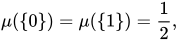
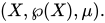
This leads to the measure space It is a probability space, since The measure corresponds to the Bernoulli distribution with which is for example used to model a fair coin flip.
Important classes of measure spaces

[edit]

Most important classes of measure spaces are defined by the properties of their associated measures. This includes, in order of increasing generality:

Another class of measure spaces are the complete measure spaces.[4]

References

[edit]
Revisions and contributorsEdit on WikipediaRead on Wikipedia
from Grokipedia
A measure space is a triple (X,A,μ)(X, \mathcal{A}, \mu) consisting of a set XX, a σ\sigma-algebra A\mathcal{A} of subsets of XX, and a measure μ:A[0,]\mu: \mathcal{A} \to [0, \infty] that is countably additive and satisfies μ()=0\mu(\emptyset) = 0. In this structure, the σ\sigma-algebra A\mathcal{A} provides the collection of measurable sets, which is closed under complements and countable unions, ensuring that the space supports rigorous definitions of size and integration. The measure μ\mu generalizes notions like , area, or by assigning a non-negative value (possibly infinite) to each measurable set, with countable additivity guaranteeing that the measure of a countable equals the sum of the individual measures. Measure spaces form the foundation of modern analysis and probability, enabling the construction of over abstract sets beyond Euclidean spaces, such as the Lebesgue . Key properties include monotonicity (if ABA \subseteq B, then μ(A)μ(B)\mu(A) \leq \mu(B)) and countable , which follow from the axioms and facilitate theorems like the Carathéodory extension for constructing measures from outer measures. A special case is the , where μ(X)=1\mu(X) = 1, linking measure theory directly to stochastic processes and statistical modeling. Examples range from the on Rn\mathbb{R}^n, which assigns volumes to Borel sets, to Dirac measures concentrating mass at a single point. Measures may also be σ\sigma-finite, meaning XX is a countable union of sets of finite measure, a condition essential for results like the existence of product measures.

Definition and Components

Core Elements

A measure space begins with a sample space [X](/page/Samplespace)[X](/page/Sample_space), which is an arbitrary non-empty set serving as the universe of possible outcomes or events under consideration. This set encapsulates all elements relevant to the measurement process, providing the foundational domain upon which more structured components are built. Central to the structure is a σ\sigma-algebra (or sigma-algebra) Σ\Sigma defined on XX, which is a collection of subsets of XX known as the measurable sets. Formally, Σ\Sigma must include the empty set \emptyset and the full set XX itself, and it is closed under complements: if AΣA \in \Sigma, then XAΣX \setminus A \in \Sigma. Additionally, Σ\Sigma is closed under countable unions and countable intersections: for any countable collection {An}n=1Σ\{A_n\}_{n=1}^\infty \subseteq \Sigma, the union n=1AnΣ\bigcup_{n=1}^\infty A_n \in \Sigma and the intersection n=1AnΣ\bigcap_{n=1}^\infty A_n \in \Sigma. This closure ensures that the measurable sets form a robust algebra capable of handling limits and infinite operations, establishing Σ\Sigma as the prerequisite framework for applying any measure before quantifying sizes or probabilities. The measure itself, denoted μ\mu, is a function μ:Σ[0,]\mu: \Sigma \to [0, \infty] that assigns a non-negative extended real number to each measurable set, quantifying its "size" in a consistent manner. A key property is countable additivity: for any countable collection of pairwise disjoint sets {An}n=1Σ\{A_n\}_{n=1}^\infty \subseteq \Sigma (meaning AiAj=A_i \cap A_j = \emptyset for iji \neq j), μ(n=1An)=n=1μ(An)\mu\left( \bigcup_{n=1}^\infty A_n \right) = \sum_{n=1}^\infty \mu(A_n), with the additional requirement that μ()=0\mu(\emptyset) = 0. This additivity extends the intuitive notion of length or volume to abstract settings, as seen later in examples like the Lebesgue measure on the real line.

Formal Definition

A measure space is formally defined as a triple (X,Σ,μ)(X, \Sigma, \mu), where XX is an arbitrary set, Σ\Sigma is a σ\sigma-algebra of subsets of XX, and μ:Σ[0,]\mu: \Sigma \to [0, \infty] is a measure on Σ\Sigma. The σ\sigma-algebra Σ\Sigma ensures that the collection of measurable sets is closed under complementation and countable unions, providing a structure suitable for defining limits and integrals. Some texts employ alternative notations, such as M\mathcal{M} for the σ\sigma-algebra, to distinguish it from other collections in the context. The measure μ\mu satisfies three key axioms: non-negativity, which is encoded in its of extended non-negative real numbers allowing for infinite values; null-empty set property, μ()=0\mu(\emptyset) = 0; and countable additivity, which states that for any countable collection of pairwise {An}n=1Σ\{A_n\}_{n=1}^\infty \subset \Sigma, μ(n=1An)=n=1μ(An).\mu\left( \bigcup_{n=1}^\infty A_n \right) = \sum_{n=1}^\infty \mu(A_n). This additivity axiom extends finite additivity to countable collections and handles cases where the sum may diverge to \infty. The allowance for infinite measures accommodates spaces of unbounded , such as the on R\mathbb{R}, without restricting to finite total measure. This formal framework originated in the work of , who introduced measure theory in his doctoral dissertation to develop a robust theory of integration beyond the .

Examples

Discrete Cases

In discrete measure spaces, the sample space is a , and the σ-algebra is often the power set of that set, allowing straightforward measurability for all subsets. These spaces highlight the basic principles of measures through simple additive structures on finite or countably infinite domains. A canonical example is the counting measure on the natural numbers X=NX = \mathbb{N}, equipped with the σ-algebra Σ=P(N)\Sigma = \mathcal{P}(\mathbb{N}), the power set of N\mathbb{N}. The measure μ\mu is defined such that for any subset ANA \subseteq \mathbb{N}, μ(A)=A\mu(A) = |A| (the cardinality of AA) if AA is finite, and μ(A)=\mu(A) = \infty otherwise. This construction satisfies countable additivity: for any countable collection of disjoint subsets {An}n=1Σ\{A_n\}_{n=1}^\infty \subseteq \Sigma, μ(n=1An)=n=1μ(An)\mu\left( \bigcup_{n=1}^\infty A_n \right) = \sum_{n=1}^\infty \mu(A_n), where the sum is understood in the extended reals and may equal infinity. For instance, consider the disjoint singletons {1}\{1\} and {2}\{2\}; then μ({1,2})=μ({1})+μ({2})=1+1=2\mu(\{1,2\}) = \mu(\{1\}) + \mu(\{2\}) = 1 + 1 = 2. The counting measure is σ-finite on countable sets like N\mathbb{N}, as N\mathbb{N} can be covered by the countable union of finite sets {1},{1,2},{1,2,3},\{1\}, \{1,2\}, \{1,2,3\}, \dots, each of finite measure. The provides another discrete example, defined on a XX with Σ=P(X)\Sigma = \mathcal{P}(X). For a fixed point xXx \in X, the measure δx\delta_x assigns δx(A)=1\delta_x(A) = 1 if xAx \in A and δx(A)=0\delta_x(A) = 0 otherwise, for any AXA \subseteq X. This measure is finitely additive and, being zero on disjoint sets not containing xx, extends to countable additivity; it totals 1 over XX, making it a . The isolates the "mass" at a single point, useful for point evaluations in integration over discrete spaces. Finite discrete spaces often model uniform probability distributions, such as a flip. Here, the is X={H,T}X = \{H, T\} (heads and tails), with Σ=P(X)\Sigma = \mathcal{P}(X), and the measure μ\mu defined by μ({H})=μ({T})=12\mu(\{H\}) = \mu(\{T\}) = \frac{1}{2}. This setup demonstrates additivity: μ(X)=μ({H})+μ({T})=12+12=1\mu(X) = \mu(\{H\}) + \mu(\{T\}) = \frac{1}{2} + \frac{1}{2} = 1, and all subsets are measurable with measures adding appropriately for disjoint unions. Such examples underpin discrete probability models where outcomes are equally likely.

Continuous Cases

A prominent example of a continuous measure space is the real line R\mathbb{R} equipped with the μ\mu, defined on the Lebesgue σ\sigma-algebra Σ\Sigma, which is the completion of the Borel σ\sigma-algebra generated by the open sets in R\mathbb{R}. The assigns to each closed interval [a,b][a, b] the value μ([a,b])=ba\mu([a, b]) = b - a, extending this assignment via the Carathéodory criterion to all measurable sets. This measure is translation-invariant, meaning μ(E+x)=μ(E)\mu(E + x) = \mu(E) for any measurable set ERE \subseteq \mathbb{R} and xRx \in \mathbb{R}, and non-atomic, as singletons {x}\{x\} have measure zero, ensuring that the measure is diffuse across the continuum rather than concentrated on points. A specific instance is the unit interval [0,1][0, 1] with the restricted , where the total measure is μ([0,1])=1\mu([0, 1]) = 1, serving as a foundational for Lebesgue integration of functions over continuous domains. More generally, Haar measures provide examples of continuous measures on locally compact topological groups, where the on R\mathbb{R} under addition exemplifies a left-invariant , normalized such that compact sets receive finite measure while preserving invariance under group translations.

Properties

Fundamental Properties

In a measure space (X,Σ,μ)(X, \Sigma, \mu), where μ\mu is a measure on the σ\sigma-algebra Σ\Sigma, the axioms of non-negativity and countable additivity imply several fundamental properties that govern the behavior of μ\mu. Monotonicity states that if A,BΣA, B \in \Sigma and ABA \subseteq B, then μ(A)μ(B)\mu(A) \leq \mu(B). To see this, decompose BB into the disjoint union B=A(BA)B = A \cup (B \setminus A). By countable additivity, μ(B)=μ(A)+μ(BA)\mu(B) = \mu(A) + \mu(B \setminus A). Since μ(BA)0\mu(B \setminus A) \geq 0 by non-negativity, it follows that μ(B)μ(A)\mu(B) \geq \mu(A). Countable subadditivity asserts that for any countable collection {An}n=1Σ\{A_n\}_{n=1}^\infty \subseteq \Sigma, μ(n=1An)n=1μ(An)\mu\left(\bigcup_{n=1}^\infty A_n\right) \leq \sum_{n=1}^\infty \mu(A_n). This follows from expressing the union as a disjoint union via the disjointization process and applying countable additivity, combined with monotonicity. Finite additivity is a direct corollary of countable additivity: for any finite collection of pairwise disjoint sets {Ak}k=1nΣ\{A_k\}_{k=1}^n \subseteq \Sigma, μ(k=1nAk)=k=1nμ(Ak)\mu\left(\bigcup_{k=1}^n A_k\right) = \sum_{k=1}^n \mu(A_k). This holds by setting Ak=A_k = \emptyset for k>nk > n in the countable additivity axiom, yielding the finite sum. Continuity from below provides that if {An}n=1Σ\{A_n\}_{n=1}^\infty \subseteq \Sigma is an increasing sequence (i.e., AnAA_n \uparrow A for some AΣA \in \Sigma), then μ(An)μ(A)\mu(A_n) \uparrow \mu(A). Decompose the union A=n=1AnA = \bigcup_{n=1}^\infty A_n into disjoint differences B1=A1B_1 = A_1 and Bn=AnAn1B_n = A_n \setminus A_{n-1} for n2n \geq 2; countable additivity then gives μ(A)=n=1μ(Bn)=limNn=1Nμ(Bn)=limNμ(AN)\mu(A) = \sum_{n=1}^\infty \mu(B_n) = \lim_{N \to \infty} \sum_{n=1}^N \mu(B_n) = \lim_{N \to \infty} \mu(A_N). For continuity from above, suppose {An}n=1Σ\{A_n\}_{n=1}^\infty \subseteq \Sigma is decreasing (i.e., AnAA_n \downarrow A for some AΣA \in \Sigma) and μ(A1)<\mu(A_1) < \infty. Then μ(An)μ(A)\mu(A_n) \downarrow \mu(A). This follows by applying continuity from below to the complements relative to A1A_1, using the finite measure assumption to ensure the relevant sets remain of finite measure.

Completeness and Extensions

A measure space (X,Σ,μ)(X, \Sigma, \mu) is called complete if every subset of a is measurable, where a is any EΣE \in \Sigma with μ(E)=0\mu(E) = 0, and such subsets automatically have measure zero as well. This property ensures that the sigma-algebra Σ\Sigma is closed under taking subsets of negligible sets, preventing "pathological" non-measurable subsets from arising within . The completion of a measure space (X,Σ,μ)(X, \Sigma, \mu) addresses incompleteness by extending the sigma-algebra to include all subsets of null sets while preserving the original measure on Σ\Sigma. Specifically, the completed sigma-algebra Σˉ\bar{\Sigma} consists of all sets EXE \subseteq X such that there exist A1,A2ΣA_1, A_2 \in \Sigma with A1EA2A_1 \subseteq E \subseteq A_2 and μ(A2A1)=0\mu(A_2 \setminus A_1) = 0, and the extended measure μˉ\bar{\mu} is defined by μˉ(E)=μ(A1)\bar{\mu}(E) = \mu(A_1). Null sets play a central role here, as the completion incorporates their subsets into Σˉ\bar{\Sigma} without altering μˉ\bar{\mu} on the original Σ\Sigma, ensuring μˉΣ=μ\bar{\mu}|_{\Sigma} = \mu. The resulting space (X,Σˉ,μˉ)(X, \bar{\Sigma}, \bar{\mu}) is complete and is the smallest such extension containing Σ\Sigma. For example, the on R\mathbb{R} is complete, meaning every subset of a Lebesgue is Lebesgue measurable. In contrast, the , which is the Lebesgue measure restricted to the Borel sigma-algebra, is not complete, as there exist subsets of Borel (such as certain subsets of the ) that are not Borel measurable. The completion of a measure space is unique up to , particularly when μ\mu is sigma-finite, making it the canonical way to achieve completeness without introducing ambiguities in the extension. This uniqueness follows from the as the minimal complete extension, ensuring that any two completions agree on the original sigma-algebra and null sets.

Important Classes

Probability Spaces

A probability space is a measure space (X,Σ,μ)(X, \Sigma, \mu) in which the measure μ\mu satisfies μ(X)=1\mu(X) = 1, and thus μ\mu is referred to as a . This structure provides the foundational framework for modeling uncertainty in through measure-theoretic tools. The concept emerged from Andrey Kolmogorov's 1933 axiomatization, which unified probability with measure theory by treating probabilities as measures on event spaces. In a probability space, the total measure is finite, specifically equal to 1, ensuring that all subset measures μ(A)\mu(A) for AΣA \in \Sigma lie between 0 and 1. Measurable sets in Σ\Sigma correspond to events, with μ(A)\mu(A) denoting the probability P(A)P(A) of event AA. Integration with respect to the probability measure μ\mu defines the expectation of a measurable function f:X[0,]f: X \to [0, \infty] as E=Xfdμ\mathbb{E} = \int_X f \, d\mu, linking measure-theoretic integration directly to probabilistic averages. A canonical example is the uniform on the unit interval [0,1][0,1], where X=[0,1]X = [0,1], Σ\Sigma is the σ\sigma-algebra of Lebesgue measurable sets, and μ\mu is the restricted to Σ\Sigma, which already satisfies μ([0,1])=1\mu([0,1]) = 1. This space models continuous uniform randomness, such as selecting a point uniformly at random from [0,1][0,1].

Sigma-Finite Spaces

A measure space (X,M,μ)(X, \mathcal{M}, \mu) is called σ\sigma-finite if the underlying set XX can be expressed as a countable union X=n=1XnX = \bigcup_{n=1}^\infty X_n, where each XnX_n is a measurable set with finite measure, i.e., μ(Xn)<\mu(X_n) < \infty for all nNn \in \mathbb{N}. This decomposition allows the space to be approximated by finite-measure subspaces, facilitating the extension of results from finite to infinite settings while preserving key behaviors of countable additivity. In σ\sigma-finite spaces, integration and limit operations can be handled by restricting to the finite-measure components and taking limits, which ensures that measurable functions and their integrals align well with the overall structure. For instance, every finite measure space is σ\sigma-finite, as XX itself serves as the single set of finite measure, and every measure space on a equipped with the is σ\sigma-finite, since XX decomposes into singletons each of measure 1. A classic example of a σ\sigma-finite measure space is the on [R](/page/R)\mathbb{[R](/page/R)}, where [R](/page/R)=n=1[n,n]\mathbb{[R](/page/R)} = \bigcup_{n=1}^\infty [-n, n] and each interval [n,n][-n, n] has finite 2n<2n < \infty. In contrast, the on an , such as the power set of [R](/page/R)\mathbb{[R](/page/R)}, is not σ\sigma-finite, because any set of finite measure must be finite (hence countable), and an uncountable union of finite sets cannot cover [R](/page/R)\mathbb{[R](/page/R)}. The σ\sigma-finiteness condition is crucial for many advanced results in measure theory, serving as a prerequisite for theorems like Fubini-Tonelli, which equate iterated and double integrals over product spaces only when both measures are σ\sigma-finite. Without it, non-σ\sigma-finite spaces can exhibit pathologies, such as ill-behaved product measures or failures in the Radon-Nikodym theorem, underscoring its role in ensuring robust theoretical frameworks.

Standard Measure Spaces

In measure theory, a Borel measure space is constructed from a topological space (X,τ)(X, \tau), where the σ\sigma-algebra Σ\Sigma is the Borel σ\sigma-algebra B(X)\mathcal{B}(X) generated by the open sets in τ\tau, and the measure μ:B(X)[0,]\mu: \mathcal{B}(X) \to [0, \infty] is defined on this σ\sigma-algebra. Such spaces arise naturally in when extending measures from open or closed sets to the full Borel structure, ensuring compatibility with the . Borel measures on these spaces are particularly useful for integrating continuous functions and studying convergence properties in topological settings. A key class consists of standard measure spaces, which are measure spaces whose underlying measurable space is a —that is, a measurable space (X,E)(X, \mathcal{E}) isomorphic to a (a separable complete metric space) equipped with its Borel σ\sigma-algebra—endowed with a σ\sigma-finite measure μ\mu. These spaces play a central role in descriptive set theory and ergodic theory due to their countable generation and separability, allowing uniform treatment of measurable structures across different Polish topologies. A canonical example is the Euclidean space Rn\mathbb{R}^n with the Borel σ\sigma-algebra generated by the standard topology and the Lebesgue-Borel measure, which assigns to each Borel set its Lebesgue measure (as defined in continuous cases). Under suitable conditions, such as on metric spaces, Borel measures exhibit regularity: for every EE, the measure μ(E)\mu(E) can be approximated from below by the measures of compact subsets of EE (inner regularity) and from above by the measures of open supersets of EE (outer regularity). Finite Borel measures on Polish spaces are always regular in this sense. In , standard measure spaces underpin many processes, as they admit complete probability measures that facilitate the construction of random variables with desirable measurability properties.

References

Add your contribution
Related Hubs
User Avatar
No comments yet.