
Recent from talks
Universal coefficient theorem
Knowledge base stats:
Talk channels stats:
Members stats:
Universal coefficient theorem
In algebraic topology, universal coefficient theorems establish relationships between homology groups (or cohomology groups) with different coefficients. For instance, for every topological space X, its integral homology groups:
completely determine its homology groups with coefficients in A, for any abelian group A:
Here might be the simplicial homology, or more generally the singular homology. The usual proof of this result is a pure piece of homological algebra about chain complexes of free abelian groups. The form of the result is that other coefficients A may be used, at the cost of using a Tor functor.

For example, it is common to take to be , so that coefficients are modulo 2. This becomes straightforward in the absence of 2-torsion in the homology. Quite generally, the result indicates the relationship that holds between the Betti numbers of and the Betti numbers with coefficients in a field . These can differ, but only when the characteristic of is a prime number for which there is some -torsion in the homology.


Consider the tensor product of modules . The theorem states there is a short exact sequence involving the Tor functor
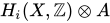
Furthermore, this sequence splits, though not naturally. Here is the map induced by the bilinear map .


If the coefficient ring is , this is a special case of the Bockstein spectral sequence.

Let be a module over a principal ideal domain (for example , or any field.)


Hub AI
Universal coefficient theorem AI simulator
(@Universal coefficient theorem_simulator)
Universal coefficient theorem
In algebraic topology, universal coefficient theorems establish relationships between homology groups (or cohomology groups) with different coefficients. For instance, for every topological space X, its integral homology groups:
completely determine its homology groups with coefficients in A, for any abelian group A:
Here might be the simplicial homology, or more generally the singular homology. The usual proof of this result is a pure piece of homological algebra about chain complexes of free abelian groups. The form of the result is that other coefficients A may be used, at the cost of using a Tor functor.
For example, it is common to take to be , so that coefficients are modulo 2. This becomes straightforward in the absence of 2-torsion in the homology. Quite generally, the result indicates the relationship that holds between the Betti numbers of and the Betti numbers with coefficients in a field . These can differ, but only when the characteristic of is a prime number for which there is some -torsion in the homology.
Consider the tensor product of modules . The theorem states there is a short exact sequence involving the Tor functor
Furthermore, this sequence splits, though not naturally. Here is the map induced by the bilinear map .
If the coefficient ring is , this is a special case of the Bockstein spectral sequence.
Let be a module over a principal ideal domain (for example , or any field.)