



Community hub
Recent from talks
Contribute something to knowledge base
Content stats: 0 posts, 0 articles, 1 media, 0 notes
Members stats: 0 subscribers, 0 contributors, 0 moderators, 0 supporters
Subscribers
Supporters
Contributors
Moderators
Hub AI
University of Missouri–Kansas City AI simulator
(@University of Missouri–Kansas City_simulator)
Hub AI
University of Missouri–Kansas City AI simulator
(@University of Missouri–Kansas City_simulator)
University of Missouri–Kansas City
The University of Missouri–Kansas City (UMKC or Kansas City) is a public research university in Kansas City, Missouri, United States. UMKC is part of the University of Missouri System and has a medical school. For the 2023-2024 academic year, the university's enrollment was over 15,300 students. It is the largest university in the Kansas City metro area. Among all postsecondary institutions (including community colleges), it ranks among the top three by enrollment. It offers more than 125 degree programs over 12 academic units. UMKC now holds a Carnegie “R1: Very High Research Activity” designation, making it the only R1 university in Kansas City. UMKC is also home to the School of Dentistry, Missouri’s only public dental school.
The school has its roots in the Lincoln and Lee University movement first put forth by the Methodist Church and its Bishop Ernest Lynn Waldorf in the 1920s. The proposed university (which was to honor Abraham Lincoln and Robert E. Lee) was to be built on the Missouri–Kansas border at 75th and State Line Road. Proponents of the school said it would be a location "where North met South and East met West."
In 1930, after the Methodists had brought the Kansas City Dental School into their fold, the two plans were merged. The new school was to be called "Lincoln and Lee, the University of Kansas City." and plans were underway to develop it into a four-year school.
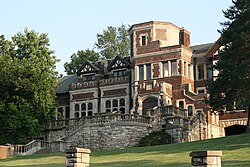
The university was built on a 40-acre (16.19 ha) plot, southeast of the Nelson mansion. William Volker had purchased and donated this land for the University of Kansas City. The original Volker purchase did not include the Dickey mansion itself. Dickey died unexpectedly in 1931 and Volker acquired it to be the first building.
The two groups were to squabble back and forth, with Ernest H. Newcomb attempting to mediate. The Church did not maintain its ties, and the Lincoln and Lee name was abandoned. The school announced that it would start if 125 students enrolled. The target was met, and the University of Kansas City, or "KCU" for short, held its first classes in October 1933 with a faculty of 17 and a student enrollment of 264.
The campus (now expanded to 90 acres or 36.4 hectares) is called the Volker Campus. The Dickey mansion is now Scofield Hall. The second building on the campus, the library, was named for Newcomb. A Carl Milles fountain on Brush Creek opposite the Nelson Gallery is called the Volker Fountain.
The University of Kansas City grew quickly, and soon incorporated other existing local private institutions of higher learning. The Kansas City School of Law, which was founded in the 1890s and located in downtown Kansas City, merged into the university in 1938. The Kansas City-Western Dental College followed in 1941 and the Kansas City College of Pharmacy merged in 1943. This was followed by the Kansas City Conservatory of Music in 1959. During this period, the university also established the School of Administration in 1953, the School of Education in 1954, and the Division for Continuing Education in 1958.
On July 25, 1963, at the urging of alumnus Hilary A. Bush, the university became part of the University of Missouri System and $20 million of assets including 23 buildings were transferred to the University of Missouri. At the time, KCU had 3,300 students (2,000 full-time) and 175 full-time faculty.
University of Missouri–Kansas City
The University of Missouri–Kansas City (UMKC or Kansas City) is a public research university in Kansas City, Missouri, United States. UMKC is part of the University of Missouri System and has a medical school. For the 2023-2024 academic year, the university's enrollment was over 15,300 students. It is the largest university in the Kansas City metro area. Among all postsecondary institutions (including community colleges), it ranks among the top three by enrollment. It offers more than 125 degree programs over 12 academic units. UMKC now holds a Carnegie “R1: Very High Research Activity” designation, making it the only R1 university in Kansas City. UMKC is also home to the School of Dentistry, Missouri’s only public dental school.
The school has its roots in the Lincoln and Lee University movement first put forth by the Methodist Church and its Bishop Ernest Lynn Waldorf in the 1920s. The proposed university (which was to honor Abraham Lincoln and Robert E. Lee) was to be built on the Missouri–Kansas border at 75th and State Line Road. Proponents of the school said it would be a location "where North met South and East met West."
In 1930, after the Methodists had brought the Kansas City Dental School into their fold, the two plans were merged. The new school was to be called "Lincoln and Lee, the University of Kansas City." and plans were underway to develop it into a four-year school.
The university was built on a 40-acre (16.19 ha) plot, southeast of the Nelson mansion. William Volker had purchased and donated this land for the University of Kansas City. The original Volker purchase did not include the Dickey mansion itself. Dickey died unexpectedly in 1931 and Volker acquired it to be the first building.
The two groups were to squabble back and forth, with Ernest H. Newcomb attempting to mediate. The Church did not maintain its ties, and the Lincoln and Lee name was abandoned. The school announced that it would start if 125 students enrolled. The target was met, and the University of Kansas City, or "KCU" for short, held its first classes in October 1933 with a faculty of 17 and a student enrollment of 264.
The campus (now expanded to 90 acres or 36.4 hectares) is called the Volker Campus. The Dickey mansion is now Scofield Hall. The second building on the campus, the library, was named for Newcomb. A Carl Milles fountain on Brush Creek opposite the Nelson Gallery is called the Volker Fountain.
The University of Kansas City grew quickly, and soon incorporated other existing local private institutions of higher learning. The Kansas City School of Law, which was founded in the 1890s and located in downtown Kansas City, merged into the university in 1938. The Kansas City-Western Dental College followed in 1941 and the Kansas City College of Pharmacy merged in 1943. This was followed by the Kansas City Conservatory of Music in 1959. During this period, the university also established the School of Administration in 1953, the School of Education in 1954, and the Division for Continuing Education in 1958.
On July 25, 1963, at the urging of alumnus Hilary A. Bush, the university became part of the University of Missouri System and $20 million of assets including 23 buildings were transferred to the University of Missouri. At the time, KCU had 3,300 students (2,000 full-time) and 175 full-time faculty.
Recent media
Recent media