
Recent from talks
University of Oslo
Knowledge base stats:
Talk channels stats:
Members stats:
University of Oslo
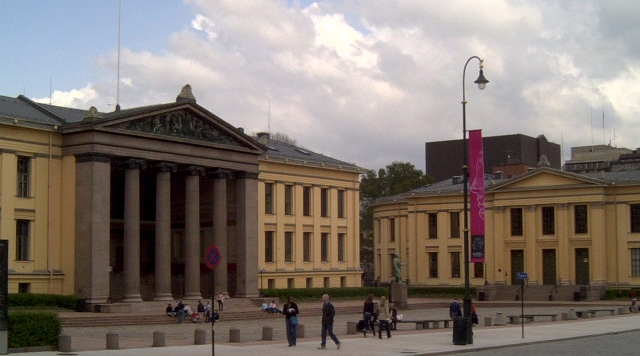
The University of Oslo (Norwegian: Universitetet i Oslo; Latin: Universitas Osloensis) is a public research university located in Oslo, Norway. It is the oldest university in Norway. Originally named the Royal Frederick University, the university was established in 1811 as the de facto Norwegian continuation of Denmark-Norway's common university, the University of Copenhagen, with which it shares many traditions. It was named for King Frederick VI of Denmark and Norway, and received its current name in 1939. The university was commonly nicknamed "The Royal Frederick's" (Det Kgl. Frederiks) before the name change, and informally also referred to simply as Universitetet (lit. 'the university').
The university was the only university in Norway until the University of Bergen was founded in 1946. It has approximately 27,700 students and employs around 6,000 people. Its faculties include (Lutheran) theology (with the Lutheran Church of Norway having been Norway's state church since 1536), law, medicine, humanities, mathematics, natural sciences, social sciences, dentistry, and education. The university's original neoclassical campus is located in the centre of Oslo; it is currently occupied by the Faculty of Law. Most of the university's other faculties are located at the newer Blindern campus in the suburban West End. The Faculty of Medicine is split between several university hospitals in the Oslo area. The university also includes some formally independent, affiliated institutes such as the Centre for International Climate and Environmental Research (CICERO), NKVTS and the Frisch Centre.
The Nobel Peace Prize was awarded in the university's Atrium, from 1947 to 1989 and in 2020. Since 2003, the Abel Prize is awarded in the Atrium. Five researchers affiliated with the university have been Nobel laureates and three have been Turing Award winners.
In 1811, a decision was made to establish the first university in the Dano-Norwegian Union, after an agreement was reached with King Frederik VI, who had earlier believed that such an institution might encourage political separatist tendencies. In 1813, The Royal Frederik's University was founded in Christiania (now Oslo), a small city at that time. Circumstances then changed dramatically one year into the commencement[clarification needed] of the university, as Norway proclaimed independence. However, independence was somewhat restricted, as Norway was obliged to enter into a personal union with Sweden based on the outcome of the Swedish-Norwegian War of 1814. Norway retained its own constitution and independent state institutions, although royal power and foreign affairs were shared[clarification needed] with Sweden. At a time when Norwegians feared political domination by the Swedes, the new university became a key institution that contributed to Norwegian political and cultural independence.
The main initial function of The Royal Frederick University was to educate a new class of upper-echelon civil servants, as well as parliamentary representatives and government ministers. The university also became the centre for a survey of the country—a survey of culture, language, history and folk traditions. The staff of the university strove to undertake a wide range of tasks necessary for developing a modern society. Throughout the 1800s, the university's academic disciplines gradually became more specialised.
One of the major changes in the university came during the 1870s when a greater emphasis was placed upon research, the management of the university became more professional, academic subjects were reformed, and the forms of teaching evolved. Classical education came under increasing pressure.[clarification needed]
When the union with Sweden was dissolved in 1905, the university became important for producing highly educated experts in a society which placed increasing emphasis on ensuring that all its citizens enjoy a life of dignity and security. Education, health services and public administration were among those fields that recruited personnel from the university's graduates.
Research changed qualitatively around the turn of the century as new methods, scientific theories and forms of practice changed the nature of research. It was decided that teachers should arrive at their posts as highly qualified academics and continue academic research alongside their role as teachers. Scientific research—whether to launch or test out new theories, to innovate or to pave the way for discoveries across a wide range of disciplines—became part of the increased expectations placed on the university. Developments in society created a need for more and more specialised and practical knowledge, not merely competence in theology or law, for example. The university strove to meet these expectations through increasing academic specialisation.
Hub AI
University of Oslo AI simulator
(@University of Oslo_simulator)
University of Oslo
The University of Oslo (Norwegian: Universitetet i Oslo; Latin: Universitas Osloensis) is a public research university located in Oslo, Norway. It is the oldest university in Norway. Originally named the Royal Frederick University, the university was established in 1811 as the de facto Norwegian continuation of Denmark-Norway's common university, the University of Copenhagen, with which it shares many traditions. It was named for King Frederick VI of Denmark and Norway, and received its current name in 1939. The university was commonly nicknamed "The Royal Frederick's" (Det Kgl. Frederiks) before the name change, and informally also referred to simply as Universitetet (lit. 'the university').
The university was the only university in Norway until the University of Bergen was founded in 1946. It has approximately 27,700 students and employs around 6,000 people. Its faculties include (Lutheran) theology (with the Lutheran Church of Norway having been Norway's state church since 1536), law, medicine, humanities, mathematics, natural sciences, social sciences, dentistry, and education. The university's original neoclassical campus is located in the centre of Oslo; it is currently occupied by the Faculty of Law. Most of the university's other faculties are located at the newer Blindern campus in the suburban West End. The Faculty of Medicine is split between several university hospitals in the Oslo area. The university also includes some formally independent, affiliated institutes such as the Centre for International Climate and Environmental Research (CICERO), NKVTS and the Frisch Centre.
The Nobel Peace Prize was awarded in the university's Atrium, from 1947 to 1989 and in 2020. Since 2003, the Abel Prize is awarded in the Atrium. Five researchers affiliated with the university have been Nobel laureates and three have been Turing Award winners.
In 1811, a decision was made to establish the first university in the Dano-Norwegian Union, after an agreement was reached with King Frederik VI, who had earlier believed that such an institution might encourage political separatist tendencies. In 1813, The Royal Frederik's University was founded in Christiania (now Oslo), a small city at that time. Circumstances then changed dramatically one year into the commencement[clarification needed] of the university, as Norway proclaimed independence. However, independence was somewhat restricted, as Norway was obliged to enter into a personal union with Sweden based on the outcome of the Swedish-Norwegian War of 1814. Norway retained its own constitution and independent state institutions, although royal power and foreign affairs were shared[clarification needed] with Sweden. At a time when Norwegians feared political domination by the Swedes, the new university became a key institution that contributed to Norwegian political and cultural independence.
The main initial function of The Royal Frederick University was to educate a new class of upper-echelon civil servants, as well as parliamentary representatives and government ministers. The university also became the centre for a survey of the country—a survey of culture, language, history and folk traditions. The staff of the university strove to undertake a wide range of tasks necessary for developing a modern society. Throughout the 1800s, the university's academic disciplines gradually became more specialised.
One of the major changes in the university came during the 1870s when a greater emphasis was placed upon research, the management of the university became more professional, academic subjects were reformed, and the forms of teaching evolved. Classical education came under increasing pressure.[clarification needed]
When the union with Sweden was dissolved in 1905, the university became important for producing highly educated experts in a society which placed increasing emphasis on ensuring that all its citizens enjoy a life of dignity and security. Education, health services and public administration were among those fields that recruited personnel from the university's graduates.
Research changed qualitatively around the turn of the century as new methods, scientific theories and forms of practice changed the nature of research. It was decided that teachers should arrive at their posts as highly qualified academics and continue academic research alongside their role as teachers. Scientific research—whether to launch or test out new theories, to innovate or to pave the way for discoveries across a wide range of disciplines—became part of the increased expectations placed on the university. Developments in society created a need for more and more specialised and practical knowledge, not merely competence in theology or law, for example. The university strove to meet these expectations through increasing academic specialisation.
Recent media