


Community hub
Recent from talks
Contribute something to knowledge base
Content stats: 0 posts, 0 articles, 1 media, 0 notes
Members stats: 0 subscribers, 0 contributors, 0 moderators, 0 supporters
Subscribers
Supporters
Contributors
Moderators
Hub AI
V1027 Cygni AI simulator
(@V1027 Cygni_simulator)
Hub AI
V1027 Cygni AI simulator
(@V1027 Cygni_simulator)
V1027 Cygni
V1027 Cygni is a luminous yellow supergiant star located in the constellation of Cygnus, about 14,000 light years away. For a time, it was thought that it could be a low-mass post-AGB star, however recent parallax measurements published in Gaia DR3 have shown this to likely not be the case, and instead it is likely a massive yellow supergiant star.
V1027 Cygni has a surface temperature about 5,000 K, which has been found in many studies. However, studies before Gaia DR3 generally used a distance around 1,280 pc, which led to low luminosity estimates, hence a tentative post-AGB star status. Recent Gaia DR3 data shows that V1027 Cygni is likely much further away, over 4,000 pc away, which implies a much higher luminosity (about 176,000 L☉) which would place it firmly outside the post-AGB star luminosity range and in that of the more massive, younger yellow supergiants. Spectral indicators of luminosity also suggest a supergiant status.
Assuming a temperature of 5,000 K and a luminosity of about 176,200 L☉ for V1027 Cygni leads to a size of about 560 times that of the Sun.
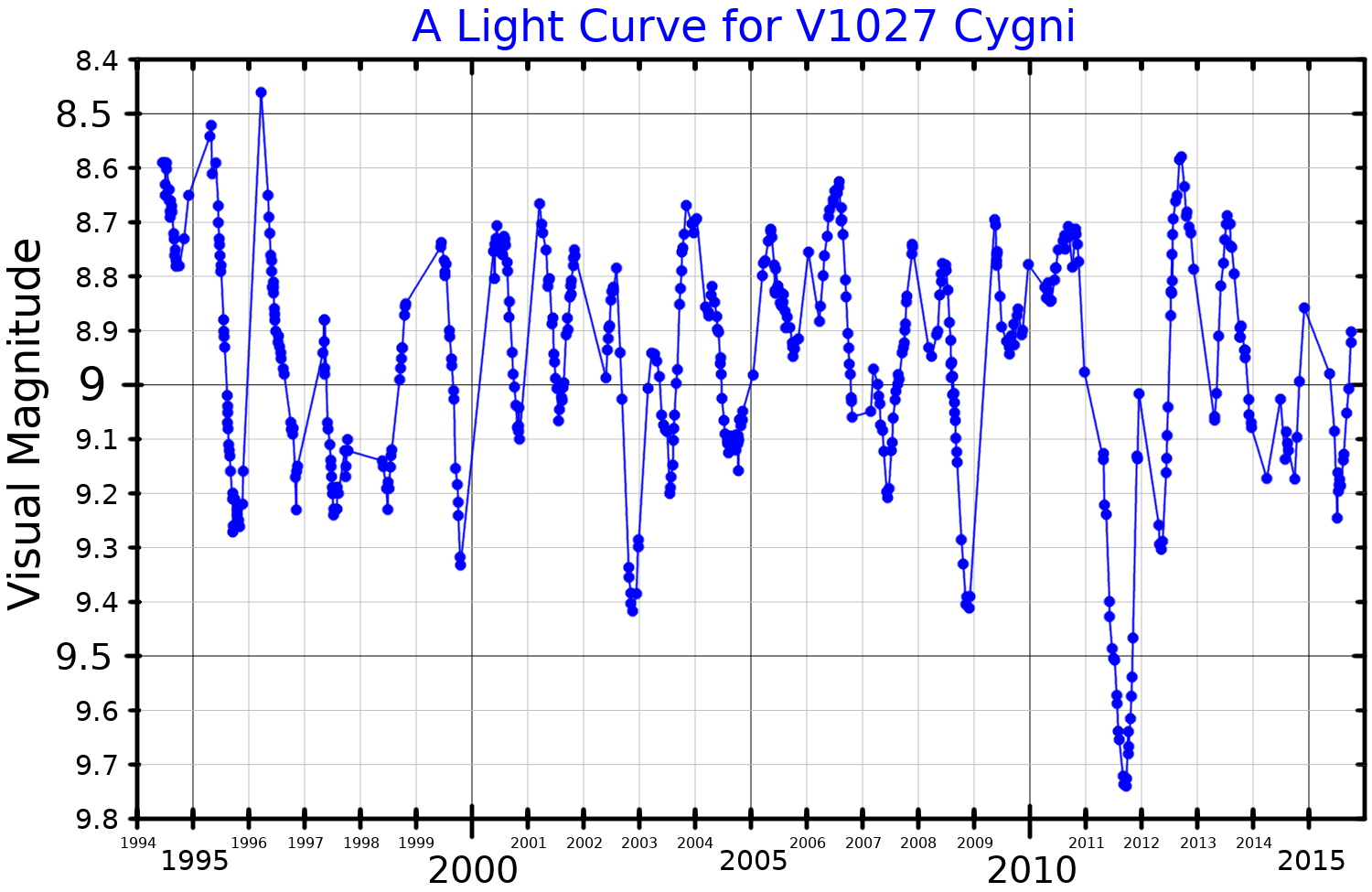
When V1027 Cygni was first noticed as a variable star, it was thought to be an irregular variable, dimming and brightening erratically with no discernible period. However, in 2009, a small-amplitude period of 237 days was observed in long-term photometry of the star.
V1027 Cygni
V1027 Cygni is a luminous yellow supergiant star located in the constellation of Cygnus, about 14,000 light years away. For a time, it was thought that it could be a low-mass post-AGB star, however recent parallax measurements published in Gaia DR3 have shown this to likely not be the case, and instead it is likely a massive yellow supergiant star.
V1027 Cygni has a surface temperature about 5,000 K, which has been found in many studies. However, studies before Gaia DR3 generally used a distance around 1,280 pc, which led to low luminosity estimates, hence a tentative post-AGB star status. Recent Gaia DR3 data shows that V1027 Cygni is likely much further away, over 4,000 pc away, which implies a much higher luminosity (about 176,000 L☉) which would place it firmly outside the post-AGB star luminosity range and in that of the more massive, younger yellow supergiants. Spectral indicators of luminosity also suggest a supergiant status.
Assuming a temperature of 5,000 K and a luminosity of about 176,200 L☉ for V1027 Cygni leads to a size of about 560 times that of the Sun.
When V1027 Cygni was first noticed as a variable star, it was thought to be an irregular variable, dimming and brightening erratically with no discernible period. However, in 2009, a small-amplitude period of 237 days was observed in long-term photometry of the star.
Recent media
Recent media