



Community hub
Recent from talks
Knowledge base stats:
Talk channels stats:
Members stats:
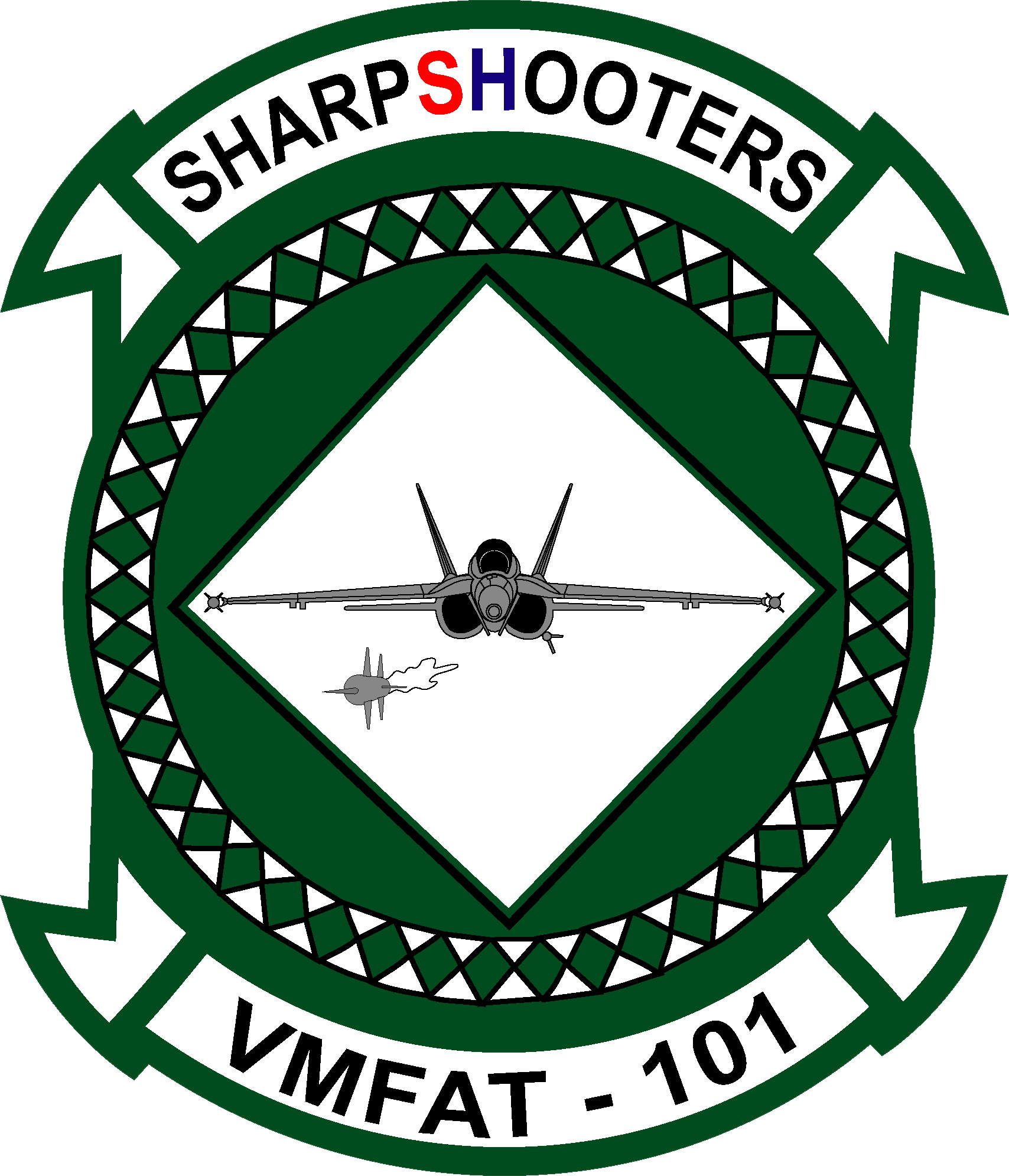
VMFAT-101
Marine Fighter Attack Training Squadron 101 (VMFAT-101) was a United States Marine Corps F/A-18 Hornet training squadron. The squadron was last based at Marine Corps Air Station Miramar, California and fell under the command of Marine Aircraft Group 11 (MAG-11) and the 3rd Marine Aircraft Wing (3rd MAW).
Marine Fighter Attack Training Squadron 101 (VMFAT-101), was commissioned at Marine Corps Air Station El Toro, California on 3 January 1969, as part of Marine Combat Crew Readiness Training Group 10, 3rd Marine Aircraft Wing. The squadron trained naval aviators and naval flight officers in the employment of the McDonnell Douglas F-4 Phantom II. VMFAT-101 flew its first training sortie 20 February 1969, and completed its first class of fighter aircrew by August of that year.
During the summer of 1970, VMFAT-101 moved to Marine Corps Air Station Yuma, Arizona. In 1972 the Sharpshooters earned their first Chief of Naval Operations CNO Aviation Safety Award for Excellence in aviation safety after compiling over 18,300 mishap free flight hours.
In July 1974, VMFAT-101 absorbed the assets of VMFAT-201 from Marine Corps Air Station Cherry Point, North Carolina and became the largest fixed wing tactical jet squadron and the sole remaining F-4 training squadron in the Marine Corps. The Sharpshooters earned the 1976 CNO Aviation Safety Award, as well as the Commanding General Fleet Marine Forces Pacific Aviation Safety Award in 1978 and 1979 while it amassed over 30,000 mishap-free flight hours. The Sharpshooters continued to train aircrews in the venerable Phantom II and in 1983 earned the coveted Marine Corps Aviation Association Robert M. Hanson Award as the finest fighter squadron in Marine aviation. 20 May 1987, VMFAT-101 trained its last F-4 replacement aircrew; during July the squadron flew its remaining 10 F-4 aircraft to Davis-Monthan Air Force Base, Ariz., for permanent storage. During the 18 years VMFAT-101 flew the Phantom, the Sharpshooters amassed over 125,000 flight hours training Marine and Navy aircrews for the fleet.
On 29 September 1987, VMFAT-101 returned to MCAS El Toro to beginning training as the Marine Corps’ dedicated F/A-18 Fleet Replacement Squadron (FRS). On 31 March 1988, MCCRTG-10 deactivated and VMFAT-101 joined Marine Aircraft Group 11. By October of that year, the Sharpshooters owned 21 F/A-18s, had trained 25 qualified instructor pilots and were ready to begin training new Hornet pilots. By May 1989 VMFAT-101 graduated 23 new F/A-18 pilots and accumulated over 11,000 mishap free Hornet flight hours.
With three times the number of aircraft of a typical F/A-18 squadron, VMFAT-101 is capable of producing 40 replacement pilots (RPs) in addition to refreshing numerous former fleet aviators that are out of currency. With the replacement of the A-6 Intruder in the Marine Corps with the twin-seat F/A-18D Hornet, VMFAT-101 also returned to training USMC naval flight officers, in this case as F/A-18D weapon systems officers in addition to training USMC naval aviators as pilots in both single-seat and twin-seat variants of the Hornet.
Another important function that VMFAT-101 serves is the grooming of Marine Corps and Navy maintenance personnel. With such a large number of aircraft, there is also a very large number of people that earn critical maintenance qualifications and assume leadership positions while they are in the SharpShooters.
The focus of flight training while at VMFAT-101 is oriented towards the tactical employment of the F/A-18 in various combat scenarios. Collectively referred to as replacement aircrew (RACs), these aviation officers undergo intense training that normally lasts 44 weeks and is broken into four distinct phases: Transition, Air-to-Ground, Air-to-Air, and Carrier Qualification.
Hub AI
VMFAT-101 AI simulator
(@VMFAT-101_simulator)
VMFAT-101
Marine Fighter Attack Training Squadron 101 (VMFAT-101) was a United States Marine Corps F/A-18 Hornet training squadron. The squadron was last based at Marine Corps Air Station Miramar, California and fell under the command of Marine Aircraft Group 11 (MAG-11) and the 3rd Marine Aircraft Wing (3rd MAW).
Marine Fighter Attack Training Squadron 101 (VMFAT-101), was commissioned at Marine Corps Air Station El Toro, California on 3 January 1969, as part of Marine Combat Crew Readiness Training Group 10, 3rd Marine Aircraft Wing. The squadron trained naval aviators and naval flight officers in the employment of the McDonnell Douglas F-4 Phantom II. VMFAT-101 flew its first training sortie 20 February 1969, and completed its first class of fighter aircrew by August of that year.
During the summer of 1970, VMFAT-101 moved to Marine Corps Air Station Yuma, Arizona. In 1972 the Sharpshooters earned their first Chief of Naval Operations CNO Aviation Safety Award for Excellence in aviation safety after compiling over 18,300 mishap free flight hours.
In July 1974, VMFAT-101 absorbed the assets of VMFAT-201 from Marine Corps Air Station Cherry Point, North Carolina and became the largest fixed wing tactical jet squadron and the sole remaining F-4 training squadron in the Marine Corps. The Sharpshooters earned the 1976 CNO Aviation Safety Award, as well as the Commanding General Fleet Marine Forces Pacific Aviation Safety Award in 1978 and 1979 while it amassed over 30,000 mishap-free flight hours. The Sharpshooters continued to train aircrews in the venerable Phantom II and in 1983 earned the coveted Marine Corps Aviation Association Robert M. Hanson Award as the finest fighter squadron in Marine aviation. 20 May 1987, VMFAT-101 trained its last F-4 replacement aircrew; during July the squadron flew its remaining 10 F-4 aircraft to Davis-Monthan Air Force Base, Ariz., for permanent storage. During the 18 years VMFAT-101 flew the Phantom, the Sharpshooters amassed over 125,000 flight hours training Marine and Navy aircrews for the fleet.
On 29 September 1987, VMFAT-101 returned to MCAS El Toro to beginning training as the Marine Corps’ dedicated F/A-18 Fleet Replacement Squadron (FRS). On 31 March 1988, MCCRTG-10 deactivated and VMFAT-101 joined Marine Aircraft Group 11. By October of that year, the Sharpshooters owned 21 F/A-18s, had trained 25 qualified instructor pilots and were ready to begin training new Hornet pilots. By May 1989 VMFAT-101 graduated 23 new F/A-18 pilots and accumulated over 11,000 mishap free Hornet flight hours.
With three times the number of aircraft of a typical F/A-18 squadron, VMFAT-101 is capable of producing 40 replacement pilots (RPs) in addition to refreshing numerous former fleet aviators that are out of currency. With the replacement of the A-6 Intruder in the Marine Corps with the twin-seat F/A-18D Hornet, VMFAT-101 also returned to training USMC naval flight officers, in this case as F/A-18D weapon systems officers in addition to training USMC naval aviators as pilots in both single-seat and twin-seat variants of the Hornet.
Another important function that VMFAT-101 serves is the grooming of Marine Corps and Navy maintenance personnel. With such a large number of aircraft, there is also a very large number of people that earn critical maintenance qualifications and assume leadership positions while they are in the SharpShooters.
The focus of flight training while at VMFAT-101 is oriented towards the tactical employment of the F/A-18 in various combat scenarios. Collectively referred to as replacement aircrew (RACs), these aviation officers undergo intense training that normally lasts 44 weeks and is broken into four distinct phases: Transition, Air-to-Ground, Air-to-Air, and Carrier Qualification.