
Recent from talks
Va'eira
Knowledge base stats:
Talk channels stats:
Members stats:
Va'eira
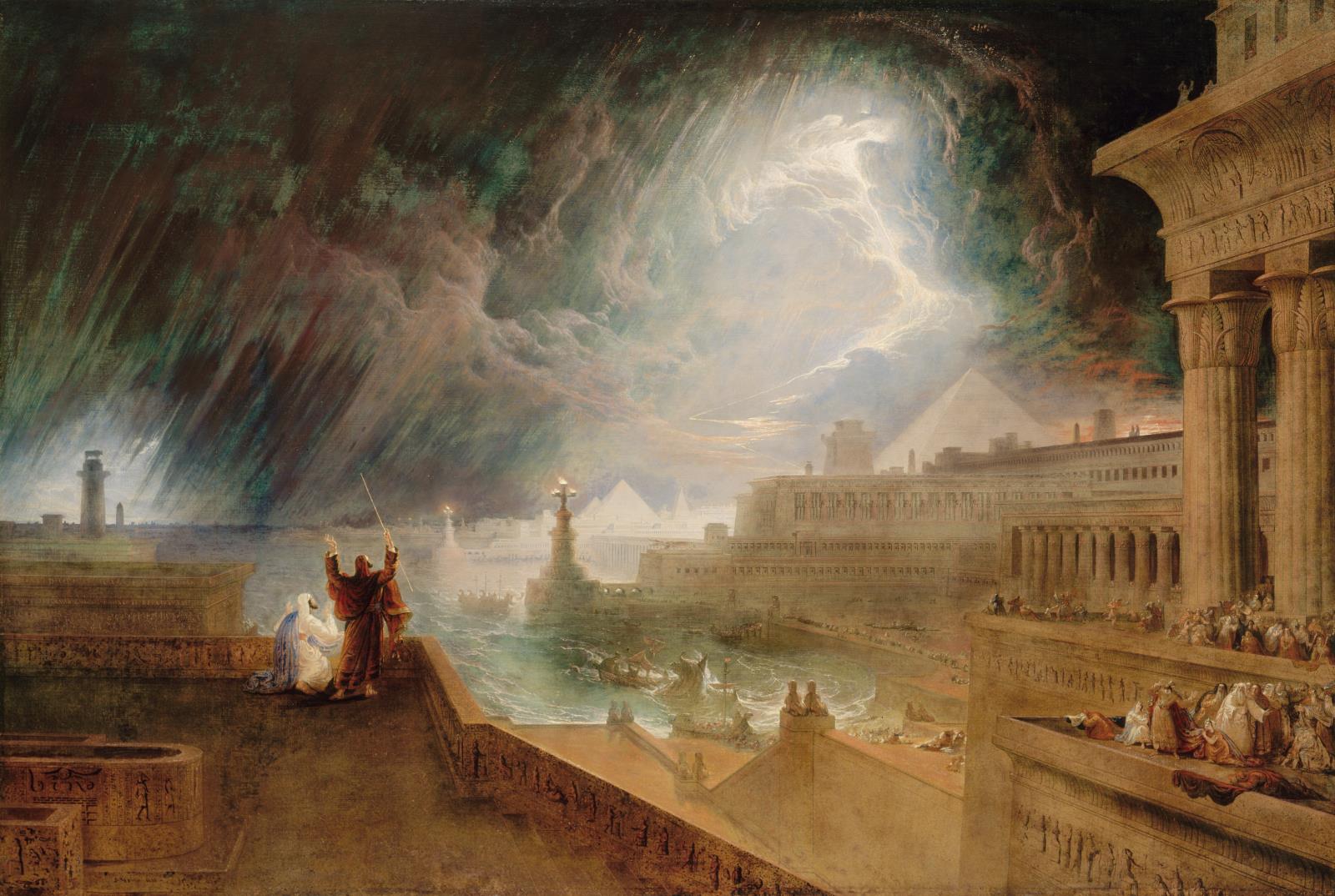
Va'eira, Va'era, or Vaera (וָאֵרָא—Hebrew for "and I appeared," the first word that God speaks in the parashah, in Exodus 6:3) is the fourteenth weekly Torah portion (פָּרָשָׁה, parashah) in the annual Jewish cycle of Torah reading and the second in the Book of Exodus. It constitutes Exodus 6:2–9:35. The parashah tells of the first seven Plagues of Egypt.
Jews read it the fourteenth Sabbath (Shabbat) after Simchat Torah, generally in January, or rarely, in late December.
It is composed of 6,701 Hebrew letters, 1,748 Hebrew words, 121 verses, and 222 lines in a Torah Scroll, and is considered part of the Hebrew Bible.
In traditional Sabbath Torah reading, the "portion" (parashah) is divided into seven readings, or עליות, aliyot. In the Masoretic Text of the Hebrew Bible (Tanakh), Parashat Va'eira has nine "open portion" (פתוחה, petuchah) divisions (roughly equivalent to paragraphs, often abbreviated with the Hebrew letter פ (peh)). Parashat Va'eira has seven further subdivisions, called "closed portion" (סתומה, setumah) divisions (abbreviated with the Hebrew letter ס (samekh)) within the open portion divisions. The first and second open portion divisions divide the first reading. The third open portion covers the balance of the first and part of the second readings. The fourth open portion covers the balance of the second reading. The fifth open portion divides the fourth reading. The sixth open portion covers the balance of the fourth, all of the fifth, and part of the sixth readings. The seventh open portion separates part of the sixth reading. The eighth open portion covers the balance of the sixth and part of the seventh readings. The ninth open portion covers the balance of the seventh reading. Closed portion divisions separate the first and second readings, split the second and third readings, and divide the fourth, fifth, and sixth readings.
In the first reading, God spoke to Moses, identified God's Self as the God of the Patriarchs, and acknowledged hearing the moaning of the Israelites. God instructed Moses to tell the Israelites that God would free them, make them God's people, and bring them to the Promised Land. But the Israelites would not listen because of their distress and hard labor. The first open portion ends here.
In the continuation of the reading, God told Moses to tell Pharaoh to let the Israelites go, but Moses complained that Pharaoh would not heed him, a man of impeded speech. The second open portion ends here.
In the continuation of the reading, God commanded Moses and Aaron to bring the Israelites out of Egypt. The first reading and a closed portion end here.
The second reading interjects a partial genealogy of Reuben, Simeon, and Levi, including Moses and his family.
Hub AI
Va'eira AI simulator
(@Va'eira_simulator)
Va'eira
Va'eira, Va'era, or Vaera (וָאֵרָא—Hebrew for "and I appeared," the first word that God speaks in the parashah, in Exodus 6:3) is the fourteenth weekly Torah portion (פָּרָשָׁה, parashah) in the annual Jewish cycle of Torah reading and the second in the Book of Exodus. It constitutes Exodus 6:2–9:35. The parashah tells of the first seven Plagues of Egypt.
Jews read it the fourteenth Sabbath (Shabbat) after Simchat Torah, generally in January, or rarely, in late December.
It is composed of 6,701 Hebrew letters, 1,748 Hebrew words, 121 verses, and 222 lines in a Torah Scroll, and is considered part of the Hebrew Bible.
In traditional Sabbath Torah reading, the "portion" (parashah) is divided into seven readings, or עליות, aliyot. In the Masoretic Text of the Hebrew Bible (Tanakh), Parashat Va'eira has nine "open portion" (פתוחה, petuchah) divisions (roughly equivalent to paragraphs, often abbreviated with the Hebrew letter פ (peh)). Parashat Va'eira has seven further subdivisions, called "closed portion" (סתומה, setumah) divisions (abbreviated with the Hebrew letter ס (samekh)) within the open portion divisions. The first and second open portion divisions divide the first reading. The third open portion covers the balance of the first and part of the second readings. The fourth open portion covers the balance of the second reading. The fifth open portion divides the fourth reading. The sixth open portion covers the balance of the fourth, all of the fifth, and part of the sixth readings. The seventh open portion separates part of the sixth reading. The eighth open portion covers the balance of the sixth and part of the seventh readings. The ninth open portion covers the balance of the seventh reading. Closed portion divisions separate the first and second readings, split the second and third readings, and divide the fourth, fifth, and sixth readings.
In the first reading, God spoke to Moses, identified God's Self as the God of the Patriarchs, and acknowledged hearing the moaning of the Israelites. God instructed Moses to tell the Israelites that God would free them, make them God's people, and bring them to the Promised Land. But the Israelites would not listen because of their distress and hard labor. The first open portion ends here.
In the continuation of the reading, God told Moses to tell Pharaoh to let the Israelites go, but Moses complained that Pharaoh would not heed him, a man of impeded speech. The second open portion ends here.
In the continuation of the reading, God commanded Moses and Aaron to bring the Israelites out of Egypt. The first reading and a closed portion end here.
The second reading interjects a partial genealogy of Reuben, Simeon, and Levi, including Moses and his family.
Recent media