
Recent from talks
Variomatic
Knowledge base stats:
Talk channels stats:
Members stats:
Variomatic
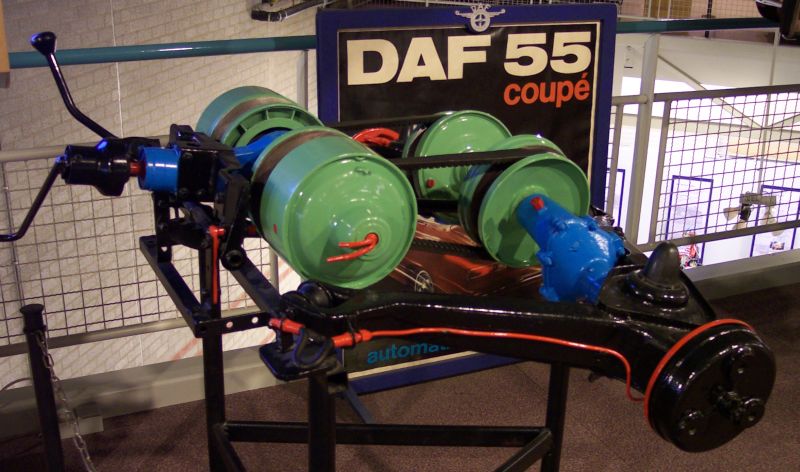
Variomatic is the continuously variable transmission (CVT) of the Dutch car manufacturer DAF, originally developed by Hub van Doorne. It is a stepless, fully-automatic transmission, consisting of a V-shaped drive-belt, and two pulleys, each of two cones, whose effective diameter can be changed so that the "V" belt runs nearer the spindle or nearer the rim, depending on the separation of the cones. These are synchronized so that the belt always remains at the same optimal tension.
Patented by Fouillaron in 1898. “To solve a thorny weaving problem, the engineer developed a variator system that prevented the thread from cutting when starting the looms”.[citation needed]
In 1904, the Fouillaron type G tonneau road vehicle was equipped with a wooden Tonneau body and a De Dion 6 HP single-cylinder engine; the car did not exceed 25 km/h. This vehicle has a very original gear transmission system with extendable pulleys.[citation needed] This invention, which he further developed and adapted to machine tools, was later acquired by the Dutch car manufacturer DAF, and developed into the Variomatic transmission, since continued by a separate company called DVT.
The Variomatic was the first commercially successful CVT (as opposed to shifting between separate gears), first marketed on the DAF 600. In theory, this always produces the optimum torque. The Variomatic was introduced by DAF in 1958, also putting an automatic gearbox in the Netherlands for the first time.
Because most of the time the engine runs at its most economical speed, the fuel consumption of this car was acceptable, although the fuel efficiency of any mechanical CVT is about 70% (then) to 75% now (Bosch).[citation needed][clarification needed]
Because the system does not have separate gears, but one (continuously shifting) gear and a separate 'reverse mode' (as opposed to reverse gear), the transmission works in reverse as well, giving it the side effect that one can drive backwards as fast as forwards. As a result, in the former Dutch annual backward driving world championship, the DAFs had to be put in a separate competition because no other car could keep up.
Manual transmission remains dominant in Europe. When DAF was acquired by Volvo in 1974, the Variomatic patents were transferred to a company called VDT (Van Doorne Transmissie), later acquired by Bosch in 1995. VDT continued the development of the CVT and introduced a push-belt system in the Ford Fiesta and Fiat Uno.
The final drive has two pulleys with moveable conical drums. The distance between the drums is controlled by the engine vacuum in the inlet manifold and engine RPM, through centrifugal weights inside the drums. Between the two pulleys runs a drive belt. As a result of the change in the distance of the conical drums in both pulleys, the diameters and so also the reduction ratio changes continuously.
Hub AI
Variomatic AI simulator
(@Variomatic_simulator)
Variomatic
Variomatic is the continuously variable transmission (CVT) of the Dutch car manufacturer DAF, originally developed by Hub van Doorne. It is a stepless, fully-automatic transmission, consisting of a V-shaped drive-belt, and two pulleys, each of two cones, whose effective diameter can be changed so that the "V" belt runs nearer the spindle or nearer the rim, depending on the separation of the cones. These are synchronized so that the belt always remains at the same optimal tension.
Patented by Fouillaron in 1898. “To solve a thorny weaving problem, the engineer developed a variator system that prevented the thread from cutting when starting the looms”.[citation needed]
In 1904, the Fouillaron type G tonneau road vehicle was equipped with a wooden Tonneau body and a De Dion 6 HP single-cylinder engine; the car did not exceed 25 km/h. This vehicle has a very original gear transmission system with extendable pulleys.[citation needed] This invention, which he further developed and adapted to machine tools, was later acquired by the Dutch car manufacturer DAF, and developed into the Variomatic transmission, since continued by a separate company called DVT.
The Variomatic was the first commercially successful CVT (as opposed to shifting between separate gears), first marketed on the DAF 600. In theory, this always produces the optimum torque. The Variomatic was introduced by DAF in 1958, also putting an automatic gearbox in the Netherlands for the first time.
Because most of the time the engine runs at its most economical speed, the fuel consumption of this car was acceptable, although the fuel efficiency of any mechanical CVT is about 70% (then) to 75% now (Bosch).[citation needed][clarification needed]
Because the system does not have separate gears, but one (continuously shifting) gear and a separate 'reverse mode' (as opposed to reverse gear), the transmission works in reverse as well, giving it the side effect that one can drive backwards as fast as forwards. As a result, in the former Dutch annual backward driving world championship, the DAFs had to be put in a separate competition because no other car could keep up.
Manual transmission remains dominant in Europe. When DAF was acquired by Volvo in 1974, the Variomatic patents were transferred to a company called VDT (Van Doorne Transmissie), later acquired by Bosch in 1995. VDT continued the development of the CVT and introduced a push-belt system in the Ford Fiesta and Fiat Uno.
The final drive has two pulleys with moveable conical drums. The distance between the drums is controlled by the engine vacuum in the inlet manifold and engine RPM, through centrifugal weights inside the drums. Between the two pulleys runs a drive belt. As a result of the change in the distance of the conical drums in both pulleys, the diameters and so also the reduction ratio changes continuously.
Recent media