
Recent from talks
Vargas tragedy
Knowledge base stats:
Talk channels stats:
Members stats:
Vargas tragedy
The Vargas tragedy was a natural disaster that occurred in Vargas State (today La Guaira), Venezuela on 15 December 1999 (over the course of 10 days), when torrential rains caused flash floods and debris flows that killed tens of thousands of people, destroyed thousands of homes, and led to the complete collapse of the state's infrastructure. According to relief workers, the neighborhood of Los Corales was buried under 3 meters (9.8 ft) of mud and a high percentage of homes were simply swept into the ocean. Entire towns including Cerro Grande and Carmen de Uria completely disappeared. As much as 10% of the population of Vargas died during the event. A deadlier natural disaster would not occur until the 2004 Indian Ocean earthquake and tsunami. According to Guinness World Records, it is the deadliest mudslide ever recorded.
The coastal area of Vargas State has long been subject to mudslides and flooding. Deposits preserved on the alluvial fan deltas here show that geologically similar catastrophes have occurred with regularity since prehistoric times. Since the 17th century, at least two large-magnitude debris flow, landslide, or flood events, on average, have occurred each century within the modern boundaries of Vargas. Recorded events occurred in February 1798, August 1912, January 1914, November 1938, May 1944, November 1944, August 1948, and February 1951. In the February 1798 event, flash floods and debris flows severely damaged 219 homes. Spanish soldiers barricaded an upstream-facing entrance to a fort with cannons in order to prevent debris from filling it.
Prior to the 1999 disaster, the most recent major flood had occurred in 1951, but that event did not cause as much damage. Based on aerial photos and records of measurements, geologists were able to directly compare the 1951 event to the 1999 event. The 1951 event involved less rainfall than the 1999 event, fewer landslides were triggered, and less fresh debris was observed on the fans. The unusually strong storm in December 1999 dumped 911 millimeters (35.9 in) of rain over just a few days, triggering widespread soil instability and flow of debris. Adding to the devastation, Vargas State had experienced high population growth and development since the 1951 disaster, thus increasing the toll of casualties.
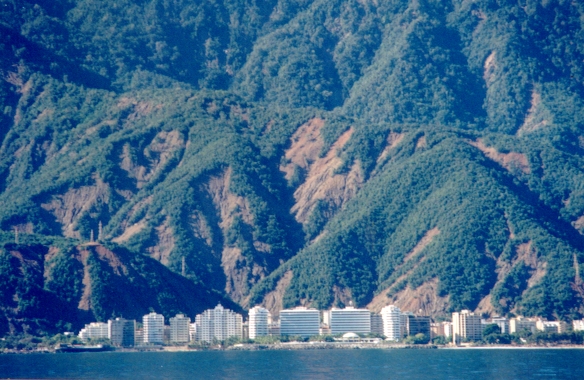
The alluvial fans built as sediments from floods and debris flows exit their channels and meet the oceans provide the only extensive flat surfaces along the mountainous coastline of north-central Venezuela. As such, many of them have been extensively developed and urbanized. This high population density increases the risk to life and property from flash flood and debris flow events.
As of 1999, several hundred thousand people lived in this narrow coastal strip in Vargas State. Many of these people lived atop alluvial fans formed by debris flows sourced out of the 2,000-meter (6,600 ft) peaks to their south.
December 1999 was unusually wet along the north-central Venezuelan coast. The first, and less powerful, storm that month occurred 2–3 December and dropped 200 millimeters (7.9 in) of rain on the coast.
Two weeks later, in a 52-hour span during 14, 15 and 16 December 1999, 911 millimeters (35.9 in) of rain (approximately one year's average total rainfall for the region) was measured on the north-central coast of Venezuela at Simón Bolívar International Airport in Maiquetia, Venezuela. These heavy rains included 72 millimeters (2.8 in) of accumulation in just one hour, between 6 and 7 AM on the 16th; precipitation on both the 15th and 16th exceeded the 1,000-year probability rainfall event. Even so, the coast received much less rain than some regions upstream.
This sudden and intense storm was especially unusual because it occurred in December, while the typical rainy season in coastal Venezuela lasts from May to October. These out-of-season rains formed when a cold front interacted with a moist southwesterly flow in the Pacific Ocean. This interaction produced moderate to heavy rainfall starting in the first week of December and culminating in the 14–16 December event that caused the deadly floods and debris flows.
Hub AI
Vargas tragedy AI simulator
(@Vargas tragedy_simulator)
Vargas tragedy
The Vargas tragedy was a natural disaster that occurred in Vargas State (today La Guaira), Venezuela on 15 December 1999 (over the course of 10 days), when torrential rains caused flash floods and debris flows that killed tens of thousands of people, destroyed thousands of homes, and led to the complete collapse of the state's infrastructure. According to relief workers, the neighborhood of Los Corales was buried under 3 meters (9.8 ft) of mud and a high percentage of homes were simply swept into the ocean. Entire towns including Cerro Grande and Carmen de Uria completely disappeared. As much as 10% of the population of Vargas died during the event. A deadlier natural disaster would not occur until the 2004 Indian Ocean earthquake and tsunami. According to Guinness World Records, it is the deadliest mudslide ever recorded.
The coastal area of Vargas State has long been subject to mudslides and flooding. Deposits preserved on the alluvial fan deltas here show that geologically similar catastrophes have occurred with regularity since prehistoric times. Since the 17th century, at least two large-magnitude debris flow, landslide, or flood events, on average, have occurred each century within the modern boundaries of Vargas. Recorded events occurred in February 1798, August 1912, January 1914, November 1938, May 1944, November 1944, August 1948, and February 1951. In the February 1798 event, flash floods and debris flows severely damaged 219 homes. Spanish soldiers barricaded an upstream-facing entrance to a fort with cannons in order to prevent debris from filling it.
Prior to the 1999 disaster, the most recent major flood had occurred in 1951, but that event did not cause as much damage. Based on aerial photos and records of measurements, geologists were able to directly compare the 1951 event to the 1999 event. The 1951 event involved less rainfall than the 1999 event, fewer landslides were triggered, and less fresh debris was observed on the fans. The unusually strong storm in December 1999 dumped 911 millimeters (35.9 in) of rain over just a few days, triggering widespread soil instability and flow of debris. Adding to the devastation, Vargas State had experienced high population growth and development since the 1951 disaster, thus increasing the toll of casualties.
The alluvial fans built as sediments from floods and debris flows exit their channels and meet the oceans provide the only extensive flat surfaces along the mountainous coastline of north-central Venezuela. As such, many of them have been extensively developed and urbanized. This high population density increases the risk to life and property from flash flood and debris flow events.
As of 1999, several hundred thousand people lived in this narrow coastal strip in Vargas State. Many of these people lived atop alluvial fans formed by debris flows sourced out of the 2,000-meter (6,600 ft) peaks to their south.
December 1999 was unusually wet along the north-central Venezuelan coast. The first, and less powerful, storm that month occurred 2–3 December and dropped 200 millimeters (7.9 in) of rain on the coast.
Two weeks later, in a 52-hour span during 14, 15 and 16 December 1999, 911 millimeters (35.9 in) of rain (approximately one year's average total rainfall for the region) was measured on the north-central coast of Venezuela at Simón Bolívar International Airport in Maiquetia, Venezuela. These heavy rains included 72 millimeters (2.8 in) of accumulation in just one hour, between 6 and 7 AM on the 16th; precipitation on both the 15th and 16th exceeded the 1,000-year probability rainfall event. Even so, the coast received much less rain than some regions upstream.
This sudden and intense storm was especially unusual because it occurred in December, while the typical rainy season in coastal Venezuela lasts from May to October. These out-of-season rains formed when a cold front interacted with a moist southwesterly flow in the Pacific Ocean. This interaction produced moderate to heavy rainfall starting in the first week of December and culminating in the 14–16 December event that caused the deadly floods and debris flows.
Recent media