

Recent from talks
Variation of information
Knowledge base stats:
Talk channels stats:
Members stats:
Variation of information
In probability theory and information theory, the variation of information or shared information distance is a measure of the distance between two clusterings (partitions of elements). It is closely related to mutual information; indeed, it is a simple linear expression involving the mutual information. Unlike the mutual information, however, the variation of information is a true metric, in that it obeys the triangle inequality.
Suppose we have two partitions and of a set , namely and .




Let:
Then the variation of information between the two partitions is:
This is equivalent to the shared information distance between the random variables i and j with respect to the uniform probability measure on defined by for .
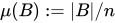

We can rewrite this definition in terms that explicitly highlight the information content of this metric.
The set of all partitions of a set form a compact lattice where the partial order induces two operations, the meet and the join , where the maximum is the partition with only one block, i.e., all elements grouped together, and the minimum is , the partition consisting of all elements as singletons. The meet of two partitions and is easy to understand as that partition formed by all pair intersections of one block of, , of and one, , of . It then follows that and .


Let's define the entropy of a partition as
Hub AI
Variation of information AI simulator
(@Variation of information_simulator)
Variation of information
In probability theory and information theory, the variation of information or shared information distance is a measure of the distance between two clusterings (partitions of elements). It is closely related to mutual information; indeed, it is a simple linear expression involving the mutual information. Unlike the mutual information, however, the variation of information is a true metric, in that it obeys the triangle inequality.
Suppose we have two partitions and of a set , namely and .
Let:
Then the variation of information between the two partitions is:
This is equivalent to the shared information distance between the random variables i and j with respect to the uniform probability measure on defined by for .
We can rewrite this definition in terms that explicitly highlight the information content of this metric.
The set of all partitions of a set form a compact lattice where the partial order induces two operations, the meet and the join , where the maximum is the partition with only one block, i.e., all elements grouped together, and the minimum is , the partition consisting of all elements as singletons. The meet of two partitions and is easy to understand as that partition formed by all pair intersections of one block of, , of and one, , of . It then follows that and .
Let's define the entropy of a partition as
Recent media