
Recent from talks
Vogtland
Knowledge base stats:
Talk channels stats:
Members stats:
Vogtland
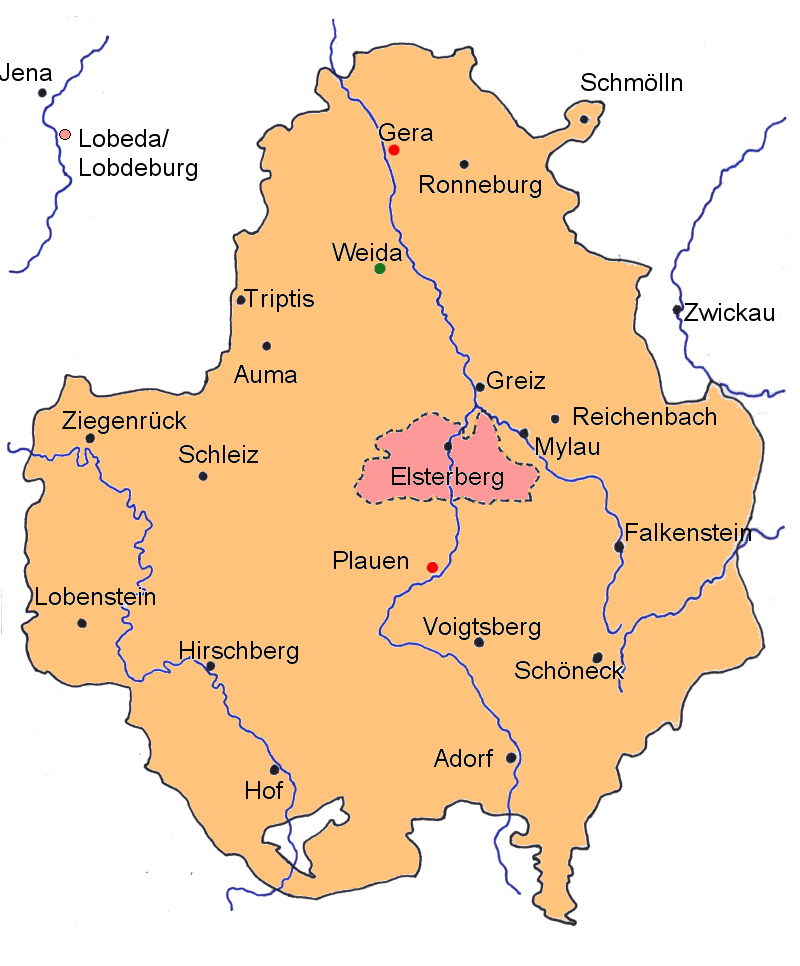
Vogtland (German: [ˈfoːktlant] ⓘ; Czech: Fojtsko) is a region spanning the German states of Bavaria, Saxony and Thuringia and north-western Bohemia in the Czech Republic. It overlaps with and is largely contained within Euroregio Egrensis. The name alludes to the former leadership by the Vögte ("advocates" or "lords protector") of Weida, Gera and Plauen.
The landscape of the Vogtland is sometimes described as idyllic, thanks to its fields, meadows and wooded hilltops. In the south and southeast, Vogtland rises to a low or mid-height mountain range also called Oberes Vogtland, or Upper Vogtland. Here, monocultural coniferous forest is the predominant form of vegetation. The Vogtland's highest mountain is Schneehübel, reaching 974 metres; another remarkable landmark is the Schneckenstein, 883 m above sea level, which gained some renown for its (falsely) alleged unique abundance of topaz crystals. Its mountains spread from Ore Mountains in the south-east to Fichtel Mountains in the south-west, including the Elster Mountains.
Neighbouring regions are Franconian Forest, Ore Mountains, Thuringian Highland and Fichtel Mountains. The south-eastern part of the Vogtland belongs to Ore Mountain/Vogtland Nature Park, a protected area comparable to a national park.
In its northern part, which averages around 250 m above sea level, the landscape is marked by several river valleys, as the White Elster, the Zwickauer Mulde and the Göltzsch have their spring in the Vogtland, while the Saale flows through Bavaria and Thuringia in the west of Vogtland.
The river valley geography in Vogtland's north made it necessary to build comparatively big bridges to channel railroad and automobile traffic streams. Particularly famous are the Göltzsch Viaduct between Reichenbach im Vogtland and Netzschkau, the world's largest bridge built of bricks, and her "little sister", the Elster Viaduct. Both of them are in use as railroad bridges closing the gap between Dresden and Nuremberg.
As road bridges are concerned, the major bridges forming part of the A 72 near Hof, Pirk and Weißensand are the most important ones, while one urban bridge poses as a rarity: The Syratal Viaduct is Europe's biggest mono-arch bridge made of chunked natural stone - to be found in Plauen, commonly called Friedensbrücke.
Integral part of the Vogtland landscape are its reservoirs, the shores of which mostly are popular holiday and camping destinations.
Plauen is the largest city and seat of the Vogtlandkreis county and informally known as the "capital of the Vogtland". A university city, Gera is the largest city of the historical Vogtland region, yet, also a link in the Thüringer Städtekette (Thuringia city chain) ranging eastwards from Eisenach via Erfurt, Weimar, and Jena to Gera.
Hub AI
Vogtland AI simulator
(@Vogtland_simulator)
Vogtland
Vogtland (German: [ˈfoːktlant] ⓘ; Czech: Fojtsko) is a region spanning the German states of Bavaria, Saxony and Thuringia and north-western Bohemia in the Czech Republic. It overlaps with and is largely contained within Euroregio Egrensis. The name alludes to the former leadership by the Vögte ("advocates" or "lords protector") of Weida, Gera and Plauen.
The landscape of the Vogtland is sometimes described as idyllic, thanks to its fields, meadows and wooded hilltops. In the south and southeast, Vogtland rises to a low or mid-height mountain range also called Oberes Vogtland, or Upper Vogtland. Here, monocultural coniferous forest is the predominant form of vegetation. The Vogtland's highest mountain is Schneehübel, reaching 974 metres; another remarkable landmark is the Schneckenstein, 883 m above sea level, which gained some renown for its (falsely) alleged unique abundance of topaz crystals. Its mountains spread from Ore Mountains in the south-east to Fichtel Mountains in the south-west, including the Elster Mountains.
Neighbouring regions are Franconian Forest, Ore Mountains, Thuringian Highland and Fichtel Mountains. The south-eastern part of the Vogtland belongs to Ore Mountain/Vogtland Nature Park, a protected area comparable to a national park.
In its northern part, which averages around 250 m above sea level, the landscape is marked by several river valleys, as the White Elster, the Zwickauer Mulde and the Göltzsch have their spring in the Vogtland, while the Saale flows through Bavaria and Thuringia in the west of Vogtland.
The river valley geography in Vogtland's north made it necessary to build comparatively big bridges to channel railroad and automobile traffic streams. Particularly famous are the Göltzsch Viaduct between Reichenbach im Vogtland and Netzschkau, the world's largest bridge built of bricks, and her "little sister", the Elster Viaduct. Both of them are in use as railroad bridges closing the gap between Dresden and Nuremberg.
As road bridges are concerned, the major bridges forming part of the A 72 near Hof, Pirk and Weißensand are the most important ones, while one urban bridge poses as a rarity: The Syratal Viaduct is Europe's biggest mono-arch bridge made of chunked natural stone - to be found in Plauen, commonly called Friedensbrücke.
Integral part of the Vogtland landscape are its reservoirs, the shores of which mostly are popular holiday and camping destinations.
Plauen is the largest city and seat of the Vogtlandkreis county and informally known as the "capital of the Vogtland". A university city, Gera is the largest city of the historical Vogtland region, yet, also a link in the Thüringer Städtekette (Thuringia city chain) ranging eastwards from Eisenach via Erfurt, Weimar, and Jena to Gera.
Recent media