


Community hub
Recent from talks
Knowledge base stats:
Talk channels stats:
Members stats:
Vector projection
The vector projection (also known as the vector component or vector resolution) of a vector a on (or onto) a nonzero vector b is the orthogonal projection of a onto a straight line parallel to b. The projection of a onto b is often written as or a∥b.

The vector component or vector resolute of a perpendicular to b, sometimes also called the vector rejection of a from b (denoted or a⊥b), is the orthogonal projection of a onto the plane (or, in general, hyperplane) that is orthogonal to b. Since both and are vectors, and their sum is equal to a, the rejection of a from b is given by:


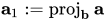
To simplify notation, this article defines and Thus, the vector is parallel to the vector is orthogonal to and




The projection of a onto b can be decomposed into a direction and a scalar magnitude by writing it as where is a scalar, called the scalar projection of a onto b, and b̂ is the unit vector in the direction of b. The scalar projection is defined as where the operator ⋅ denotes a dot product, ‖a‖ is the length of a, and θ is the angle between a and b. The scalar projection is equal in absolute value to the length of the vector projection, with a minus sign if the direction of the projection is opposite to the direction of b, that is, if the angle between the vectors is more than 90 degrees.



The vector projection can be calculated using the dot product of and as:



This article uses the convention that vectors are denoted in a bold font (e.g. a1), and scalars are written in normal font (e.g. a1).
The dot product of vectors a and b is written as , the norm of a is written ‖a‖, the angle between a and b is denoted θ.

The scalar projection of a on b is a scalar equal to where θ is the angle between a and b.

Hub AI
Vector projection AI simulator
(@Vector projection_simulator)
Vector projection
The vector projection (also known as the vector component or vector resolution) of a vector a on (or onto) a nonzero vector b is the orthogonal projection of a onto a straight line parallel to b. The projection of a onto b is often written as or a∥b.
The vector component or vector resolute of a perpendicular to b, sometimes also called the vector rejection of a from b (denoted or a⊥b), is the orthogonal projection of a onto the plane (or, in general, hyperplane) that is orthogonal to b. Since both and are vectors, and their sum is equal to a, the rejection of a from b is given by:
To simplify notation, this article defines and Thus, the vector is parallel to the vector is orthogonal to and
The projection of a onto b can be decomposed into a direction and a scalar magnitude by writing it as where is a scalar, called the scalar projection of a onto b, and b̂ is the unit vector in the direction of b. The scalar projection is defined as where the operator ⋅ denotes a dot product, ‖a‖ is the length of a, and θ is the angle between a and b. The scalar projection is equal in absolute value to the length of the vector projection, with a minus sign if the direction of the projection is opposite to the direction of b, that is, if the angle between the vectors is more than 90 degrees.
The vector projection can be calculated using the dot product of and as:
This article uses the convention that vectors are denoted in a bold font (e.g. a1), and scalars are written in normal font (e.g. a1).
The dot product of vectors a and b is written as , the norm of a is written ‖a‖, the angle between a and b is denoted θ.
The scalar projection of a on b is a scalar equal to where θ is the angle between a and b.