


Community hub
Recent from talks
Contribute something
Nothing was collected or created yet.
Velká pardubická
View on Wikipedia | This article includes a list of general references, but it lacks sufficient corresponding inline citations. (October 2013) |
 Racecourse in Pardubice | |
| Location | Pardubice, Czech Republic |
|---|---|
| Inaugurated | 5 November 1874 |
| Race type | Steeplechase |
| Website | zavodistepardubice.cz |
| Race information | |
| Distance | 6.9 km (4 mi 506 yd) |
| Surface | Turf |
| Qualification | Six-years-old and up |
Velká pardubická (Grand Pardubice Steeplechase[1]) is a cross-country (point to point) steeplechase run in Pardubice, Czech Republic since 1874. It takes place every year on the second Sunday in October.
The length of the steeplechase is 6.9 km (34 furlongs), with 31 obstacles. It usually takes 9–10 minutes to finish the course; the record is 8:56.01 set by Ribelino in 2015.
Horses starting in the race must be at least six years old (before 2009, the minimum age was seven years); Czech horses must qualify by finishing at least one of four qualifying races during the season.
History
[edit]The race was first run in 1874 in Pardubice, a town long known in the horse racing world, as some trainers and jockeys from England came there to work. The current steeplechase course was established in 1856, however the course first took its present-day form in the years just after World War II.[2]
The course of the race has been changed several times, most recently in 1998 when the direction of the final phase of the race was changed to accommodate the new grandstand. The surface of the racecourse is mainly grass, but one-quarter of the race is run through ploughed fields, which used to take almost half of the race in the past. Some obstacles have also been changed, mostly to improve safety, although the difficulty of the race is said to have suffered as a result.[2]
Obstacles
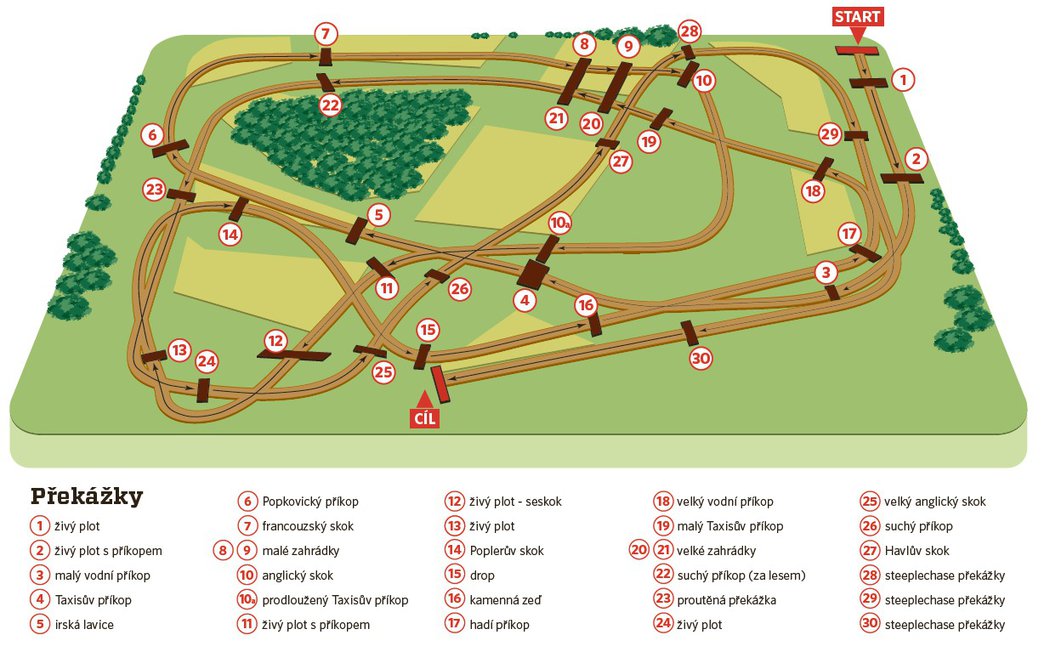
[edit]Horses must negotiate a total of 31 obstacles.[3] These are:
- 1 - Hedge. (1.2m)
- 2 - Hedge with ditch. (1.3m, with a 60 cm ditch on the other side)
- 3 - Small water jump. (3m long)
- 4 - Taxis ditch. (This is the most famous obstacle in the race, and it is jumped just once. 28 horses have died at this obstacle. In the past it consisted of a 2 m deep and 5 m long ditch hidden behind a 1.5 m high hedge. It was changed before the 1994 race to be a 1 m deep and 4 m long ditch with a 1.5 m high hedge. For the 2021 race the obstacle will have a 0.75 m deep ditch and 5 m long ditch with a 1.35 m to 1.45 m high hedge.[4] This obstacle is used only for the Velká pardubická, and horses are not permitted to use it for training.)
- 5 - Irish bank. (This unusual obstacle requires the horses to shimmy up and down a steep artificial bank.)
- 6 - Popkovic ditch. (1.3m hedge with a 2m long ditch on the other side)
- 7 - French jump. A pair of closely spaced hedges, 1.2m and 1.3m in height, which must be jumped as one.
- 8 & 9 - Small gardens. A pair of hedges, 1.25m and 1.3m in height, which are jumped in quick succession.
- 10 - English jump. (1.2m hedge with a ditch on the takeoff side)
- 10a - Extended taxis ditch. (Small hedge, about 1.1m tall, which joins with the main taxis ditch)
- 11 - Hedge with ditch. (1.3m, with a ditch on the landing side)[5]
- 12 - Hedge. (1.2 m high and 1.3 m wide hedge with a 60 cm. The landing side is 0.5 m lower than the takeoff side)
- 13 - Hedge. (1.3 m high and wide hedge that's 0.8 m high)
- 14 - Popler's Jump. (0.8 m high double railing. It is named after the famous interwar rider and two-time winner of the Grand Cpt. Rudolf Popler, who died on this jump in 1932. In 1991, Železník fell here, but jockey Josef Váňa senior remounted and Železník went on to claim his fourth victory.)
- 15 - Drop Bank. (In front of the stands. It is a two-meter drop.)
- 16 - Stone Wall. (Stone wall in front of the stands 0.8 m wide and 0.85 m high wall, which is approached from a plowed field.)
- 17 - Water Trough. (The largest water obstacle in the race. It is used to be 2 m deep but since the 1990s it has been changed to be 4.5 m wide and 0.7 m lower rebound compared to the original rebound.)
- 18 - Large Moat. (In the past the second most feared obstacle[citation needed] behind Taxis Ditch now 4 m wide and 0.45 m deep.)
- 19 - Mini Taxis drop. (The last of the three 'Taxis' ditch on the course. The hedge is 1.5 m high, 2 m wide and there is a 1.7 m ditch on the landing side.)
- 20 & 21 - Small gardens. (A pair of hedges, 1.25m and 1.3m in height, which are jumped in quick succession.)
- 22 - Open brook. (A simple ditch with a white bounce beam which in the past where not there which lead to horses not seeing the brook. The brook is 3m wide and 0.9 m deep.)
- 23 - Steeplechase obstacle. (Steeplechase jumps have replaced wicker obstacles, which are no longer jumped. This fence is 1.3 m high and 0.6 m wide.)
- 24 - "At the hangar hedge" Hedge. (Named after it closeness to hangars by a nearby airport. It is a 1.3 m high and wide hedge. 0.6 m in front of it is an 0.8 m high bouncing crossbar.)
- 25 - Big English jump. (0.5 m high and 1.6 m wide hedge, 0.6 m in front of it stands an 0.8 m high bounce beam. The difficulty of the obstacle is the landing, because the landing area is 40 cm higher than the takeoff side. Often causes problems in the wet.)
- 26 - American post and rails. (2.4 m wide ditch with a 0.5 m high bounce beam.)
- 27 - Havel's Jump. (1.4 m high and 1.9 m wide hedge with an 0.8 m high bounce beam at a distance of 0.5 m in front of the fence, followed by a 2.5 m wide shallow ditch. The difficulty of the jump is mainly due to its closeness to the end of the race.)
- 28 - Steeplechase obstacle. (1.3 m high and 0.6 m wide)
- 29 - Steeplechase obstacle. (1.3 m high and 0.6 m wide)
- 30 - Steeplechase obstacle. (1.3 m high and 0.6 m wide)[6]
Curiosities
[edit]Historically, the most successful horse in the race was Železník, winning four times (from 1987 to 1989 and again in 1991).
Josef Váňa Sr. is the event's most successful jockey, with eight victories.[citation needed]
The first (and, as of 2025, only) woman to have won the race is Countess Lata Brandisová, who won in 1937 with her mare, Norma, seven lengths ahead of the professional jockey Willibald Schlagbaum in second place. Only 10 of the 15 runners finished. She was the first woman to enter the race in 1927 (falling five times and remounting to finish fifth). In later years[clarification needed] she came in fourth, third, and second on Norma.[7]
The 1937 Velká pardubická was the last race held for nearly a decade. The 1938 race was called off following the Munich Agreement and not run during World War II.
Winners
[edit]| Year | Winning Horse | Age | Handicap (kg) | Jockey | Trainer | Owner | Winning Time |
| 2025 |  Stumptown Stumptown |
8 | 70 | Keith Donoghue |
Gavin Cromwell |
Furze Bush Syndicate |
9m 06.55s |
| 2024[a] |  Sexy Lord Sexy Lord |
8 | 70 | Jaroslav Myška |
Martina Růžičková |
HC Amphora-Hora
|
9m 40.00s |
 Godfrey Godfrey |
8 | 70 | Jan Faltejsek |
Dalibor Török |
DS Pegas
| ||
| 2023 | Sacamiro |
10 | 70 | Jan Faltejsek |
Eva Petříková |
Jezdecký oddíl Beňov | 9m 28.27s |
| 2022 |  Mr Spex Mr Spex |
8 | 70 |  Lukáš Matuský Lukáš Matuský |
Luboš Urbánek |
Lokotrans | 9m 31.24s |
| 2021 | Talent |
10 | 70 | Pavel Složil ml. |
Hana Kabelková |
DS Kabelkovi | 9m 12.79s |
| 2020 | Hegnus |
12 | 70 | Lukáš Matuský |
Radek Holčák |
Ševců | 9m 22.99s |
| 2019 | Theophilos |
9 | 70 | Josef Bartoš |
Josef Váňa sr. |
Dostihový klub iSport-Váňa | 9m 28.76s |
| 2018 | Tzigane du Berlais |
7 | 70 | Jan Faltejsek |
Pavel Tůma |
Dr. Charvát | 9m 05.56s |
| 2017 |  No Time To Lose No Time To Lose |
8 | 70 | Jan Kratochvíl |
Josef Váňa sr. |
DS Paragan | 9m 39.98s |
| 2016 | Charme Look |
9 | 70 | Jan Faltejsek |
Martina Růžičková |
Orling | 9m 42.86s |
| 2015 | Ribelino[b] |
7 | 68 | Pavel Kašný |
Stanislav Kovář |
Lokotrans | 8m 56.01sR |
| 2014 | Orphee des Blins |
12 | 66 | Jan Faltejsek |
 Grzegorz Witold Wroblewski Grzegorz Witold Wroblewski |
DS Pegas | 9m 08.25s |
| 2013 | Orphee des Blins |
11 | 66 | Jan Faltejsek |
Grzegorz Witold Wroblewski |
DS Pegas | 9m 33.22s |
| 2012 | Orphee des Blins |
10 | 66 | Jan Faltejsek |
Grzegorz Witold Wroblewski |
DS Pegas | 9m 13.39s |
| 2011 | Tiumen |
10 | 68.5 | Josef Váňa sr. |
Josef Váňa sr. |
Köi Dent | 9m 15.29s |
| 2010 | Tiumen |
9 | 68 | Josef Váňa sr. |
Josef Váňa sr. |
Köi Dent | 9m 03.73s |
| 2009 | Tiumen |
8 | 68 | Josef Váňa sr. |
Josef Váňa sr. |
Köi Dent | 9m 19.56s |
| 2008 | Sixteen[c] |
8 | 66 | Josef Bartoš |
Josef Váňa sr. |
Jaroslav Bouček Buc-Film | 8m 58.99sR |
| 2007 | Sixteen |
7 | 66 | Dušan Andrés |
Josef Váňa sr. |
Jaroslav Bouček Buc-Film | 9m 18.66s |
| 2006 | Decent Fellow |
11 | 67 | Josef Bartoš |
Josef Váňa sr. |
Dr. Charvát | 9m 20.60s |
| 2005 |  Maskul Maskul |
11 | 67 | Dirk Fuhrmann |
František Holčák |
Nýznerov | 9m 11.25sR |
| 2004 | Registana |
8 | 65 | Peter Gehm |
Čestmír Olehla |
Wrbna Racing | 9m 15.48sR |
| 2003 | Registana |
7 | 65 | Peter Gehm |
Čestmír Olehla |
Wrbna Racing | 9m 30.14s |
| 2002 | Maskul |
8 | 67 | Peter Gehm |
Radek Holčák |
Nýznerov | 10m 22.07s |
| 2001 | Chalco |
9 | 67 | Peter Gehm |
Josef Váňa sr. |
Viktor Komárek | 10m 04.52s |
| 2000 | Peruán |
12 | 67 | Zdeněk Matysík |
Lenka Horáková |
DC Zámrsk - MUDr. Bruna | 9m 29.00s |
| 1999 | Peruán |
11 | 67 | Zdeněk Matysík |
Lenka Horáková |
DC Zámrsk - MUDr. Bruna | 9m 16.00sR |
| 1998 | Peruán |
10 | 67 | Zdeněk Matysík |
Lenka Horáková |
DC Zámrsk - MUDr. Bruna | 10m 10.01s |
| 1997 | Vronsky |
9 | 67 | Josef Váňa sr. |
Josef Váňa sr. |
Viktor Komárek | 10m 33.30s |
| 1996 | Cipísek |
8 | 64.5 |  Vladislav Snitkovskij Vladislav Snitkovskij |
Josef Váňa sr. |
Stáj Luka | 9m 35.10sR |
| 1995 | It's a Snip |
10 | 67 | Charlie Mann |
Charlie Mann |
The Icy Fire Partnership | 10m 03.43s |
| 1994 | Erudit |
8 | 65.5 | Vladislav Snitkovskij |
František Holčák |
Pěník Vlachovice | 10m 06.07s |
| 1993 |  Rigoletto Rigoletto |
9 | 70.5 | Libor Štencl |
František Holčák |
Valstav-Paschal | 10m 29.0s |
| 1992 | Quirinus |
10 | 70.5 | Jaroslav Brečka |
Pavel Kalaš |
Pôdohospodárske družstvo Senica | 10m 09.1s |
| 1991 | Železník |
13 | 70.5 | Josef Váňa sr. |
Čestmír Olehla |
Státní statek Bruntál - Světlá Hora | 10m 01.0s |
| 1990 | Libentína |
7 | 70.5 | Karel Zajko |
František Holčák |
ŠPP Motěšice | 9m 49.4sR |
| 1989 | Železník |
11 | 70.5 | Josef Váňa sr. |
Čestmír Olehla |
Státní statek Bruntál - Světlá Hora | 10m 16.3s |
| 1988 | Železník |
10 | 70.5 | Josef Váňa sr. |
Čestmír Olehla |
Státní statek Bruntál - Světlá Hora | 10m 59.8s |
| 1987 | Železník |
9 | 70.5 | Josef Váňa sr. |
Čestmír Olehla |
Státní statek Bruntál - Světlá Hora | 9m 56.13sR |
| 1986 | Valencio |
9 | Karel Zajko |
František Holčák |
JZD Velké Karlovice | 10m 39.4s | |
| 1985 | Festival |
11 | Petr Vozáb |
Václav Čermák |
PP Kladruby | 10m 36.4s | |
| 1984 |  Erot Erot |
9 | N. Chludějev |
G. Chajanin |
Hřebčín Voschod | 10m 48.9s | |
| 1983 | Sagar |
8 | Pavel Liebich |
Václav Čermák |
PP Kladruby | 10m 28.0s | |
| 1982 | Sagar |
7 | Pavel Liebich |
Václav Čermák |
PP Kladruby | 10m 12.04s | |
| 1981 | Sagar |
6 | Pavel Liebich |
Václav Čermák |
PP Kladruby | 12m 46.37s | |
| 1980 | Simon |
9 | Vlastimil Knápek |
Květoslav Mocek |
JZD Pokrok Otice | 11m 47.53s | |
| 1979 | Legenda |
6 | Jiří Chaloupka |
Jiří Chaloupka |
JZD Družba Čebín | 11m 07.10s | |
| 1978 | Lancaster |
6 | Jiří Kasal |
Harry Petrlík sr. |
PP Šamorín | 11m 30.60s | |
| 1977 | Václav |
9 | Václav Chaloupka |
Václav Chaloupka |
Státní statek Židlochovice | 12m 15.20s | |
| 1976 | Limit |
8 | František Zobal |
František Janík |
PP Albertovec | 10m 59.40s | |
| 1975 | Mor |
11 | Karel Benš |
František Janík |
PP Albertovec | 11m 01.70s | |
| 1974 | Mor |
10 | Karel Benš |
František Janík |
PP Albertovec | 10m 42.70s | |
| 1973 | Stephen's Society |
7 | Christopher Collins |
Arthur Stephenson |
Christopher Collins | 10m 04.90sR | |
| 1972 | Korok |
13 | Václav Chaloupka |
Václav Chaloupka |
Státní statek Židlochovice | 10m 55.20s | |
| 1971 | Korok |
12 | Václav Chaloupka |
Václav Chaloupka |
Státní statek Židlochovice | 11m 02.80s | |
| 1970 |  Vezna II Vezna II |
6 | Nedělko G. Milev |
Petko Vladimirov |
DZS Štefan Karadža | 11m 41.20s | |
| 1969 | Korok |
10 | Václav Chaloupka |
Václav Chaloupka |
Státní statek Židlochovice | 11m 01.20s | |
| 1968 | cancelled[d] | ||||||
| 1967 | Dresděn |
8 | A.N. Sokolov |
JO Avangard Lvov | 11m 34.70s | ||
| 1966 | Nestor |
7 | Tibor Kňazík |
Tibor Kňazík |
ŠPU Prešov | 12m 22.60s | |
| 1965 | Mocná |
7 | František Vítek |
Stanislav Bárta |
Státní statek Benešov | 10m 39.60s | |
| 1964 | Priboj |
7 | Valentin Z. Gorelkin |
Ivan Avdějev |
DSO Urožaj | 11m 33.60s | |
| 1963 | Koran |
12 | František Vítek |
Václav Čechura |
SPÚ Tlumačov | 10m 47.20s | |
| 1962 | Gaboj |
6 | Rostislav P. Makarov |
Ivan Avdějev |
DSO Urožaj | 10m 05.10sR | |
| 1961 | Grifel |
8 | Ivan L. Avdějev |
Ivan Avdějev |
Hřebčín č. 158 | 10m 21.30sR | |
| 1960 | Grifel |
7 | Ivan L. Avdějev |
Ivan Avdějev |
Hřebčín č. 158 | 12m 32.00s | |
| 1959 | Epigraf |
10 | Vladimir P. Prachov |
Valerian Kujbyšev |
CKSK MO | 12m 05.20s | |
| 1958 | Epigraf |
9 | Vladimir P. Prachov |
Valerian Kujbyšev |
CKSK MO | 13m 11.00s | |
| 1957 | Epigraf |
8 | Vladimir N. Fedin |
Valerian Kujbyšev |
CKSK MO | 11m 27.90s | |
| 1956 | Letec |
11 | Josef Vavroušek |
Josef Dobeš |
Státní statek Xaverov | 13m 14.80s | |
| 1955 | Furioso XIV |
7 | Josef Čajda |
Emil Šulgan |
ŠŽ Topoľčianky | 11m 32.10s | |
| 1954 | Unkas |
14 | Ludvík Raimond |
Jiskra Moravský Beroun | 13m 08.00s | ||
| 1953 | Junák |
10 | Ferdinand Palyza |
Ferdinand Palyza |
DSO Slavoj Opava | 11m 13.50s | |
| 1952 | Vítěz |
13 | Miloš Svoboda |
Družstvo Kalich | 11m 25.30s | ||
| 1951 | Salvátor |
10 | Vladimír Hejmovský (Vladimír Alexandrovič Gejmovskij) |
Vladimír Hejmovský (Vladimír Alexandrovič Gejmovskij) |
Sokol KP Opava | 10m 58.00s | |
| 1950 | n/d Var | 11 | Josef Jungmann |
Sokol Borek | 11m 17.20s | ||
| 1949 | Učeň |
11 | Oldřich Dostál |
VSJ Pardubice | 10m 55.30s | ||
| 1948 | n/d Var | 9 | Miroslav Kotek |
Jaroslav Houra |
Vojenský útvar 2108 | 11m 03.30s | |
| 1947 | Rayon De Lune |
12 | Maurice Buret |
Centre National des Sports Equesters | 10m 30.80sR | ||
| 1946 | n/d Titan | 9 | Miloš Svoboda |
Miloš Svoboda |
Vojenský útvar 2228 | 11m 56.40s | |
| 1938–1945 | cancelled[e] | ||||||
| 1937 | Norma |
10 | Lata Brandisová[7] |
Karel Šmejda | Zdenko Radslav Kinský | 10m 47.00s | |
| 1936 |  Herold Herold |
11 | Oskar Lengnik |
Kerpen | Oskar Lengnik | 10m 47.00s | |
| 1935 | Herold |
10 | Oskar Lengnik |
Oskar Lengnik | 10m 41.40s | ||
| 1934 |  Wahne Wahne |
11 | H. Wiese |
H. Wiese | H. Wiese | 12m 44.00s | |
| 1933 | Remus |
8 |  Reguiero Spano Reguiero Spano |
Dr. Alfred Tonelles | 11m 24.60s | ||
| 1932 | Remus |
7 | Reguiero Spano |
Dr. Alfred Tonelles | 12m 48.80s | ||
| 1931 | Pohanka |
5 | Lt. F. Durand |
Karel Šmejda | Zdenko Radslav Kinský | 14m 47.80s | |
| 1930 |  Gyi Lovam! Gyi Lovam! |
8 | Rudolf Popler |
Rudolf Popler | Cpt. Rudolf Popler | 12m 00.00s | |
| 1929 | Ben Hur |
7 | Gustav Schwandt |
Gustav Schwandt | Gustav Schwandt | 12m 37.00s | |
| 1928 |  Vogler Vogler |
8 | Hans Schmidt |
Feldwebel H. Nünninghoff |
Feldwebel H. Nünninghoff | 12m 03.90s | |
| 1927 | Forum |
n/a | Josef Charous |
Josef Charous |
Cpt. J. Charous | 14m 00.00s | |
| 1926 | All Right II |
7 | Rudolf Popler |
Lufta | Stáj Popler-Formánková | 17m 44.60s | |
| 1925 | Landgraf II |
7 | Karek Holoubek |
Stáj Max | 19m 19.20s | ||
| 1924 | Herero | Eduard Stärz | Eduard Stärz | Stáj Sankt Georg | 13m 10.00s | ||
| 1923 | Landgraf II |
5 | 66 | Jan Pintér |
Martinkovich | Stáj Max | 13m 29.00s |
| 1922 | Baldur | 5 | 60 | František Gimpel |
Buřival | Lady Huntingghost | 15m 27.00s |
| 1921 | Periwig | 7 | 68 | Josef Syrový |
Oldřich Rosák |
A. Vaněk | 15m 32.00s |
| 1920 | Jonathan[f] | 11 | 70 | Karel Kozlík |
Jan Pálffy | 20m 15.00s | |
| 1914–1919 | cancelled[g] | ||||||
| 1913[h] | Hurain | Cpt. Wilhelm Reimer | Capt. Johann Buzinkay v. Buzinka | ||||
| Dick Turpin | 10 | Ferencz Janek | Martinkovich | Lt. Friedrich Rosenthal | 11m 11.50s | ||
| 1912[h] | Hurain | 1Lt. Wilhelm Reimer | Capt. Johann Buzinkay v. Buzinka | ||||
| Jamagata | 6 |  František Bartosch František Bartosch |
František Bartosch |
František Bartosch | 11m 39.40s | ||
| 1911 |  Glenmorgan Glenmorgan |
6 | 73.5 | Jenö von Egan-Krieger |
Jenö von Egan-Krieger |
Count Frankenberg | 10m 22.00s |
| 1910 | Paul Heston |
5 | 70 | Max Seiffert | Maj. Karl Adam von Wuthenau-Hohenthurm | 14m 26.50s | |
| 1909 | race void[i] | ||||||
| 1908 | cancelled[j] | ||||||
| 1907 | Kourgan |
6 | Josef Birghan |
Rottman | P. Mecklenburg | 11m 24.60s | |
| 1906 | Tigra |
4 | Harry H. Huxtable |
Wheeler | Anton Dreher | 12m 10.60s | |
| 1905 | Scotch Moor |
10 | 71 | Max Seiffert | Feldwebel Knesebeck | not measured | |
| 1904 | Dennis | 6 | Thomas H. Buckenham |
Walter Earl |
Count Karel Kinsky | not measured | |
| 1903 | Jour Fix | 7 | 67.5 |  Oldřich Rosák Oldřich Rosák |
van Ness | Emil von David jr. | 12m 04.00s |
| 1902 | Jour Fix | 6 | 62.5 | Oldřich Rosák |
Hough | Emil von David jr. | not measured |
| 1901 | Chorazy | 6 | 62 | Frederick E. Slinn |
1st Lt. Eduard Koller | not measured | |
| 1900 |  Magyarád Magyarád |
8 | 68.5 | Thomas H. Buckenham |
Ralph Heath |
Count Zdenko Kinský | not measured |
| 1899 | Sláva | 5 | 63.5 | Thomas H. Buckenham |
Ralph Heath |
Count Zdenko Kinský | not measured |
| 1898 | Handy Andy |
n/a | 80 | Robert Jekyll |
H.Brown Jr. | Gustav Beit | not measured |
| 1897 | Magyarád |
5 | 71 |  Edward Geoghegan Edward Geoghegan |
Ralph Heath |
Count Zdenko Kinský | not measured |
| 1896 | Lady Anne |
10 | 80 | Edward Geoghegan |
George Herbert |
Jacques Schawell | not measured |
| 1895 | Galamb II |
4 | 74 | Arthur Hall |
John Pache | Robert Lebaudy | not measured |
| 1894 | Lady Anne |
8 | 77.5 | Edward Geoghegan |
George Herbert |
Jacques Schawell | not measured |
| 1893 | Hadnagy | 7 | 69 | George Williamson |
Hansi Fries | General Count H. Lamberg | not measured |
| 1892 | Alphabet | 7 | 63 | John Westlake |
Dobrovský |
Count Rudolf Ferdinand Kinský | not measured |
| 1891 | Lady Anne |
5 | 64 | Richard Harry Fletcher |
George Herbert |
Jacques Schawell | not measured |
| 1890 | Alphabet | 5 | 62.5 | George Williamson |
Dobrovský |
Count Rudolf Ferdinand Kinský | not measured |
| 1889 | Parisis | 6 | 61.5 | Richard Harry Fletcher |
1st Lt. Alex Kutchenbach | not measured | |
| 1888 | Et Caetera |
4 | 66.5 | Max Phillips |
 Count Nicolo Esterházy Count Nicolo Esterházy |
not measured | |
| 1887 | Woodman | 9 | 70 | Hector Baltazzi |
Hector Baltazzi | not measured | |
| 1886 | Hanno |
4 | 62 | Richard Harry Fletcher |
Ferdinand von Schosberger | not measured | |
| 1885 | Abracadabra | 6 | 73 | Hansi Fries | Hansi Fries | Count Nicolo Esterházy |
not measured |
| 1884 | Jessica |
6 | 75 | William H. Moore |
Oscar Oehlschläger | not measured | |
| 1883 | Victoria | 10 | 80.5 | Hector Baltazzi |
George Herbert |
Jacques Schawell | not measured |
| 1882 | Per Dampf |
5 | 71 | Thomas Harraway |
Baron Ernst von Falkenhausen | not measured | |
| 1881 | Victoria | 8 | 83.5 | Hector Baltazzi |
George Herbert |
Jacques Schawell | not officially 10m 45.20s |
| 1880 | Good Morning | 4 | 66 | Max Phillips |
Ralph Heath |
G.F.J. Smith (Zdenko Kinský) | not measured |
| 1879 | Rudi |
5 | 73.5 | I. Hanreich | John Beeson |
Count Nicolo Esterházy |
not measured |
| 1878 | Brigand |
8 | 84 | Fritz Reichsgraf Wolff-Metternich zur Grachth |
John Reeves |
Count Tasziló Festetics |
not measured |
| 1877 | Brigand |
7 | 80 | Fritz Reichsgraf Wolff-Metternich zur Grachth |
George Long |
Count Tasziló Festetics |
not measured |
| 1876 | cancelled[k] | ||||||
| 1875 | Brigand |
5 | 78.5 | George Herbert |
George Long |
Count Tasziló Festetics |
not measured |
| 1874 | Fantôme |
6 | 80.5 | George Sayers |
Baron von Cramm |
not measured | |
- R – track record
- ^ Dead heat.
- ^ In 2015, Nikas finished first but was disqualified for doping.
- ^ In 2008, Amant Gris finished first but was disqualified for taking the wrong course.
- ^ The 1968 race was cancelled due to the Soviet Union occupation of the Czechoslovakia Prague Spring.
- ^ The race was not run in 1938–1945 due to Nazi occupation and World War II.
- ^ In 1920, Jonathan was disqualified for not finishing in time limit.
- ^ The race was not run in 1914–1919 due to World War I.
- ^ a b In 1912 and 1913 there was also a steeple-chase race for army.
- ^ The 1909 race was declared void as none of the three horses that ran finished.
- ^ The 1908 race was cancelled due to snow.
- ^ The 1876 race was cancelled due to frost.
References
[edit]- ^ Jenkins, Tom (18 October 2018). "Grand Pardubice Steeplechase: the world's toughest horse race – a photo essay". The Guardian. Retrieved 10 June 2023.
- ^ a b "History of the Velká Pardubická České pojišťovny". Archived from the original on 2015-12-18.
- ^ "Obstacles".
- ^ "Váňa: kvůli "novému" Taxisu nepřítel. Upravenou překážku čeká premiéra". Blesk (in Czech). 6 October 2021. Retrieved 16 October 2021.
- ^ "Course" (JPG).
- ^ "131. Velká pardubická se Slavia pojišťovnou". Blesk (in Czech). 10 October 2021. Retrieved 16 October 2021.
- ^ a b Richard Askwith (2019). Unbreakable: The Woman Who Defied the Nazis in the World's Most Dangerous Horse Race. Yellow Jersey Press.
External links
[edit]
Velká pardubická
View on GrokipediaOverview
Description
The Velká pardubická is a renowned cross-country steeplechase race held annually in the Czech Republic, covering a demanding distance of 6,900 meters over diverse terrain that includes open fields, wooded sections, and paved roads.[4][2] This point-to-point format distinguishes it from traditional closed-circuit track races, as competitors navigate a linear course from start to finish, testing both equine stamina and rider skill across natural and artificial barriers.[10] The race features a total of 31 fixed obstacles, comprising fences, ditches, and hedges that must be jumped in sequence, making it one of Europe's most grueling equestrian events.[11][4] Scheduled on the second Sunday in October at Pardubice Racecourse, the event draws international entrants and spectators, with the main race typically starting in the mid-afternoon following preliminary heats.[2][10] For the 2025 edition, the total prize fund was 5 million Czech crowns (approximately €200,000), with the winner receiving €75,000, reflecting the race's prestige despite its emphasis on challenge over commercial scale.[12] Participation is limited to qualified horses and jockeys, with fields typically comprising 15 to 20 runners selected through prior qualifying events.[10][11]Significance
The Velká pardubická is widely regarded as the "world's most dangerous horse race" owing to its demanding cross-country format and the high incidence of injuries and fatalities to both horses and riders.[5][13] Over its history, the race has seen numerous equine deaths, particularly at challenging obstacles like the Taxis Ditch, where dozens of horses have perished, including at least 25 documented cases since the early 20th century, underscoring the severe risks involved.[14][6] Compared to other prominent steeplechases such as the Grand National, the Velká pardubická stands out for its greater number of obstacles—31 in total—and its true cross-country nature, traversing varied terrain rather than a fixed circuit, which amplifies the physical and mental demands on participants.[15][3] This configuration tests the raw endurance and resilience of horses and riders without concessions like weight handicaps based on prior achievements; all entrants carry a uniform 70 kg, with only a 2 kg allowance for mares, ensuring a level playing field that emphasizes inherent stamina over adjusted advantages.[16] The race holds significant prestige in equestrian sports, recognized internationally for its historical rigor and included in elite steeplechase calendars since the 1990s, akin to Group 1-level events in jump racing hierarchies.[17] The 2025 edition was won by the Irish-trained Stumptown, marking a historic victory for Ireland and underscoring the event's growing international draw.[12] Economically, it vitalizes Pardubice by drawing over 20,000 spectators each year, fostering tourism, hospitality, and local commerce during the annual October festival.[18]History
Origins and Establishment
The Velká pardubická steeplechase was established in 1874 as a prestigious cross-country race inspired by English steeplechases, particularly the Grand National, which emphasized endurance over natural terrain and obstacles. The inaugural event was organized by the Czech Society of Horseracing, with key involvement from Duke Maxmilian Ugarte, Prince Emil Fürstenberg, and Duke Octavian Kinsky, on the newly developed racecourse at the Cvrčkov pastures in Pardubice, drawing on the region's long tradition of equestrian activities dating back to organized hunts in the 1840s. On November 5, 1874, 14 horses competed over a demanding cross-country course featuring natural barriers such as walls, ditches, and forested sections, culminating in a straight finish with a bullfinch hedge. The victory went to the French horse Fantôme, ridden by English jockey George Sayers for German owner Baron von Cramm, who claimed a substantial prize of 11,700 guilders—the equivalent of a significant fortune at the time.[1][3][19] In its early years, the race faced practical challenges with the terrain, leading to adjustments in the route to ensure safety and fairness while preserving the cross-country character. The original path, laid out since the racecourse's establishment in 1856, incorporated plowed fields, streams, and wooded areas, but initial editions encountered issues with uneven ground and waterlogged sections, prompting refinements by the late 1870s. The course continued to evolve over the following decades, eventually reaching its modern length of 6,900 meters with 31 obstacles. These changes reflected the organizers' commitment to balancing spectacle with equine welfare, influenced by feedback from international participants accustomed to British racing standards.[1] Participation in the race's formative period was predominantly limited to European nobility and military officers, who owned the competing horses and often served as patrons of the sport within the Austro-Hungarian Empire. Owners such as Counts Festetics, Esterházy, and Kinský—prominent figures in Bohemian aristocracy—dominated the entries, with foreign jockeys from England and Germany handling the rides due to their expertise in steeplechasing. This elite composition underscored the event's status as a social gathering for the upper classes, attracting crowds from across the continent. Local adoption gained momentum as Czech nobles increasingly invested in breeding and training, paving the way for greater involvement; however, the first outright Czech winner did not arrive until 1902 with Ulrich Rosák, symbolizing the race's deepening roots in national equestrian culture.[20][13]Evolution and Key Milestones
The Velká pardubická steeplechase faced significant interruptions during the two World Wars, reflecting the broader turmoil in Europe. The race was canceled from 1914 to 1918 due to World War I, halting the event amid widespread mobilization and resource shortages across the Austro-Hungarian Empire. Similarly, it was not held from 1939 to 1945 during World War II, with the Nazi occupation of Czechoslovakia leading to further disruptions and the full steeplechase suspended as wartime priorities dominated. These breaks marked the longest pauses in the race's history, underscoring its vulnerability to geopolitical conflicts.[1] Following World War II, the race resumed in 1946 but underwent profound changes with the communist coup in 1948, which nationalized all private stables, breeding operations, and racing infrastructure in Czechoslovakia. Under the new regime, horse racing became a state-controlled enterprise, emphasizing centralized breeding programs to produce superior thoroughbreds for national prestige and agricultural integration. State farms like those in Kladruby and Slatiňany focused on developing hardy steeplechase horses, often incorporating Soviet influences, which led to dominance by state-bred or imported Soviet runners in the 1950s and 1960s. The race was also paused following the Soviet invasion in 1968. This era transformed the event into a symbol of socialist achievement, though it limited private participation and innovation until the regime's end.[21][1] The transition to democracy in the late 1980s and early 1990s brought modernization efforts, including the introduction of qualification races in the 1990s to assess horse fitness and safety over preparatory courses mimicking the main obstacles. This reform aimed to reduce risks and elevate competitive standards, aligning with international norms. A pivotal organizational shift occurred in 1993 with the founding of the Dostihový spolek Pardubice, a professional association that assumed management of the race, improving infrastructure, marketing, and governance to professionalize the event.[1][22] Post-2000, the Velká pardubická saw a surge in international participation, drawing entries from Ireland, France, Germany, and the UK, which diversified the field and heightened global prestige. A key milestone came in 2022 when the German-bred Mr Spex, ridden by Slovak jockey Lukáš Matuský, became the first non-Czech winner in the modern era since 1995, signaling the race's growing appeal beyond national borders.[23][1]Course and Obstacles
Race Course Layout
The Velká Pardubická race course starts at the Pardubice Racecourse in the eastern Bohemian city of Pardubice and spans 6,900 meters through a varied cross-country terrain that combines open fields, ploughed areas, and forested sections. This layout demands significant stamina from participants, as the path weaves across grass, dirt, and mud surfaces in a natural setting originally designed for hunting grounds.[1][3][6] The course incorporates twists and turns, including a crossing over a small stream, which adds to the challenges of navigating the undulating landscape around the racecourse. In its early decades, nearly half the distance was run over ploughed fields, though this proportion has since been reduced to about a quarter to lessen the physical toll on horses. The path integrates natural hedges alongside artificial fences, totaling 31 obstacles that punctuate the route.[3][24] Throughout its history since 1874, the course has seen multiple modifications to its length and configuration, with the current 6,900-meter distance established relatively recently. Precursor steeplechases in the region, such as one measuring 3,200 meters in 1842, were shorter. Notable changes include a reconfiguration in the 1990s to build a new grandstand and adjustments in 1998 that shifted the final stage inside the main track for improved safety and logistics.[1][18] Viewing opportunities for spectators are provided by grandstands at the Pardubice Racecourse and open vantage points along the fields and wooded areas, allowing crowds to follow the race's progression; historical attendance has reached 30,000 to 40,000 viewers.[1][3]Notable Obstacles
The Velká pardubická steeplechase features 31 unique obstacles over its 6,900-meter course, testing the endurance, agility, and precision of horses and riders through a mix of hedges, ditches, banks, and walls.[3] Among these, several stand out for their design and historical significance, including water jumps, steep banks, and solid walls that demand flawless technique to avoid falls. The course includes a mix of plain fences, water jumps, banks, and walls, contributing to its reputation as one of the world's most demanding races.[25] The most notorious obstacle is the Great Taxis Ditch, a water jump introduced in 1874 that features a 1.4-meter-high hedgerow followed by an 8-meter span including a 1-meter-deep ditch. Known for its width over 5 meters and history of fatalities, it remains the race's signature challenge despite safety modifications.[3][6] One of the most iconic challenges is the Big Water Ditch (Háječek), a formidable water jump that requires horses to clear a 1.5-meter hedge before landing in a 4-meter-long ditch filled with water (currently 1 meter deep). Historically, the ditch was deeper, up to the necks of fallen riders, and this obstacle has been the site of numerous falls due to its deceptive approach over uneven terrain and the momentum needed for the broad span.[13][3] Its placement early in the race often weeds out less prepared competitors, emphasizing balance and speed. The Irish Bank presents a steep artificial ascent followed by a sharp drop-off, forcing horses to scramble up a near-vertical slope before leaping down, which demands precise landing to maintain rhythm. This bank-like obstacle, unique in its up-and-down motion, tests a horse's power and rider's control, as any hesitation can lead to stumbling or refusal.[5] Often cited as a pivotal test of athleticism midway through the course, it has prompted refinements over decades to preserve its challenge while reducing outright dangers.[13] The Great English Jump, a solid obstacle known for its unforgiving nature, is one of the few that becomes nearly unjumpable if approached at the wrong angle or speed, requiring a straight, committed effort from both horse and rider. Unlike flexible hedges, its rigid structure offers no forgiveness for errors, making it a psychological as well as physical barrier.[26] Positioned among the later jumps, it exemplifies the race's emphasis on sustained accuracy after earlier exertions. In response to animal welfare concerns and fatal incidents, significant safety updates have been implemented since 2000, including softer foam-padded landings on key obstacles like water ditches and the addition of optional bypass routes for injured horses to withdraw without further risk. For instance, the notorious Taxis Ditch—a similar water jump to the Big Water Ditch—was softened in 2021 by reducing its depth and adding padded edges following multiple horse deaths, while maintaining the core challenge. These modifications, alongside stricter qualification standards, have aimed to balance tradition with modern equine safety protocols.[14][27]Race Format and Organization
Rules and Regulations
The Velká pardubická operates under a handicap system where weights are assigned based on the horse's age, sex, and past performance to ensure competitive balance. Horses typically carry between 65 and 75 kg, including the rider's weight, with a base assignment of 70 kg and a 2 kg allowance for mares.[28][29] Entry into the race requires qualification, though there are no mandatory rounds on race day itself; instead, participation is encouraged and effectively gated through four annual trials held at Pardubice, along with select international cross-country events. Horses aged six years and older must finish in the top five or within 20 seconds of the winner in one of these Pardubice trials (race numbers 040301, 040401, 040501, 040701) or equivalent races in the Crystal Cup series or abroad in countries like Ireland, the UK, France, or Italy. The previous year's winner is exempt from these requirements.[28] In the event of a fall, a horse may be remounted by the rider provided it is not lamed or otherwise unfit to continue, but the rider is prohibited from assisting the horse from the ground or receiving external aid. Remounting has historically been a key feature of the race's endurance-testing nature, with riders sometimes remounting multiple times to complete the course. Horses that fall and cannot proceed are eliminated per the Czech Horseracing Code.[30][28] Veterinary inspections are conducted both pre-race and post-race to ensure animal welfare, with mandatory checks including a closed inspection on race morning. Disqualification is enforced for any detected doping violations or evidence of abuse, as seen in past cases where winners like Nikas in 2015 were stripped of titles following positive tests.[28][31] Winning times have occasionally fallen below 9 minutes, with the record at 8:56.01 set by Ribelino in 2015.[32]Participants and Preparation
The Velká pardubická typically features a field of 15 to 20 horses, with recent editions attracting around 16 entrants, including a mix of domestic and international competitors.[2][10] While the majority remain Czech-bred Thoroughbreds, foreign entries from countries such as Ireland, Germany, France, and Poland have increased since the 2010s, often comprising up to nine international horses in a single field to challenge the local specialists. The 2025 edition exemplified this trend, with Irish-trained Stumptown becoming the first horse from Ireland to win the race, ridden by Keith Donoghue.[33][34][35] Jockeys must meet one of the following criteria: at least 10 career wins over fences and completion of at least one steeplechase or cross-country race in the current year; or at least 10 placed finishes over fences and completion of one of the qualification races in the current year.[28] Prominent figures like Josef Váňa exemplify this expertise, having secured eight victories as a rider in the race, with his most recent win in 2011 at age 58 aboard Tiumen.[36][37] Horses, aged six years or older, prepare through a regimen of qualification races held at Pardubice throughout the season, such as the four specified events (races 040301, 040401, 040501, and 040701), where they must finish in the top five or within 20 seconds of the winner to qualify.[28] This process, spanning several months of cross-country and obstacle-specific training, prioritizes endurance and adaptability over raw speed to navigate the demanding 6,900-meter course, with modern approaches involving tailored conditioning to simulate the event's unique terrain and 31 obstacles.[4] International qualifiers may also earn entry via comparable long-distance steeplechases (at least 4,800 meters) in Ireland, the UK, France, or Italy from the prior season.[28] Breeding trends favor Thoroughbreds with proven jumping pedigrees, often sourced from Czech programs or imported lines that emphasize stamina and agility for cross-country demands; historically, state-supported breeding initiatives have contributed to the domestic pool, though specific lineages like those from traditional studs are less prominent in modern racing entries.[34] Entry involves fees set by the Czech Jockey Club, including an initial submission of 15,000 CZK plus VAT by early September, a declaration to run fee of 50,000 CZK plus VAT, and a supplementary option of 45,000 CZK plus VAT for late additions, with 15 slots reserved for club-registered owners.[16] International horses require EU-compliant health certificates and undergo a mandatory veterinary inspection on race week, ensuring compliance with cross-border animal welfare standards.[16] Sponsorships from entities like Slavia Insurance often support top contenders, offsetting costs for owners while enhancing the event's prestige.[16]Notable Events and Records
Famous Races and Incidents
One of the most dramatic moments in the race's early history occurred in 1937, when the finish line saw intense emotion as rider Oskar Lengnik, who had won the previous two editions in 1935 and 1936, congratulated the victor before collapsing from exhaustion and injury after breaking his collarbone earlier in the race, requiring immediate hospitalization. This incident underscored the physical toll on participants in the grueling event.[38] The 1960s marked a period of significant challenges for the race, with multiple horse fatalities highlighting the dangers of the course, particularly at obstacles like the Taxis Ditch, where over two dozen horses have perished historically. These incidents contributed to ongoing debates about safety, leading to modifications in obstacle design over the years to reduce risks, though the race was cancelled in 1968 due to the Soviet invasion of Czechoslovakia, temporarily halting the event amid political turmoil.[13][6] The post-communist era brought a notable resurgence, with the 1990 edition marking the 100th running and the first following the fall of the regime, symbolizing a return to full international participation after decades of restrictions under communist rule. This revival continued into 1992, when animal rights activists invaded the course by hiding in nearby woods and cutting the finish line tape in protest against horse fatalities, delaying the event and amplifying calls for reforms.[39][3] Environmental and animal welfare controversies persisted into the 2000s, exemplified by a 2000 demonstration where approximately 50 activists gathered to oppose the race, citing the high risk to horses and broader ethical concerns over the event's intensity. These protests reflected growing scrutiny of the course's impact on animal welfare, though no direct effects on local wildlife were documented in major reports.[40] In more recent years, the 2015 edition drew attention when the apparent winner, Nikas, faced potential disqualification due to a rules violation, marking a rare post-race controversy in the event's long history and sparking discussions on regulatory enforcement. Such incidents, alongside persistent debates over obstacles like the Big Water Ditch—known for frequent falls—continue to fuel conversations about balancing tradition with safety.[41] The 2024 edition achieved a historic milestone as the first dead-heat finish in the race's history, with Sexy Lord (ridden by Jaroslav Myška) and Godfrey (ridden by Jan Faltejsek) crossing the line simultaneously after navigating the demanding course. This unprecedented outcome, confirmed by photo finish, highlighted the race's unpredictability and drew global attention to its enduring challenges.[42][43]Winners and Achievements
The Velká pardubická steeplechase has produced a legacy of remarkable equine and human achievements since its inception in 1874, with winners demonstrating exceptional stamina and precision over the demanding 6,900-meter course featuring 31 obstacles. Horses and jockeys who succeed multiple times stand out as legends, underscoring the race's grueling nature that often limits repeat victories. For instance, Brigand secured three wins in 1875, 1877, and 1878, while Lady Anne triumphed in 1891, 1894, and 1896; more recently, Epigraf claimed consecutive victories from 1957 to 1959, and Korok won in 1969, 1971, and 1972. Zeleznik achieved four successes between 1991 and 2001, all under jockey Josef Váňa.[32][3] Josef Váňa holds the record for most wins as a jockey with eight, spanning from 1973 to 2011, and has added nine more as a trainer, including victories with Tiumen in 2009 and 2011. Jan Faltejsek follows closely with six jockey wins, including three consecutive triumphs on Orphée des Blins from 2012 to 2014, as well as successes on Charme Look in 2016, Tzigane du Berlais in 2018, and Sacamiro in 2023. Peter Gehm is the only rider to win four times in a row, from 1928 to 1931. These feats highlight the rare combination of skill and endurance required, as the race's attrition rate often prevents sustained dominance.[5][3][26] The course record stands at 8:56.01, set by Ribelino in 2015, reflecting optimal conditions and flawless execution amid typically 9- to 10-minute finishing times. Foreign-trained winners have been scarce in recent decades, with Czech horses dominating since 1995; however, notable breakthroughs include the United Kingdom's No Time To Lose in 2017, France's Tzigane du Berlais in 2018 and Theophilos in 2019, Germany's Mr Spex in 2022, France's Godfrey in 2024 (co-winner in dead-heat), and Ireland's Stumptown in 2025—the first Irish-trained victor. This 2025 milestone by Stumptown, ridden by Keith Donoghue for trainer Gavin Cromwell, marked the sixth non-Czech success since 2000, emphasizing the challenge for international contenders.[44] Recent winners illustrate the typical profile of victors: seasoned horses aged 9 to 10 years on average, often with prior steeplechase experience. Below is a table of winners from 2020 to 2025:| Year | Winner | Country | Age | Jockey |
|---|---|---|---|---|
| 2020 | Hegnus | CZ | 12 | Lukáš Matuský |
| 2021 | Talent | CZ | 10 | Pavel Složil |
| 2022 | Mr Spex | DE | 8 | Lukáš Matuský |
| 2023 | Sacamiro | CZ | 10 | Jan Faltejsek |
| 2024 | Sexy Lord | CZ | 8 | Jaroslav Myška |
| 2024 | Godfrey | FR | 8 | Jan Faltejsek |
| 2025 | Stumptown | IRE | 8 | Keith Donoghue |