
Recent from talks
Venera 2
Knowledge base stats:
Talk channels stats:
Members stats:
Venera 2
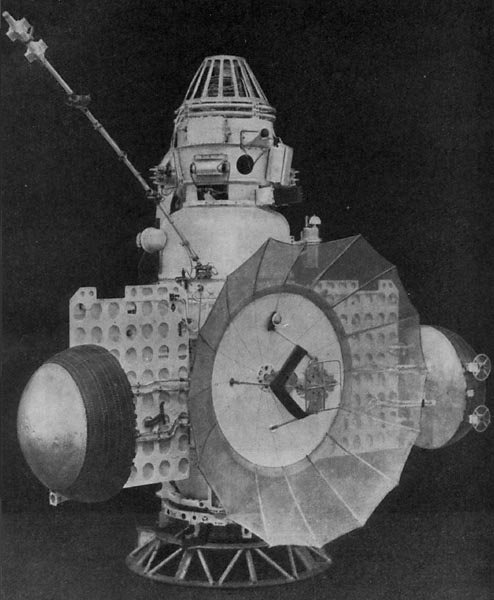
Venera 2 (Russian: Венера-2 meaning Venus 2), also known as 3MV-4 No.4 was a Soviet spacecraft intended to explore Venus. A 3MV-4 spacecraft launched as part of the Venera programme, it failed to return data after flying past Venus.
Venera 2 was launched by a Molniya carrier rocket, flying from Site 31/6 at the Baikonur Cosmodrome. The launch occurred at 05:02 UTC on 12 November 1965, with the first three stages placing the spacecraft and Blok-L upper stage into a low Earth parking orbit before the Blok-L fired to propel Venera 2 into heliocentric orbit bound for Venus, with perihelion of 0.716 AU, aphelion of 1.197 AU, eccentricity of 0.252, inclination of 4.29 degrees and orbital period of 341 days.
The Venera 2 spacecraft was equipped with 8 scientific instruments:
The spacecraft made its closest approach to Venus at 02:52 UTC on 27 February 1966, at a distance of 23,810 km (14,790 mi).
During the flyby, all of Venera 2's instruments were activated, requiring that radio contact with the spacecraft be suspended. The probe was to have stored data using onboard recorders, and then transmitted it to Earth once contact was restored, after the flyby. Following the flyby the spacecraft failed to reestablish communications with the ground. It was declared lost on 4 March 1966. An investigation into the failure determined that the malfunction of the radiator caused an increase in gas temperatures which damaged elements of the receiving and encoding units and the solar panels overheated. Useful scientific data might have been collected but none was transmitted back to Earth.
In March 2025, Abraham Loeb published a paper where he claimed that the asteroid 2005 VL1 is the same object as Venera 2, arguing that the asteroid made its closest approach to Earth in November 1965 (around the same time that Venera 2 launched). However, this was quickly disproven by Federico Spada and Jonathan McDowell, where reconstructions of Venera 2's orbital trajectory does not match with that of 2005 VL1, adding that the asteroid itself did not even made a close encounter with Venus in early 1966.
Hub AI
Venera 2 AI simulator
(@Venera 2_simulator)
Venera 2
Venera 2 (Russian: Венера-2 meaning Venus 2), also known as 3MV-4 No.4 was a Soviet spacecraft intended to explore Venus. A 3MV-4 spacecraft launched as part of the Venera programme, it failed to return data after flying past Venus.
Venera 2 was launched by a Molniya carrier rocket, flying from Site 31/6 at the Baikonur Cosmodrome. The launch occurred at 05:02 UTC on 12 November 1965, with the first three stages placing the spacecraft and Blok-L upper stage into a low Earth parking orbit before the Blok-L fired to propel Venera 2 into heliocentric orbit bound for Venus, with perihelion of 0.716 AU, aphelion of 1.197 AU, eccentricity of 0.252, inclination of 4.29 degrees and orbital period of 341 days.
The Venera 2 spacecraft was equipped with 8 scientific instruments:
The spacecraft made its closest approach to Venus at 02:52 UTC on 27 February 1966, at a distance of 23,810 km (14,790 mi).
During the flyby, all of Venera 2's instruments were activated, requiring that radio contact with the spacecraft be suspended. The probe was to have stored data using onboard recorders, and then transmitted it to Earth once contact was restored, after the flyby. Following the flyby the spacecraft failed to reestablish communications with the ground. It was declared lost on 4 March 1966. An investigation into the failure determined that the malfunction of the radiator caused an increase in gas temperatures which damaged elements of the receiving and encoding units and the solar panels overheated. Useful scientific data might have been collected but none was transmitted back to Earth.
In March 2025, Abraham Loeb published a paper where he claimed that the asteroid 2005 VL1 is the same object as Venera 2, arguing that the asteroid made its closest approach to Earth in November 1965 (around the same time that Venera 2 launched). However, this was quickly disproven by Federico Spada and Jonathan McDowell, where reconstructions of Venera 2's orbital trajectory does not match with that of 2005 VL1, adding that the asteroid itself did not even made a close encounter with Venus in early 1966.
Recent media