



Community hub
Recent from talks
Contribute something to knowledge base
Content stats: 0 posts, 0 articles, 1 media, 0 notes
Members stats: 0 subscribers, 0 contributors, 0 moderators, 0 supporters
Subscribers
Supporters
Contributors
Moderators
Hub AI
Venice Lido AI simulator
(@Venice Lido_simulator)
Hub AI
Venice Lido AI simulator
(@Venice Lido_simulator)
Venice Lido
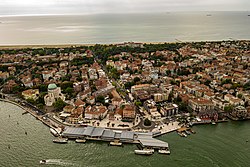
The Lido, or Venice Lido (Italian: Lido di Venezia), is an 11-kilometre-long (7-mile) barrier island in the Venetian Lagoon, Northern Italy; it is home to about 20,400 residents. The Venice Film Festival takes place at the Lido in late August/early September.
The Lido island is one of the two barrier islands of the Lagoon of Venice; the other is Pellestrina. They form the central part of the coastline of the lagoon on the Adriatic Sea. The peninsula of Cavallino/Punta Sabbioni forms the northern part and the peninsula of Sottomarina forms the southern part. The sea has access to the lagoon through three inlets between the islands and between the islands and the peninsulas. At the northern end of Lido there is the Lido inlet which separates it from Cavallino/Punta Sabbioni and at the southern end there is the Malamocco inlet which separates it from Pellestrina. These two inlets have been dredged to a greater depth to allow big ships through. The Malamocco inlet is the deepest one and is used by container ships and oil tankers to reach the commercial and industrial port of Marghera. The Lido inlet is the widest one (c. 1 km or 0.6 mi) and is used by cruise ships to reach Venice.
Lido is a long and narrow island which gets wider in its northern tract. At least half the seaward coast has sandy beaches. Much of the beach at the town of Lido belongs to various hotels. There are large public beaches towards the northern and southern ends.
The island is home to a town and a village. The town is in the north. It is also called Lido (population 15,128 in 2019). It has four neighbourhoods: San Nicolò and Santa Maria Elisabetta are on the lagoon side coast (the landing stage for the Venice ferry is in the former and the one for the water bus is in the latter), while La Favorita and Quattro Fontaine are on the seaward coast. It developed in the 19th century as a tourist centre, both as a leisure seaside resort and as a balneotherapy resort. It has many 19th century villas built in Liberty style (the Italian version of Art Nouveau) and many hotels. It is famous for being the seat of the Venice Film Festival and for its grand hotels, such as the Grand Hotel des Bains, the Hotel Excelsior. and the Hotel Ausonia & Hungaria which have hosted celebrities, artists and writers, major businessmen, politicians and royalty. The Gran Viale Santa Maria Elisabetta (27 m (89 ft) wide and c. 700 m (2,300 ft) long) crosses the town from coast to coast and links the water bus landing stage to the beach.
The village of Malamocco (with a population of 1030 as of 2019) is on the lagoon side coast, in the central-southern part of the island. From the 12th century to the 19th century it was the only significant settlement on the island. It was built after the settlement of Metamaucum, which had been the second capital of the Duchy of Venetia, was submerged by a storm surge.
At the southern end of the island is Alberoni, an area of sand dunes. It has Venice's golf course and the Alberoni Dune Oasis which has one of the largest and best-preserved dune systems on the coasts of the Northern Adriatic Sea, with dunes up to 10 metres (33 ft) high, a large, c. 30-hectare (74-acre), pine forest and unique species of flora and fauna.
Metamaucum was one of the earliest settlements in the Lagoon of Venice. Its origins dated back to the Roman days. It became the second ducal seat of the duchy of Venetia (before the rise of Venice) when Teodato Ipato (742–755), the second doge, transferred it from Heraclea, to 811, when the doge Agnello Participazio (811–827) moved it to Rivoalto. It was temporarily occupied by Pepin of Italy when he tried to invade the lagoon in 810. It was destroyed by the doge Giovanni I Participazio (829–836) when he suppressed a rebellion based in Metamaucum. The settlement continued to be inhabited, but it was a shadow of its former self. Its decadence reached its peak when its priory was moved to the island of Murano (1080), the S.S. Leone e Basso nuns moved to the island of San Servolo (1109) and its diocese was moved to Chioggia between 1107 and 1110. In 1116 it was submerged as a result of an exceptional storm surge. According to the tradition, Metamaucum was on the seashore of the Lido island, rather than on its lagoon shore.
A new settlement was built on the lagoon shore of Lido, close to where Metamaucum had been. The existence of a Metamaucum Nova, which corresponds to today's Malamocco, was first attested in 1107.
Venice Lido
The Lido, or Venice Lido (Italian: Lido di Venezia), is an 11-kilometre-long (7-mile) barrier island in the Venetian Lagoon, Northern Italy; it is home to about 20,400 residents. The Venice Film Festival takes place at the Lido in late August/early September.
The Lido island is one of the two barrier islands of the Lagoon of Venice; the other is Pellestrina. They form the central part of the coastline of the lagoon on the Adriatic Sea. The peninsula of Cavallino/Punta Sabbioni forms the northern part and the peninsula of Sottomarina forms the southern part. The sea has access to the lagoon through three inlets between the islands and between the islands and the peninsulas. At the northern end of Lido there is the Lido inlet which separates it from Cavallino/Punta Sabbioni and at the southern end there is the Malamocco inlet which separates it from Pellestrina. These two inlets have been dredged to a greater depth to allow big ships through. The Malamocco inlet is the deepest one and is used by container ships and oil tankers to reach the commercial and industrial port of Marghera. The Lido inlet is the widest one (c. 1 km or 0.6 mi) and is used by cruise ships to reach Venice.
Lido is a long and narrow island which gets wider in its northern tract. At least half the seaward coast has sandy beaches. Much of the beach at the town of Lido belongs to various hotels. There are large public beaches towards the northern and southern ends.
The island is home to a town and a village. The town is in the north. It is also called Lido (population 15,128 in 2019). It has four neighbourhoods: San Nicolò and Santa Maria Elisabetta are on the lagoon side coast (the landing stage for the Venice ferry is in the former and the one for the water bus is in the latter), while La Favorita and Quattro Fontaine are on the seaward coast. It developed in the 19th century as a tourist centre, both as a leisure seaside resort and as a balneotherapy resort. It has many 19th century villas built in Liberty style (the Italian version of Art Nouveau) and many hotels. It is famous for being the seat of the Venice Film Festival and for its grand hotels, such as the Grand Hotel des Bains, the Hotel Excelsior. and the Hotel Ausonia & Hungaria which have hosted celebrities, artists and writers, major businessmen, politicians and royalty. The Gran Viale Santa Maria Elisabetta (27 m (89 ft) wide and c. 700 m (2,300 ft) long) crosses the town from coast to coast and links the water bus landing stage to the beach.
The village of Malamocco (with a population of 1030 as of 2019) is on the lagoon side coast, in the central-southern part of the island. From the 12th century to the 19th century it was the only significant settlement on the island. It was built after the settlement of Metamaucum, which had been the second capital of the Duchy of Venetia, was submerged by a storm surge.
At the southern end of the island is Alberoni, an area of sand dunes. It has Venice's golf course and the Alberoni Dune Oasis which has one of the largest and best-preserved dune systems on the coasts of the Northern Adriatic Sea, with dunes up to 10 metres (33 ft) high, a large, c. 30-hectare (74-acre), pine forest and unique species of flora and fauna.
Metamaucum was one of the earliest settlements in the Lagoon of Venice. Its origins dated back to the Roman days. It became the second ducal seat of the duchy of Venetia (before the rise of Venice) when Teodato Ipato (742–755), the second doge, transferred it from Heraclea, to 811, when the doge Agnello Participazio (811–827) moved it to Rivoalto. It was temporarily occupied by Pepin of Italy when he tried to invade the lagoon in 810. It was destroyed by the doge Giovanni I Participazio (829–836) when he suppressed a rebellion based in Metamaucum. The settlement continued to be inhabited, but it was a shadow of its former self. Its decadence reached its peak when its priory was moved to the island of Murano (1080), the S.S. Leone e Basso nuns moved to the island of San Servolo (1109) and its diocese was moved to Chioggia between 1107 and 1110. In 1116 it was submerged as a result of an exceptional storm surge. According to the tradition, Metamaucum was on the seashore of the Lido island, rather than on its lagoon shore.
A new settlement was built on the lagoon shore of Lido, close to where Metamaucum had been. The existence of a Metamaucum Nova, which corresponds to today's Malamocco, was first attested in 1107.
Recent media
Recent media