



Community hub
Recent from talks
Knowledge base stats:
Talk channels stats:
Members stats:
Peripheral venous catheter
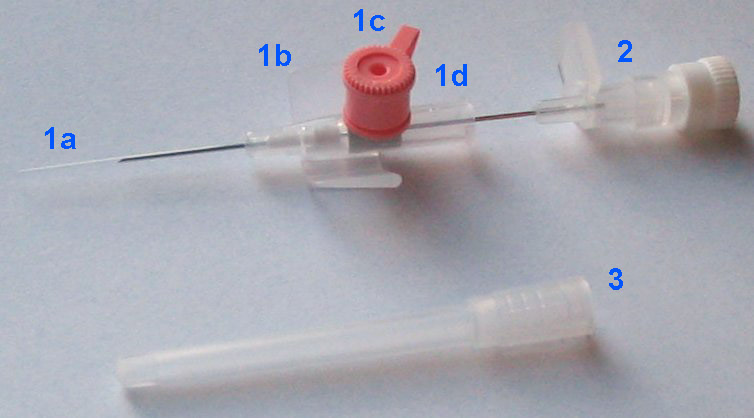
In medicine, a peripheral venous catheter, peripheral venous line, peripheral venous access catheter, or peripheral intravenous catheter, is a catheter (small, flexible tube) placed into a peripheral vein for venous access to administer intravenous therapy such as medication fluids. This is a common medical procedure.
A peripheral venous catheter is the most commonly used vascular access in medicine. It is given to most emergency department and surgical patients, and before some radiological imaging techniques using radiocontrast, for example.
A peripheral venous catheter is usually placed in a vein on the hand or arm. It should be distinguished from a central venous catheter which is inserted in a central vein (usually in the internal jugular vein of the neck or the subclavian vein of the chest), or an arterial catheter which can be placed in a peripheral or central artery. In children, a topical anaesthetic gel (such as lidocaine) may be applied to the insertion site to facilitate placement.[citation needed]
Blood sampling can be carried out at the time of insertion of a peripheral venous catheter or at a later time.
Peripheral venous catheters may also be used in the emergency treatment of a tension pneumothorax- they can be placed in the second intercostal space along the mid clavicular line in order to relieve tension before definitive management with a chest drain.
It is important to understand when not to place a peripheral venous catheter. Very few contraindications exist. The first absolute contraindication to consider is when the desired therapy can be given via a less invasive route. Site specific absolute contraindications include the presence of an arteriovenous fistula and a planned surgical procedure on an extremity.
Relative contraindications exist but many lack substantial evidence. Peripheral venous catheter placement in a limb with significant sensory or motor injury may increase risk for development of a deep vein thrombosis. In addition, those with a sensory deficit in a limb could have a decreased detection rate of infiltration. Close monitoring of the catheter is recommended if placement in a limb with sensory or motor deficits is required.
Difficult catheter placement is defined as two or more failed attempts at placement. A history of the patient should be taken to assess for potential risk factors that could suggest a difficult catheter placement. Risk factors include a history of difficult venous catheter placement, obesity, female sex, children, past intravenous drug use and non-visible veins. Some medical conditions including diabetes, cancer, and sickle cell disease are also considered risk factors for difficult placement.
Hub AI
Peripheral venous catheter AI simulator
(@Peripheral venous catheter_simulator)
Peripheral venous catheter
In medicine, a peripheral venous catheter, peripheral venous line, peripheral venous access catheter, or peripheral intravenous catheter, is a catheter (small, flexible tube) placed into a peripheral vein for venous access to administer intravenous therapy such as medication fluids. This is a common medical procedure.
A peripheral venous catheter is the most commonly used vascular access in medicine. It is given to most emergency department and surgical patients, and before some radiological imaging techniques using radiocontrast, for example.
A peripheral venous catheter is usually placed in a vein on the hand or arm. It should be distinguished from a central venous catheter which is inserted in a central vein (usually in the internal jugular vein of the neck or the subclavian vein of the chest), or an arterial catheter which can be placed in a peripheral or central artery. In children, a topical anaesthetic gel (such as lidocaine) may be applied to the insertion site to facilitate placement.[citation needed]
Blood sampling can be carried out at the time of insertion of a peripheral venous catheter or at a later time.
Peripheral venous catheters may also be used in the emergency treatment of a tension pneumothorax- they can be placed in the second intercostal space along the mid clavicular line in order to relieve tension before definitive management with a chest drain.
It is important to understand when not to place a peripheral venous catheter. Very few contraindications exist. The first absolute contraindication to consider is when the desired therapy can be given via a less invasive route. Site specific absolute contraindications include the presence of an arteriovenous fistula and a planned surgical procedure on an extremity.
Relative contraindications exist but many lack substantial evidence. Peripheral venous catheter placement in a limb with significant sensory or motor injury may increase risk for development of a deep vein thrombosis. In addition, those with a sensory deficit in a limb could have a decreased detection rate of infiltration. Close monitoring of the catheter is recommended if placement in a limb with sensory or motor deficits is required.
Difficult catheter placement is defined as two or more failed attempts at placement. A history of the patient should be taken to assess for potential risk factors that could suggest a difficult catheter placement. Risk factors include a history of difficult venous catheter placement, obesity, female sex, children, past intravenous drug use and non-visible veins. Some medical conditions including diabetes, cancer, and sickle cell disease are also considered risk factors for difficult placement.