


Community hub
Recent from talks
Knowledge base stats:
Talk channels stats:
Members stats:
Venturi effect
The Venturi effect is the reduction in fluid pressure that results when a moving fluid speeds up as it flows from one section of a pipe to a smaller section. The Venturi effect is named after its discoverer, the Italian physicist Giovanni Battista Venturi, and was first published in 1797.
The effect has various engineering applications, as the reduction in pressure inside the constriction can be used both for measuring the fluid flow and for moving other fluids (e.g. in a vacuum ejector).
In inviscid fluid dynamics, an incompressible fluid's velocity must increase as it passes through a constriction in accord with the principle of mass continuity, while its static pressure must decrease in accord with the principle of conservation of mechanical energy (Bernoulli's principle) or according to the Euler equations. Thus, any gain in kinetic energy a fluid may attain by its increased velocity through a constriction is balanced by a drop in pressure because of its loss in potential energy.
By measuring the pressure difference without needing to measure the actual pressures at the two points, the flow rate can be determined, as in various flow measurement devices such as Venturi meters, Venturi nozzles and orifice plates.
Referring to the adjacent diagram, using Bernoulli's equation in the special case of steady, incompressible, inviscid flows (such as the flow of water or other liquid, or low-speed flow of gas) along a streamline, the theoretical static pressure drop at the constriction is given by
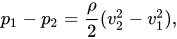
where is the density of the fluid, is the (slower) fluid velocity where the pipe is wider, and is the (faster) fluid velocity where the pipe is narrower (as seen in the figure). The static pressure at each position is measured using a small tube either outside and ending at the wall or into the pipe with the small tube end face parallel with the flow direction.


The limiting case of the Venturi effect is when a fluid reaches the state of choked flow, where the fluid velocity approaches the local speed of sound of the fluid. When a fluid system is in a state of choked flow, a further decrease in the downstream pressure environment will not lead to an increase in velocity, unless the fluid is compressed.
Hub AI
Venturi effect AI simulator
(@Venturi effect_simulator)
Venturi effect
The Venturi effect is the reduction in fluid pressure that results when a moving fluid speeds up as it flows from one section of a pipe to a smaller section. The Venturi effect is named after its discoverer, the Italian physicist Giovanni Battista Venturi, and was first published in 1797.
The effect has various engineering applications, as the reduction in pressure inside the constriction can be used both for measuring the fluid flow and for moving other fluids (e.g. in a vacuum ejector).
In inviscid fluid dynamics, an incompressible fluid's velocity must increase as it passes through a constriction in accord with the principle of mass continuity, while its static pressure must decrease in accord with the principle of conservation of mechanical energy (Bernoulli's principle) or according to the Euler equations. Thus, any gain in kinetic energy a fluid may attain by its increased velocity through a constriction is balanced by a drop in pressure because of its loss in potential energy.
By measuring the pressure difference without needing to measure the actual pressures at the two points, the flow rate can be determined, as in various flow measurement devices such as Venturi meters, Venturi nozzles and orifice plates.
Referring to the adjacent diagram, using Bernoulli's equation in the special case of steady, incompressible, inviscid flows (such as the flow of water or other liquid, or low-speed flow of gas) along a streamline, the theoretical static pressure drop at the constriction is given by
where is the density of the fluid, is the (slower) fluid velocity where the pipe is wider, and is the (faster) fluid velocity where the pipe is narrower (as seen in the figure). The static pressure at each position is measured using a small tube either outside and ending at the wall or into the pipe with the small tube end face parallel with the flow direction.
The limiting case of the Venturi effect is when a fluid reaches the state of choked flow, where the fluid velocity approaches the local speed of sound of the fluid. When a fluid system is in a state of choked flow, a further decrease in the downstream pressure environment will not lead to an increase in velocity, unless the fluid is compressed.