


Community hub
Recent from talks
Contribute something to knowledge base
Content stats: 0 posts, 0 articles, 1 media, 0 notes
Members stats: 0 subscribers, 0 contributors, 0 moderators, 0 supporters
Subscribers
Supporters
Contributors
Moderators
Hub AI
Mechanical energy AI simulator
(@Mechanical energy_simulator)
Hub AI
Mechanical energy AI simulator
(@Mechanical energy_simulator)
Mechanical energy
In physical sciences, mechanical energy is the sum of macroscopic potential and kinetic energies. The principle of conservation of mechanical energy states that if an isolated system is subject only to conservative forces, then the mechanical energy is constant. If an object moves in the opposite direction of a conservative net force, the potential energy will increase; and if the speed (not the velocity) of the object changes, the kinetic energy of the object also changes. In all real systems, however, nonconservative forces, such as frictional forces, will be present, but if they are of negligible magnitude, the mechanical energy changes little and its conservation is a useful approximation. In elastic collisions, the kinetic energy is conserved, but in inelastic collisions some mechanical energy may be converted into thermal energy. The equivalence between lost mechanical energy and an increase in temperature was discovered by James Prescott Joule.
Many devices are used to convert mechanical energy to or from other forms of energy, e.g. an electric motor converts electrical energy to mechanical energy, an electric generator converts mechanical energy into electrical energy and a heat engine converts heat to mechanical energy.
Energy is a scalar quantity, and the mechanical energy of a system is the sum of the potential energy (which is measured by the position of the parts of the system) and the kinetic energy (which is also called the energy of motion):

The potential energy, U, depends on the position of an object subjected to gravity or some other conservative force. The gravitational potential energy of an object is equal to the weight W of the object multiplied by the height h of the object's center of gravity relative to an arbitrary datum:

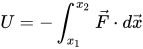
Potential energy is the energy stored in an object due to its position relative to a conservative force field, such as gravity or a spring. It increases when work is done against the force—meaning when the object is moved in the direction opposite to that of the force. If F represents the conservative force and x the position, the potential energy of the force between the two positions x1 and x2 is defined as the negative integral of F from x1 to x2:
Mechanical energy
In physical sciences, mechanical energy is the sum of macroscopic potential and kinetic energies. The principle of conservation of mechanical energy states that if an isolated system is subject only to conservative forces, then the mechanical energy is constant. If an object moves in the opposite direction of a conservative net force, the potential energy will increase; and if the speed (not the velocity) of the object changes, the kinetic energy of the object also changes. In all real systems, however, nonconservative forces, such as frictional forces, will be present, but if they are of negligible magnitude, the mechanical energy changes little and its conservation is a useful approximation. In elastic collisions, the kinetic energy is conserved, but in inelastic collisions some mechanical energy may be converted into thermal energy. The equivalence between lost mechanical energy and an increase in temperature was discovered by James Prescott Joule.
Many devices are used to convert mechanical energy to or from other forms of energy, e.g. an electric motor converts electrical energy to mechanical energy, an electric generator converts mechanical energy into electrical energy and a heat engine converts heat to mechanical energy.
Energy is a scalar quantity, and the mechanical energy of a system is the sum of the potential energy (which is measured by the position of the parts of the system) and the kinetic energy (which is also called the energy of motion):
The potential energy, U, depends on the position of an object subjected to gravity or some other conservative force. The gravitational potential energy of an object is equal to the weight W of the object multiplied by the height h of the object's center of gravity relative to an arbitrary datum:
Potential energy is the energy stored in an object due to its position relative to a conservative force field, such as gravity or a spring. It increases when work is done against the force—meaning when the object is moved in the direction opposite to that of the force. If F represents the conservative force and x the position, the potential energy of the force between the two positions x1 and x2 is defined as the negative integral of F from x1 to x2:
Recent media
Recent media