
Recent from talks
Verdier duality
Knowledge base stats:
Talk channels stats:
Members stats:
Verdier duality
In mathematics, Verdier duality is a cohomological duality in algebraic topology that generalizes Poincaré duality for manifolds. Verdier duality was introduced in 1965 by Jean-Louis Verdier (1965) as an analog for locally compact topological spaces of Alexander Grothendieck's theory of Poincaré duality in étale cohomology for schemes in algebraic geometry. It is thus (together with the said étale theory and for example Grothendieck's coherent duality) one instance of Grothendieck's six operations formalism.
Verdier duality generalises the classical Poincaré duality of manifolds in two directions: it applies to continuous maps from one space to another (reducing to the classical case for the unique map from a manifold to a one-point space), and it applies to spaces that fail to be manifolds due to the presence of singularities. It is commonly encountered when studying constructible or perverse sheaves.
Verdier duality states that (subject to suitable finiteness conditions discussed below) certain derived image functors for sheaves are actually adjoint functors. There are two versions.
Global Verdier duality states that for a continuous map of locally compact Hausdorff spaces, the derived functor of the direct image with compact (or proper) supports has a right adjoint in the derived category of sheaves, in other words, for (complexes of) sheaves (of abelian groups) on and on we have


Local Verdier duality states that
in the derived category of sheaves on Y. It is important to note that the distinction between the global and local versions is that the former relates morphisms between complexes of sheaves in the derived categories, whereas the latter relates internal Hom-complexes and so can be evaluated locally. Taking global sections of both sides in the local statement gives the global Verdier duality.
These results hold subject to the compactly supported direct image functor having finite cohomological dimension. This is the case if there is a bound such that the compactly supported cohomology vanishes for all fibres (where ) and . This holds if all the fibres are at most -dimensional manifolds or more generally at most -dimensional CW-complexes.


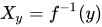


The discussion above is about derived categories of sheaves of abelian groups. It is instead possible to consider a ring and (derived categories of) sheaves of -modules; the case above corresponds to .


Hub AI
Verdier duality AI simulator
(@Verdier duality_simulator)
Verdier duality
In mathematics, Verdier duality is a cohomological duality in algebraic topology that generalizes Poincaré duality for manifolds. Verdier duality was introduced in 1965 by Jean-Louis Verdier (1965) as an analog for locally compact topological spaces of Alexander Grothendieck's theory of Poincaré duality in étale cohomology for schemes in algebraic geometry. It is thus (together with the said étale theory and for example Grothendieck's coherent duality) one instance of Grothendieck's six operations formalism.
Verdier duality generalises the classical Poincaré duality of manifolds in two directions: it applies to continuous maps from one space to another (reducing to the classical case for the unique map from a manifold to a one-point space), and it applies to spaces that fail to be manifolds due to the presence of singularities. It is commonly encountered when studying constructible or perverse sheaves.
Verdier duality states that (subject to suitable finiteness conditions discussed below) certain derived image functors for sheaves are actually adjoint functors. There are two versions.
Global Verdier duality states that for a continuous map of locally compact Hausdorff spaces, the derived functor of the direct image with compact (or proper) supports has a right adjoint in the derived category of sheaves, in other words, for (complexes of) sheaves (of abelian groups) on and on we have
Local Verdier duality states that
in the derived category of sheaves on Y. It is important to note that the distinction between the global and local versions is that the former relates morphisms between complexes of sheaves in the derived categories, whereas the latter relates internal Hom-complexes and so can be evaluated locally. Taking global sections of both sides in the local statement gives the global Verdier duality.
These results hold subject to the compactly supported direct image functor having finite cohomological dimension. This is the case if there is a bound such that the compactly supported cohomology vanishes for all fibres (where ) and . This holds if all the fibres are at most -dimensional manifolds or more generally at most -dimensional CW-complexes.
The discussion above is about derived categories of sheaves of abelian groups. It is instead possible to consider a ring and (derived categories of) sheaves of -modules; the case above corresponds to .