Recent from talks
Nothing was collected or created yet.
Vermont copper
View on Wikipedia


Vermont coppers were copper coins issued by the Vermont Republic.[1] The coins were first struck in 1785 and continued to be minted until Vermont's admission to the United States in 1791 as the State of Vermont.
History
[edit]On June 10, 1785, the House of Representatives of the Freemen of Vermont met to select a committee of three to consider a request from Reuben Harmon, Jr. of Rupert to mint copper coins for the new entity Vermont.[2] Though Vermont's legislative branch at this period was unicameral, the Governor's Council, a part of the executive branch, acted as a sort of upper house. The Governor's Council appointed one of its members to join the committee studying the proposal. On June 15, 1785, the committee presented to the House of Representatives of the Freemen of Vermont their recommendation that Vermont grant Harmon "...the exclusive right of coining Copper within this State for the term of two years..." The approved language required the coins to have a minimum weight of one-third of an ounce troy weight (160 grains).[3] The House approved the measure and sent the recommendation to the Governor's Council which concurred. On June 17, 1785, Harmon posted a required bond and began establishing his mint situated beside Hagar's Brook in Rupert.[3]
Design and motto
[edit]1785 and 1786 landscape design
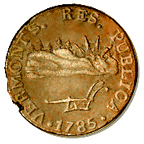
[edit]The same committee was retained to select a motto for the coins, and to oversee design. The design of the obverse, on the initial 1785 and 1786 coins, featured the Sun rising above the Green Mountains and a plow in the foreground encircled by the inscription VERMONTS. RES. PUBLICA.,[4] which can be translated as the republic, or commonwealth, of Vermont. The design of the reverse of the coin is an almost wholesale appropriation of an earlier 1783 American coin called the Nova Constellatio (new constellation) design.[5] It features a large single star emanating rays, with an eye within, it is surrounded by a wreath of 13 smaller stars, and they are encircled by the motto STELLA QUARTA DECIMA which translates as "the 14th star". Subsequent issues altered the inscription on the obverse, variously using VERMONTIS. RES. PUBLICA. and VERMONTENSIUM. RES. PUBLICA.
1787 and 1788 bust design
[edit]In October 1785, with new Vermont coppers in circulation, Harmon sought an extension of his exclusive two-year contract. An act, possibly written with Harmon, himself a former member of the House, extends the agreement eight years from July 1, 1787, and describes a dramatically different design. The obverse is to bear a bust, encircled with a new motto reading AUCTORITATE VERMONTENSIUM. which translates as by authority of Vermont. The reverse of the coin depicts a seated woman, and the inscription INDE ET LIB an abbreviation of independence and liberty.[6] Sixteen variations of dies on this second set of coins were made. The new design closely resembled the British halfpenny then in circulation in the American colonies. On that coin a bust of George III is encircled by the inscription GEORGIVS. III. REX. and the reverse with a seated female embodiment of Britain called Britannia. A common explanation of the redesign of Vermont's coins, so close to the British half-pence model, has been made to make their circulation and exchange easier beyond Vermont's boundaries.
Symbolism
[edit]While the 1785 Act of the Vermont House describes the design of the bust and seated female figure design in detail, no notes of the period exist on the meaning of either the mottoes or imagery of Vermont's copper coinage. Twentieth century numismatists Kenneth Bressett, Tony Carlotto and Hillyer Ryder offer nearly identical explanations of the imagery and mottoes. The depiction of the Sun rising above the Green Mountains is to indicate peace, and possibly the approval of Divine Providence. The plow may simply represent agriculture, a primary activity and industry of the young state, but might also allude to the story of Cincinnatus the ancient Roman citizen-farmer who left his plow in the field to serve Rome as consul, fight the encroachment of aristocracy, and later return to his field. The large single star, with the eye, on the 1785 and 1786 issues, is nearly identical in design to a widely available typographic device, or dingbat, of the time called the Eye of Providence, a Deist and Masonic image suggestive of an all-seeing God. Here however the star may simply be Vermont itself, centered among the 13 stars likely used to suggest the existing 13 American states.[7] The addition of the motto STELLA QUARTA DECIMA, the 14th star, is cited as a hope for eventual statehood. The seated female on the reverse side of the second design is modeled on the Britannia figure then on British half-penny. A similar seated female is found on the reverse of the coat of arms of Vermont, and is described variously as Agriculture, or Ceres.[8]
See also
[edit]References
[edit]- Sources consulted
- Carlotto, Tony. The Copper Coins of Vermont and Those Bearing the Vermont Name. C-4: 1998. ASIN B0006QZJNQ.
- Doty, Richard G., Eric P. Newman, Kenneth Bressett, et al.. Studies on Money in Early America. The American Numismatic Society: 1996. ASIN B000KT1BDQ.
- Doyle, William T. "The Vermont Political Tradition and Those Who Helped Make It." Doyle Publisher: 1987. ISBN 0-9615486-1-4.
- Duffy, John J., et al. The Vermont Encyclopedia. University Press of New England: 2003. ISBN 1-58465-086-9.
- Mussey, Barrows. Vermont Heritage, a Picture Story. A.A. Wyn, Inc.: 1947.
- Orton, Vrest. Personal Observations on the Republic of Vermont. Academy Books: 1981. ISBN 0-914960-30-X.
- Potash, P. Jeffrey, et al. Freedom and Unity: A History of Vermont. Vermont Historical Society: 2004. ISBN 0-934720-49-5.
- Ryder, Hillyer. Colonial Coins of Vermont. Durst: 1982. ISBN 978-0-915262-65-6.
- Van de Water, Frederic Franklyn The Reluctant Republic: Vermont 1724–1791. The Countryman Press: 1974. ISBN 0-914378-02-3.
- Zieber, Eugene, Heraldry in America: A Classic Surverry of Coats of Arms and Insignia. Greenwich House: 1974. ISBN 0-8383-0322-6.
- Endnotes
- ^ Van DeWater, Frederic F. (1974) [1941]. The Reluctant Republic, Vermont 1724–1791. The Countryman Press. pp. 195, 218–219. ISBN 0-914378-02-3.
- ^ Margaret Bucholt Manchester and the Mountains Chamber of Commerce Archived December 6, 2013, at the Wayback Machine An Insider's Guide to Southern Vermont, Penguin, 1991
- ^ a b "Vermont Coppers 1785–1788: Introduction". Notre Dame University. Archived from the original on March 1, 2008. Retrieved February 4, 2008.
- ^ "Vermont Coppers 1785, 1786: Introduction". Coin and Currency Collections in the Department of Special Collections University of Notre Dame Libraries. Archived from the original on November 3, 2020. Retrieved February 4, 2008.
- ^ Guth, Ronald J. (1985). America's Copper Coinage 1783–1857. American Numismtic Society.
- ^ "Vermont Coppers Dies attributed to James Atlee". NCoin and Currency Collections in the Department of Special Collections University of Notre Dame Libraries. Retrieved February 4, 2008.
- ^ Hillyer Ryder, Colonial Coins of Vermont. Durst, 1982
- ^ Zieber, Eugene (1974). Heraldry in America: A Classic Surverry of Coats of Arms and Insignia. Greenwich House. pp. 184–185. ISBN 0-8383-0322-6.
External links
[edit]Vermont copper
View on GrokipediaHistorical Context
Vermont Republic and Economic Independence
The Vermont Republic, established through a declaration of independence on January 15, 1777, from the claims of New York and New Hampshire, operated as a sovereign entity until its admission to the United States on March 4, 1791. Amid the economic disruptions following the Revolutionary War, the Republic faced a chronic shortage of small-denomination currency, which hindered local trade and everyday transactions in a predominantly agrarian economy reliant on barter and foreign coins of varying quality. To promote economic self-sufficiency and reduce dependence on British or continental paper money, Vermont authorities pursued the minting of copper coins as a means to circulate reliable, low-value specie tailored to regional needs.[4][5] On June 15, 1785, the Vermont General Assembly, meeting in Norwich, granted Reuben Harmon Jr. of Rupert an exclusive eight-year contract to establish a mint and produce copper coins, following the formation of a four-man legislative committee to oversee the process. This authorization reflected a deliberate strategy for fiscal autonomy, as the coins were intended to standardize small change values consistent with other regional issues while asserting Vermont's independent monetary policy during the Articles of Confederation era, when no unified federal coinage existed. An amendment to the coining act in October 1785 adjusted coin weights to align with prevailing standards, ensuring broader acceptability in trade extending to neighboring areas, Canada, and even the Caribbean.[4][7] The issuance of these coppers symbolized the Republic's broader quest for economic independence, with inscriptions such as "INDE ET LIB" (for Independence and Liberty) and "VERMONTENSE" underscoring sovereignty rather than subservience to external powers. By contracting private enterprise under state oversight, Vermont avoided the costs of a public mint while fostering local metallurgy using imported copper blanks, thereby stimulating domestic economic activity without relying on distant mints or depreciating continental currency. This approach, though limited in scale, contributed to stabilizing intraregional commerce until federal monetary reforms supplanted such territorial emissions.[5][4]Legislative Authorization and Initial Plans
On June 15, 1785, during its session in Norwich, the Vermont General Assembly granted Reuben Harmon Jr. of Rupert the exclusive right to coin copper within the state, addressing the scarcity of low-denomination currency for everyday transactions.[8][7] This authorization permitted Harmon to operate a mint starting July 1, 1785, for an initial term of two years, with the coins intended to circulate at a value equivalent to fractions of a shilling.[2] The legislature stipulated that coin designs and mottos required approval by a designated committee to ensure alignment with state interests, reflecting Vermont's efforts to assert economic sovereignty as an independent republic amid disputes with New York and New Hampshire.[9] Harmon planned to establish the mint on his property, sourcing copper blanks and employing local workmanship to produce durable, standardized pieces for regional trade.[10] This legislative action marked Vermont's first official coinage initiative, predating its union with the United States in 1791, and aimed to reduce reliance on foreign or depreciated paper currency prevalent during the post-Revolutionary period.[5]Production History
Establishment of the Mint
The Vermont General Assembly, during its session in Norwich on June 15, 1785, enacted legislation granting Reuben Harmon Jr. of Rupert the exclusive privilege to establish and operate a mint for coining copper money within the Republic of Vermont.[7] This authorization, which specified a two-year term commencing July 1, 1785, positioned Vermont as the inaugural American local government to formally sanction its own mint for circulating coinage, addressing the republic's acute shortage of small-denomination currency amid postwar economic challenges.[11][2] Harmon secured the required bond on June 17, 1785, and promptly initiated construction of the mint facility—a modest 16-by-18-foot clapboard structure—adjacent to Hagar's Brook in East Rupert, leveraging the site's water power for machinery.[1] The operation, known as Harmon & Co. Mint, relied on imported copper planchets and dies, with Harmon assembling coining presses adapted from local resources, marking the practical inception of Vermont's sole official minting endeavor.[5] Legislative terms mandated that coins bear denominations, weight standards, and inscriptions affirming Vermont's sovereignty, such as "VERMONTENSE," to circulate at face value equivalent to Continental coppers.[7] This establishment reflected the republic's push for monetary autonomy, independent of British or federal influences, though enforcement of the exclusivity proved challenging due to limited oversight and emerging counterfeits.[12] Harmon's initiative, backed by figures like Colonel William Coley, facilitated the production of pattern coins by late 1785, laying the groundwork for the series' landscape-reverse designs emblematic of Vermont's agrarian identity.[5]Timeline of Minting Operations
In 1785, the Vermont General Assembly granted Reuben Harmon Jr. of Rupert exclusive rights to establish and operate a mint for coining copper pieces, marking the initiation of official minting operations. Harmon posted the required £5000 bond on June 16, 1785, enabling the setup of a small facility—measuring approximately 16 by 18 feet—along a stream in northeastern Rupert, equipped with coining presses and sourced copper, likely from Connecticut suppliers given the absence of local mining at the time.[13][7] Production commenced following the formal two-year franchise effective July 1, 1785, with the mint capable of striking 30 to 60 coins per minute using steam-powered or manual presses.[14][7][2] Operations continued beyond the initial two-year term, with coins struck through 1787 and into 1788, producing varieties dated 1785 and 1786 across landscape and bust designs.[9][6] Although legislative authorization extended up to ten years in some accounts, Harmon's mint did not sustain full operations that long, ceasing production entirely by late 1788 amid economic pressures and regulatory changes, such as a 1787 New York law prohibiting their circulation.[7][1] The total output remains uncertain but was notably lower than contemporaneous issues from Connecticut or New Jersey, reflecting limited scale and Harmon's personal copper stockpiles rather than state-supplied metal.[9][4]Closure and Aftermath
The minting operations at Reuben Harmon Jr.'s facility in East Rupert ceased in 1788, approximately three years after commencing on July 1, 1785, despite legislative authorization that could have extended longer.[2] [7] The closure followed the expiration of Harmon's initial two-year contract and was influenced by external pressures, notably a New York state law passed on March 5, 1787, which deemed underweight coppers—including Vermont issues—illegal for circulation, subjecting them to seizure effective August 1, 1787, amid ongoing territorial disputes between New York and Vermont.[9] [15] This restriction limited the coins' utility in trade beyond Vermont's borders, exacerbating economic challenges for the independent republic's currency. In the immediate aftermath, the mint's dies and equipment were relocated to Machin's Mills in New York, where additional Vermont coppers were produced into 1789, though these strikes are regarded as unauthorized extensions or potential counterfeits rather than official output.[16] Genuine Vermont coppers persisted in circulation as fractional currency within Vermont and adjacent regions, valued at a penny each despite their lighter weight compared to British halfpence prototypes, filling a void in small-denomination specie during the Confederation period.[5] Vermont's admission to the Union as the 14th state on March 4, 1791, eliminated the rationale for independent minting, paving the way for federal coinage under the Coinage Act of 1792, which introduced standardized U.S. coppers and gradually supplanted state issues.[6] However, the coins' legacy was undermined by pervasive counterfeiting, with at least one documented contemporary counterfeit variety mimicking authentic dies, contributing to broader distrust in copper money that culminated in the Copper Panic of 1789—a market collapse triggered by oversupply and debasement across state and private mints.[3] Limited original production, estimated in the tens of thousands rather than millions as initially planned, rendered surviving authentic specimens scarce, while fakes proliferated, eroding their role in everyday transactions by the early federal era.[5]Designs and Inscriptions
Landscape Reverse Design
The landscape reverse design depicts a rising sun positioned behind a range of pine-topped hills representing Vermont's Green Mountains, with a plow situated in the foreground field. This motif symbolizes the republic's geographic features and emphasis on agriculture as an economic cornerstone. Encircling the scene is the Latin inscription VERMONTIS RES PUBLICA, translating to "Public Thing of Vermont" or effectively "Republic of Vermont," underscoring the issuing authority during the period of independence from 1777 to 1791. The design appears on coins dated 1785 and 1786, with minor die variations affecting tree counts, hill contours, and plow details.[5][3] This reverse was adapted from the 1785 Nova Constellatio pattern coin, a proposed federal issue that itself drew from European influences, reflecting limited original artistry in Vermont's minting efforts due to resource constraints in the frontier republic. Numismatists note the crude engraving style, with the sun often anthropomorphized by facial features and rays extending unevenly, typical of hand-cut dies produced in England or America. Ryder classifications RR-1 through RR-8 encompass landscape reverse varieties, primarily paired with obverse inscriptions varying in spelling from VERMONTS to VERMONTENSIUM RES PUBLICA, indicating multiple strikes to meet legislative quotas of up to 40,000 pounds of copper coinage authorized in 1785.[9][17] In certain emissions, particularly transitional pieces around 1786, the landscape reverse was combined with bust obverses, though most surviving examples maintain the eye-of-Providence obverse for earlier landscape reverses; this flexibility arose from die pairings at the Rubrecht & Crawford operation in New York. The plow element specifically evokes Vermont's farming heritage, while the eastward-rising sun alludes to enlightenment and the republic's aspiration for statehood as the "fourteenth star" in the union, though not explicitly inscribed here. Contemporary accounts, such as those in legislative records, confirm the design's intent to promote local identity amid scarce circulating currency.[18]Bust Obverse Design
The bust obverse design, employed on Vermont copper coins struck from 1786 to 1788, presents a right-facing profile bust of a youthful figure wearing a laurel wreath, evoking classical Roman iconography associated with victory and republican virtue. The bust features curly hair bound by the wreath and is positioned centrally, with the denomination or date numeral often inscribed below in select varieties. This portraiture replaced the landscape motif of the 1785 issues, aiming for a more standardized appearance akin to contemporary state and federal coinage efforts.[19][5] Encircling or flanking the bust is the legend "VERMON / AUCTORI," a Latin abbreviation signifying "By the authority of Vermont," which validates the coin as an official emission authorized by the Vermont legislature on November 3, 1785, with production commencing thereafter. Lettering style varies across dies, with some exhibiting crude engraving indicative of local craftsmanship rather than professional minting. In the 1786 "Baby Head" variety (Ryder-9), the bust appears infantile, with rounded contours, a prominent ribbon below resembling a bib, and disproportionate features resulting from an early, experimental die. Later 1787 and 1788 dies refined the bust's proportions, occasionally depicting it facing left or incorporating armored (mailed) elements for added detail.[20][21][22] Certain rarities, such as overstruck examples, adapt foreign busts—including one derived from King George III—with the Vermont legend crudely added, highlighting ad hoc manufacturing practices amid resource constraints. These variations underscore the transitional nature of Vermont's numismatic independence, balancing symbolic aspirations with technical limitations before U.S. federal standardization post-1792.[23][24]
