



Community hub
Recent from talks
Knowledge base stats:
Talk channels stats:
Members stats:
Plantar wart
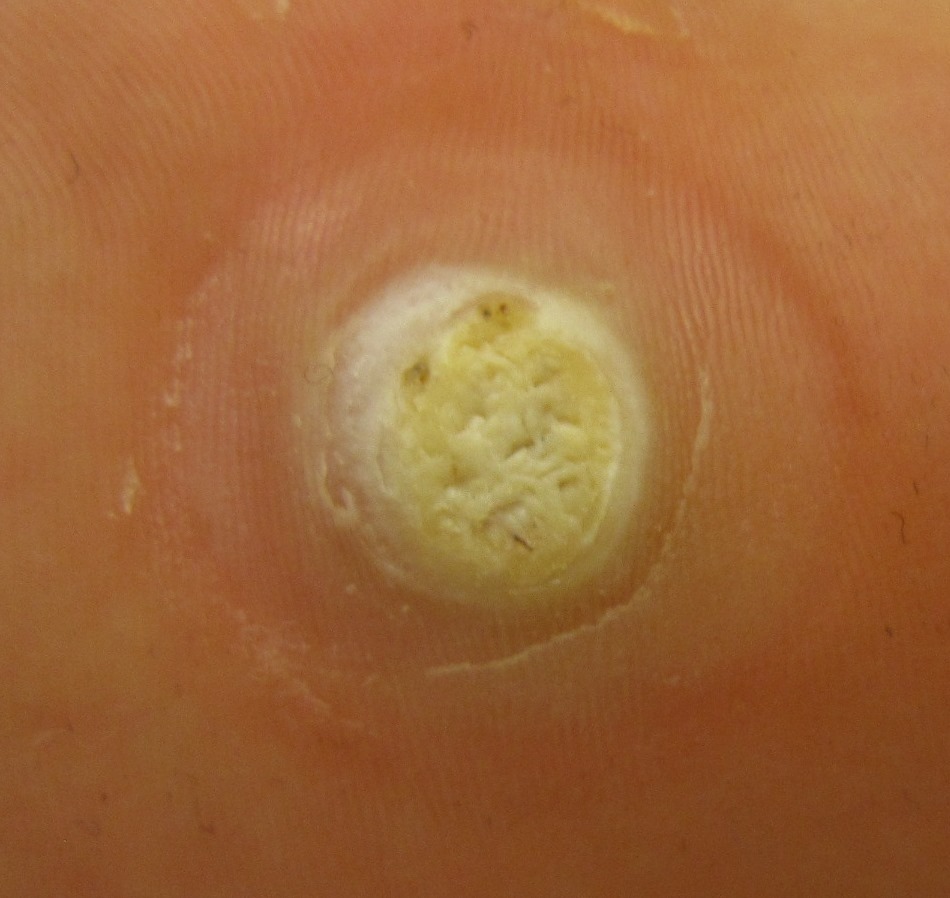
A plantar wart is a wart occurring on the bottom of the foot or toes. Its color is typically similar to that of the skin. Small black dots often occur on the surface. One or more may occur in an area. They may result in pain with pressure such that walking is difficult.
They are caused by the human papillomavirus (HPV). A break in the skin is required for infection to occur. Risk factors include use of communal showers, having had prior warts, and poor immune function. Diagnosis is typically based on symptoms.
Treatment is only needed if it is causing symptoms. This may include salicylic acid, cryotherapy, chemo-based fluorouracil or bleomycin, and surgical removal. The skin atop the lesion should generally be removed before treatment. In about a third to two-thirds of cases, they go away without specific treatment, but this may take a few years. Plantar warts are common. Children and young adults are most often affected.
Their colors are typically similar to that of the nearby skin. Small, black dots may occur on their surfaces. One or more may occur in an area. They may result in pain with pressure, such that walking may be difficult.
Plantar warts are benign epithelial tumors generally caused by infection by human papillomavirus types 1, 2, 4, 60, or 63, but also by types 57, 65, 66, and 156. These types are classified as clinical (visible symptoms). The virus attacks compromised skin through direct contact, possibly entering through tiny cuts and abrasions in the stratum corneum (outermost layer of skin). After infection, warts may not become visible for several weeks or months. Because of pressure on the sole of the foot or finger, the wart is pushed inward, and a layer of hard skin may form over the wart. A plantar wart can be painful if left untreated.
Warts may spread through autoinoculation, by infecting nearby skin, or by contaminated walking surfaces. They may fuse or develop into clusters called mosaic warts.
A plantar wart is a small lesion that appears on the surface of the skin and typically resembles a cauliflower, with tiny black petechiae (tiny hemorrhages under the skin) in the center. Pinpoint bleeding may occur when these are scratched. Plantar warts occur on the soles of the feet and toes. They may be painful when standing or walking.[citation needed]
Plantar warts are often similar to calluses or corns, but can be differentiated by close observation of skin striations. Feet are covered in friction ridges, which are akin to fingerprints of the feet. Friction ridges are disrupted by plantar warts; if the lesion is not a plantar wart, the striations continue across the top layer of the skin. Plantar warts tend to be painful on application of pressure from either side of the lesion, rather than direct pressure, unlike corns (which tend to be painful on direct pressure instead).[citation needed]
Hub AI
Plantar wart AI simulator
(@Plantar wart_simulator)
Plantar wart
A plantar wart is a wart occurring on the bottom of the foot or toes. Its color is typically similar to that of the skin. Small black dots often occur on the surface. One or more may occur in an area. They may result in pain with pressure such that walking is difficult.
They are caused by the human papillomavirus (HPV). A break in the skin is required for infection to occur. Risk factors include use of communal showers, having had prior warts, and poor immune function. Diagnosis is typically based on symptoms.
Treatment is only needed if it is causing symptoms. This may include salicylic acid, cryotherapy, chemo-based fluorouracil or bleomycin, and surgical removal. The skin atop the lesion should generally be removed before treatment. In about a third to two-thirds of cases, they go away without specific treatment, but this may take a few years. Plantar warts are common. Children and young adults are most often affected.
Their colors are typically similar to that of the nearby skin. Small, black dots may occur on their surfaces. One or more may occur in an area. They may result in pain with pressure, such that walking may be difficult.
Plantar warts are benign epithelial tumors generally caused by infection by human papillomavirus types 1, 2, 4, 60, or 63, but also by types 57, 65, 66, and 156. These types are classified as clinical (visible symptoms). The virus attacks compromised skin through direct contact, possibly entering through tiny cuts and abrasions in the stratum corneum (outermost layer of skin). After infection, warts may not become visible for several weeks or months. Because of pressure on the sole of the foot or finger, the wart is pushed inward, and a layer of hard skin may form over the wart. A plantar wart can be painful if left untreated.
Warts may spread through autoinoculation, by infecting nearby skin, or by contaminated walking surfaces. They may fuse or develop into clusters called mosaic warts.
A plantar wart is a small lesion that appears on the surface of the skin and typically resembles a cauliflower, with tiny black petechiae (tiny hemorrhages under the skin) in the center. Pinpoint bleeding may occur when these are scratched. Plantar warts occur on the soles of the feet and toes. They may be painful when standing or walking.[citation needed]
Plantar warts are often similar to calluses or corns, but can be differentiated by close observation of skin striations. Feet are covered in friction ridges, which are akin to fingerprints of the feet. Friction ridges are disrupted by plantar warts; if the lesion is not a plantar wart, the striations continue across the top layer of the skin. Plantar warts tend to be painful on application of pressure from either side of the lesion, rather than direct pressure, unlike corns (which tend to be painful on direct pressure instead).[citation needed]