Hubbry Logo
Victor KanVictor KanMain
Open search
Victor Kan
Community hub
Victor Kan
logo
8 pages, 0 posts
0 subscribers
Be the first to start a discussion here.
Victor Kan
Victor Kan
from Wikipedia

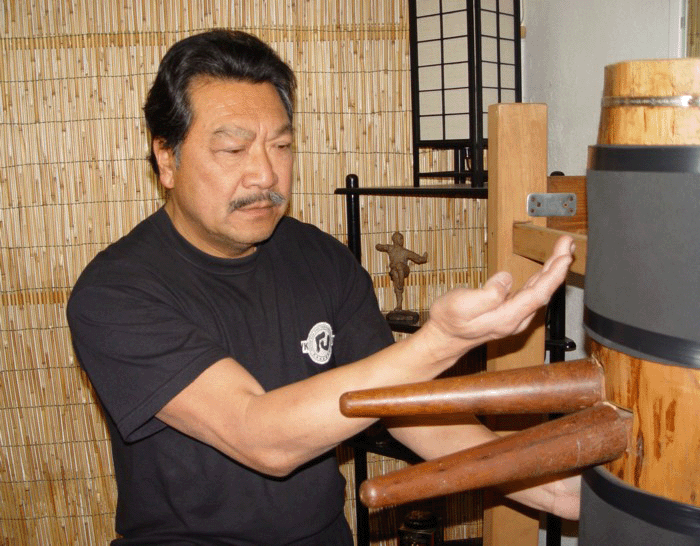
Victor Kan (簡華捷, Kan Wah-chit; born 1941) is a student of the late Ip Man[1] and began his Wing Chun instruction at the age of 13 years in Hong Kong.[2] He was with Yip Man for 7 years and in that time during which he became known as the 'King of Chi Sao' or 'The Untouchable'.[3] By the late 1950s he assisted Yip Man[3] until he left for Europe in 1961. He teaches in the UK[4] and has been doing so since 1975. He also has branches in Italy, Australia and Hong Kong.

Key Information

Bruce Lee

[edit]

Is reputed to have taught Bruce Lee the first section of the Siu Nim Tao form.[5]

References

[edit]
Revisions and contributorsEdit on WikipediaRead on Wikipedia
from Grokipedia
Victor Kan Wah Chit (born 1941) is a Chinese-British martial artist and grandmaster of Ving Tsun Kung Fu, best known as one of the last surviving direct disciples of the renowned and for his lifelong commitment to preserving the authentic, unmodified classical Ip Man lineage. Nicknamed the "King of Chi Sao" for his exceptional sticky hands proficiency, Kan has taught internationally since the 1970s, emphasizing the art's core principles of economy of motion, centerline control, and practical self-defense. At over 80 years old, he was an active instructor as of 2023, conducting seminars to safeguard the tradition against modern dilutions. Born in to a scholarly family—his father was the historian Kan Yu-wen—Kan grew up amid the city's post-war challenges, including street violence that initially drew him to for protection. In 1954, at age 13, he commenced intensive Ving Tsun training under at the Kowloon Catering Union in , later moving to the master's school on Lay Dak Street. He committed 3–4 hours daily, seven days a week, for seven years, assisting as an instructor and earning the personal moniker "Big Boy" from the grandmaster for his physical presence and dedication. Among his notable experiences, Kan helped train early students like in Sil Lim Tao and attended 's funeral in in 1972. In the early 1960s, Kan relocated to for university studies, where he initially kept a low profile before launching public Ving Tsun instruction in 1974, founding the UK's first school dedicated to the classical system. He created a 10-grade to systematize the teachings, focusing on foundational forms like Sil Lim Tao while rejecting adaptations that stray from Ip Man's methods. Over decades, Kan has influenced generations of practitioners across , , and beyond, with affiliated schools like those in his VKVT lineage promoting the art's purity. His philosophy, encapsulated in adages like "more haste, less speed," underscores patient, methodical practice for real-world efficacy. As recently as 2023, he led seminars in , demonstrating his enduring vitality and role as the foremost living authority on classical Ving Tsun.

Early Life

Birth and Family Background

Victor Kan, born in 1941 in under the name Kan Wah-chit (Chinese: 簡華捷), grew up in a scholarly that prioritized and . His father, Kan Yu-wen, was a who, by the mid-20th century, had reached the age of 80 and played a central role in shaping Victor's early upbringing by instilling the 's moral heritage, including values of modesty and respect for elders and teachers. This culturally rich household emphasized education and scholarly pursuits over physical activities in Victor's initial years, reflecting the environment of .

Introduction to Martial Arts

Victor Kan began his Wing Chun training in 1954 at the age of 13 in , marking the start of his lifelong dedication to the martial art. Growing up in a post-war plagued by street fighting, violence, and , Kan sought primarily for and to protect his family in this turbulent environment. A friend introduced him to the Ving Tsun system at the Catering Union headquarters in [Sham Shui Po](/page/Sham Shui Po), where he first encountered the practical, efficient principles of the art that emphasized close-quarters combat and redirection of force over brute strength. During his initial meeting with , the grandmaster—a middle-aged, bald gentleman dressed in traditional Chinese attire—immediately nicknamed the young Kan "Big Boy" due to his sturdy build, fostering an early personal connection. With his parents' permission, Kan formally joined 's school on Lay Dah Street in , immersing himself in the modest yet disciplined setting where students gathered to learn the foundational forms and concepts of under 's guidance. The school's environment reflected the era's challenges, with training sessions held in union halls that served as hubs for working-class practitioners seeking both skill and camaraderie amid Hong Kong's social unrest. Coming from a scholarly —his , Kan Yu-wen, was a renowned who instilled in him an appreciation for and classics from a young age—Kan's choice to pursue physical training represented a deliberate contrast to his intellectual upbringing, blending discipline from both worlds. This early exposure laid the groundwork for his rapid progress, as he committed to daily practice that would define his role in preserving Ip Man's lineage.

Training Under Ip Man

Apprenticeship and Assistance

Victor Kan commenced his training under in 1954 at the age of 13. He dedicated 3-4 hours daily, seven days a week, to rigorous training, immersing himself in the art's principles of efficiency and directness. This seven-year period, spanning from 1954 to around 1961, allowed Kan to master the core curriculum as taught by , including the foundational forms of Siu Nim Tao, Chum Kiu, and Biu Jee, alongside wooden dummy training and advanced chi sao (sticky hands) applications. His intensive practice emphasized practical combat techniques, such as centerline control and simultaneous attack-defense, earning him the nickname "King of Chi Sao" among peers for his proficiency in sensitivity drills. By the late , Kan had progressed to leading advanced chi sao sessions with over 20 students twice daily, honing his skills through repetitive, high-volume training that simulated real fighting scenarios. In 1957-1958, at around age 17-18, Kan began assisting directly, supporting the grandmaster during a challenging period when 's health was declining and the school faced financial difficulties. By approximately age 20 in the early 1960s, he had advanced to the role of assistant chief instructor, guiding junior students in forms, techniques, and partner drills while continuing his own development under 's oversight. This assistance role solidified Kan's understanding of Wing Chun's holistic system, from solo forms to weapon sets like the butterfly knives and long pole, ensuring fidelity to 's traditional methods.

Interaction with Bruce Lee

Victor Kan commenced his Wing Chun training under Ip Man in 1954 at the age of 13, establishing himself as one of the early dedicated students in the master's school. Six months later, in early 1955, joined the class, positioning Kan as a senior student, or Si-Hing, relative to the younger Lee. In this hierarchical environment, Kan took on instructional responsibilities for junior members, including guiding Lee through foundational techniques. Kan specifically taught Lee the initial section of the Siu Nim Tao form, the first and most essential set in that emphasizes structure, balance, and centerline theory. This direct mentorship highlighted Kan's role in helping Lee build core skills early in his martial arts journey. The two trained together under Ip Man's oversight in a shared kwoon setting, where sessions focused on forms, chi sao (sticky hands) drills, and practical applications. Lee's attendance was often irregular due to his budding acting career in films like The Orphan, yet Kan observed his exceptional speed of thought and eagerness to absorb knowledge, traits that foreshadowed Lee's future prowess. Kan's seven-year apprenticeship overall reinforced his seniority during this period, allowing him to contribute to the school's dynamic as both student and assistant instructor.

Emigration and Career Development

Move to Europe

In 1961, at the age of 20, Victor Kan left Hong Kong for Europe to pursue further studies, marking the end of his formal apprenticeship under Ip Man, where he had served as assistant chief instructor since the late 1950s. Upon arrival, Kan initially settled in France, dedicating himself to academic pursuits while continuing his Wing Chun training on a personal basis without public instruction. This period abroad presented logistical hurdles in sustaining the rigorous daily practice ingrained from his Hong Kong years, as access to traditional training environments and fellow practitioners was limited in the unfamiliar setting. Kan navigated cultural differences and the isolation of emigration by focusing on self-discipline and refinement of his skills in solitude, a phase of introspection that lasted over a decade before he relocated to the in 1974. This transitional era solidified his role as an independent guardian of Ip Man's lineage, emphasizing personal mastery over immediate dissemination of the art.

Initial Teaching Efforts

Following his arrival in in the early , Victor Kan initially concentrated on furthering his education rather than formal instruction in . However, after returning to in 1970 and subsequently re-establishing himself in in 1974, Kan began his initial public teaching endeavors, marking a transitional phase toward professional instruction. Kan's early teaching efforts centered on informal sessions and demonstrations in London's district, where he established a modest kwoon accommodating up to 15 students at a time from a total base of around 30 dedicated practitioners. These sessions, held twice weekly, focused on foundational elements of classical Ving Tsun, such as the Sil Lim Tao form, which students practiced continuously for 20 minutes to an hour, alongside warm-up routines to adapt to the local climate and build muscle flexibility. To suit non-Hong Kong audiences unfamiliar with traditional , Kan refined his approach by stressing discipline and rote practice over cultural embellishments, using accessible equipment like wooden dummies (Mook Yan Jong), punch bags, and kicking pads to toughen techniques without overwhelming beginners with advanced weapons training. Among the key milestones before his 1974 settlement was the cultivation of a core group of early students, including Michael Street, who joined shortly after Kan's arrival and trained under rigorous conditions emphasizing practical application. This small cohort allowed Kan to iteratively adjust his pedagogy, prioritizing the 116-movement Jong Sau sequence on the wooden dummy to instill conceptual precision and force generation tailored to Western learners' physical and motivational contexts. By late 1974, these efforts had laid the groundwork for a committed following, demonstrating Wing Chun's efficacy through controlled demonstrations that highlighted its close-range combat principles.

Teaching Career

Establishment in the United Kingdom

Victor Kan arrived in the United Kingdom in the early 1960s following his emigration from Hong Kong in 1961. He commenced formal teaching of Ving Tsun Kung Fu in London in 1974, establishing his first school in central London (originally in Soho), with the primary school now at the Watling Centre in Edgware, which remains a central hub for his lineage. This marked the structured introduction of authentic Ip Man Wing Chun to British practitioners, emphasizing classical techniques without modifications. Central to Kan's UK efforts was the development of the Victor Kan Ving Tsun (VKVT) system, a codified preserving Yip Man's teachings through a 10-grade progression that integrates forms like Sil Nim Tao, Chum Kiu, and Bil Jee, alongside weapons training and chi sao (sticking hands) drills. This system prioritizes centerline control, economy of motion, and internal power development, distinguishing it as a direct transmission of the lineage. Kan's approach adapted subtly to Western students by incorporating a methodical grading structure to ensure progressive mastery, while maintaining 99% fidelity to the original methods he learned in . Over the decades, Kan expanded VKVT presence across the by authorizing branches and training dedicated instructors, fostering a network centered in but extending to other areas through certified affiliates. Notable among these is the first authorized branch opened by Sifu Jack Kontou in , which operated under Kan's direct oversight and contributed to local dissemination of the system. Sifu , Kan's long-time assistant, has also played a pivotal role, instructing classes in and upholding the lineage's standards since the . These efforts have trained hundreds of students, building a committed community focused on practical application and authenticity. To promote the Ip Man lineage, Kan organized seminars in the UK, including a significant event in attended by Ip Man's sons, and , where publicly acknowledged Kan as Yip Man's top student. More recent seminars, such as the 2023 gathering, have continued this tradition, drawing practitioners to experience classical VKVT directly from Kan and his assistants. These sessions underscore the system's emphasis on preserving unaltered techniques amid varying interpretations globally.

International Expansion

Following his establishment in the , Victor Kan expanded the teaching of Classical Ving Tsun beyond by developing branches in during the late , marking a return to his roots where he first trained under . This branch contributes to preserving the lineage in its origin country, serving dedicated students committed to the system's authenticity. In , Kan's outreach grew through branches in , , and , established as extensions of his pioneering efforts that began in 1961. The Italian branch in Genova, led by Sifu Sandro, exemplifies this expansion, attracting over 70 regular students who train rigorously in the unaltered techniques. These outposts maintain high standards, focusing on serious practitioners who invest time in mastering the art without modifications. Kan has further promoted global dissemination via international seminars, accepting invitations worldwide to demonstrate Chi Sao and core forms to Wing Chun enthusiasts. His UK base coordinates these efforts, facilitating the spread of authentic practices through in-person events that emphasize practical application and fidelity to Ip Man's methods. Additionally, the website victorkanvt.com provides online resources, including articles and interviews, to share his experiences and techniques with a broader .

Legacy and Recognition

Titles and Contributions

Victor Kan holds the titles of Grandmaster and Great Grandmaster in , recognized within the Ip Man lineage for his direct apprenticeship and instructional roles. Among his peers during training in , he earned the nicknames "King of Chi Sao" and "The Untouchable" due to his exceptional proficiency in sticky hands techniques, where he reportedly remained untouched in extended practice sessions against multiple opponents. Kan has made significant contributions to by emphasizing Chi Sao as the core training method for developing sensitivity, timing, and reflexive responses, viewing it as the "cream" of the art essential for practical application and . He teaches the purest forms from Ip Man's curriculum, including Sil Lim Tao for building and stance stability, Chum Kiu for bridging and seeking techniques, and Biu Jee for advanced thrusting applications, ensuring authenticity through a structured 10-grade derived directly from his master's instructions. In recognition of Ip Man's legacy, Kan participated in an commemorating the 100th anniversary of Ip Man's birth in 1993, discussing his personal experiences as an assistant instructor and the importance of preserving classical Ving Tsun techniques. Through such writings and seminars, he has shared insights into Chi Sao's role in maintaining the art's unadulterated essence.

Preservation of Wing Chun

Victor Kan has dedicated his later years to safeguarding the authentic Ip Man lineage of Classical Ving Tsun, emphasizing 100% fidelity to the teachings he received directly from his sifu between 1954 and the 1960s. He founded the Traditional Ving Tsun Association, recognized by the Government, with the explicit goal of preserving the art against dilutions and variants that have proliferated in modern interpretations. Kan asserts that his school is the only one worldwide teaching exactly as instructed, focusing on core principles such as economy of movement, directness, the vertical straight fist, sticking hands (Chi Sao), and centerline theory to maintain the system's integrity. In response to the risk of the authentic lineage fading, Kan resumed active teaching and demonstration efforts in his advanced age, conducting Chi Sao seminars internationally to demonstrate and transmit the pure form. As of 2023, at age 82, he accepted invitations for these seminars, showcasing his physical prowess in semi-contact Chi Sao sessions with students across countries including the and , thereby ensuring hands-on transmission of undiluted techniques. These global seminars serve as a direct counter to fragmented or altered versions of , reinforcing the art's original efficacy and preventing its potential extinction among future practitioners. To secure the lineage for generations ahead, Kan has developed structured resources, including a 10-grade derived from over 20 years of experience, which prioritizes deep mastery of foundational forms like Sil Lim Tao, Chum Kiu, and Biu Jee, alongside advanced wooden dummy training. As a grandmaster, Kan's authority in these preservation initiatives underscores his commitment to and completeness in passing on the tradition.
Add your contribution
Related Hubs
User Avatar
No comments yet.