
Recent from talks
War bond
Knowledge base stats:
Talk channels stats:
Members stats:
War bond
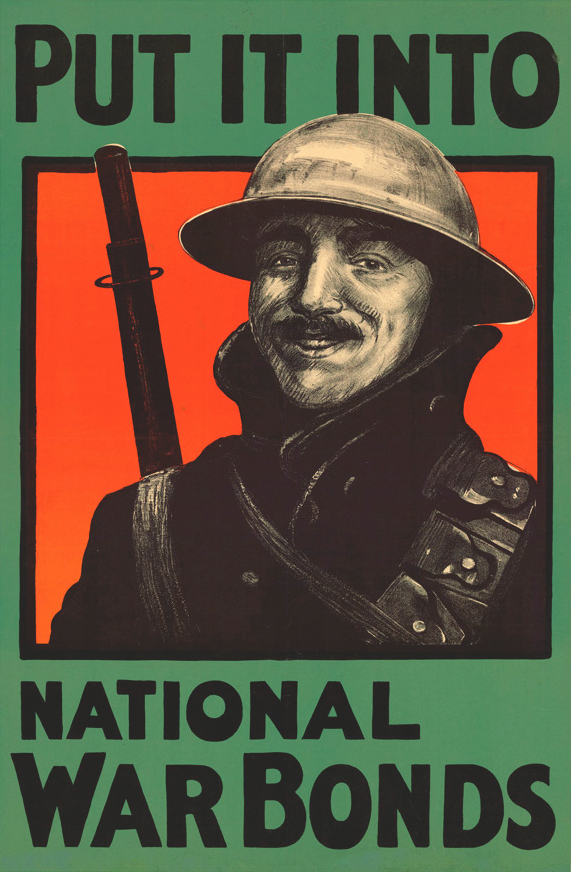
War bonds (sometimes referred to as victory bonds, particularly in propaganda) are debt securities issued by a government to finance military operations and other expenditure in times of war without raising taxes to an unpopular level. They are also a means to control inflation by removing money from circulation in a stimulated wartime economy. War bonds are either retail bonds marketed directly to the public or wholesale bonds traded on a stock market. Exhortations to buy war bonds have often been accompanied by appeals to patriotism and conscience. Retail war bonds, like other retail bonds, tend to have a yield which is below that offered by the market and are often made available in a wide range of denominations to make them affordable for all citizens.
Governments throughout history have needed to borrow money to fight wars. Traditionally they dealt with a small group of rich financiers such as Jakob Fugger and Nathan Rothschild, but no particular distinction was made between debt incurred in war or peace. An early use of the term "war bond" was for the $11 million raised by the US Congress in an Act of 14 March 1812, to fund the War of 1812, but this was not aimed at the general public. Until July 2015, perhaps the oldest bonds still outstanding as a result of war were the British Consols, some of which were the result of the refinancing of incurring debts during the Napoleonic Wars, but these were redeemed following the passing of the Finance Act 2015.
The government of Austria-Hungary knew from the early days of the First World War that it could not count on advances from its principal banking institutions to meet the growing costs of the war. Instead, it implemented a war finance policy modeled upon that of Germany: in November 1914, the first funded loan was issued. As in Germany, the Austro-Hungarian loans followed a prearranged plan and were issued at half yearly intervals every November and May. The first Austrian bonds paid 5% interest and had a five-year term. The smallest bond denomination available was 100 kronen.
Hungary issued loans separately from Austria in 1919, after the war and after it had separated from Austria, in the form of stocks that permitted the subscriber to demand repayment after a year's notice. Interest was fixed at 6%, and the smallest denomination was 50 korona. Subscriptions to the first Austrian bond issue amounted to $440 million; those of the first Hungarian issue amounted to $235 million.
The limited financial resources of children were tapped through campaigns in schools. The initial minimum Austrian bond denomination of 100 kronen still exceeded the means of most children, so the third bond issue, in 1915, introduced a scheme whereby children could donate a small amount and take out a bank loan to cover the rest of the 100 kronen. The initiative was immensely successful, eliciting funds and encouraging loyalty to the state and its future among Austro-Hungarian youth. Over 13 million kronen was collected in the first three "child bond" issues.
Canada's involvement in the First World War began in 1914, with Canadian war bonds called "Victory Bonds" after 1917. The first domestic war loan was raised in November 1915, but not until the fourth campaign of November 1917 was the term Victory Loan applied. The First Victory Loan was a 5.5% issue of 5, 10 and 20 year gold bonds in denominations as small as $50. It was quickly oversubscribed, collecting $398 million or about $50 per capita. The Second and Third Victory Loans were floated in 1918 and 1919, bringing another $1.34 billion. For those who could not afford to buy Victory Bonds, the government also issued War Savings Certificates.[citation needed] The government awarded communities who bought large amounts of bonds Victory Loan Honour Flags.
Unlike France and Britain, at the outbreak of the First World War Germany found itself largely excluded from international financial markets. This became most apparent after an attempt to float a major loan on Wall Street failed in 1914. As such, Germany was largely limited to domestic borrowing, which was induced by a series of war credit bills passing the Reichstag. This took place in many forms; however, the most publicised were the public war bond (Kriegsanleihe) drives.
Nine bond drives were conducted over the length of the war and, as in Austria-Hungary, the loans were issued at six-month intervals. The drives themselves would often last several weeks, during which there was extensive use of propaganda via all possible media. Most bonds had a rate of return of 5% and were redeemable over a ten-year period, in semi-annual payments. Like war bonds in other countries, the German war bonds drives were designed to be extravagant displays of patriotism and the bonds were sold through banks, post offices and other financial institutions.
Hub AI
War bond AI simulator
(@War bond_simulator)
War bond
War bonds (sometimes referred to as victory bonds, particularly in propaganda) are debt securities issued by a government to finance military operations and other expenditure in times of war without raising taxes to an unpopular level. They are also a means to control inflation by removing money from circulation in a stimulated wartime economy. War bonds are either retail bonds marketed directly to the public or wholesale bonds traded on a stock market. Exhortations to buy war bonds have often been accompanied by appeals to patriotism and conscience. Retail war bonds, like other retail bonds, tend to have a yield which is below that offered by the market and are often made available in a wide range of denominations to make them affordable for all citizens.
Governments throughout history have needed to borrow money to fight wars. Traditionally they dealt with a small group of rich financiers such as Jakob Fugger and Nathan Rothschild, but no particular distinction was made between debt incurred in war or peace. An early use of the term "war bond" was for the $11 million raised by the US Congress in an Act of 14 March 1812, to fund the War of 1812, but this was not aimed at the general public. Until July 2015, perhaps the oldest bonds still outstanding as a result of war were the British Consols, some of which were the result of the refinancing of incurring debts during the Napoleonic Wars, but these were redeemed following the passing of the Finance Act 2015.
The government of Austria-Hungary knew from the early days of the First World War that it could not count on advances from its principal banking institutions to meet the growing costs of the war. Instead, it implemented a war finance policy modeled upon that of Germany: in November 1914, the first funded loan was issued. As in Germany, the Austro-Hungarian loans followed a prearranged plan and were issued at half yearly intervals every November and May. The first Austrian bonds paid 5% interest and had a five-year term. The smallest bond denomination available was 100 kronen.
Hungary issued loans separately from Austria in 1919, after the war and after it had separated from Austria, in the form of stocks that permitted the subscriber to demand repayment after a year's notice. Interest was fixed at 6%, and the smallest denomination was 50 korona. Subscriptions to the first Austrian bond issue amounted to $440 million; those of the first Hungarian issue amounted to $235 million.
The limited financial resources of children were tapped through campaigns in schools. The initial minimum Austrian bond denomination of 100 kronen still exceeded the means of most children, so the third bond issue, in 1915, introduced a scheme whereby children could donate a small amount and take out a bank loan to cover the rest of the 100 kronen. The initiative was immensely successful, eliciting funds and encouraging loyalty to the state and its future among Austro-Hungarian youth. Over 13 million kronen was collected in the first three "child bond" issues.
Canada's involvement in the First World War began in 1914, with Canadian war bonds called "Victory Bonds" after 1917. The first domestic war loan was raised in November 1915, but not until the fourth campaign of November 1917 was the term Victory Loan applied. The First Victory Loan was a 5.5% issue of 5, 10 and 20 year gold bonds in denominations as small as $50. It was quickly oversubscribed, collecting $398 million or about $50 per capita. The Second and Third Victory Loans were floated in 1918 and 1919, bringing another $1.34 billion. For those who could not afford to buy Victory Bonds, the government also issued War Savings Certificates.[citation needed] The government awarded communities who bought large amounts of bonds Victory Loan Honour Flags.
Unlike France and Britain, at the outbreak of the First World War Germany found itself largely excluded from international financial markets. This became most apparent after an attempt to float a major loan on Wall Street failed in 1914. As such, Germany was largely limited to domestic borrowing, which was induced by a series of war credit bills passing the Reichstag. This took place in many forms; however, the most publicised were the public war bond (Kriegsanleihe) drives.
Nine bond drives were conducted over the length of the war and, as in Austria-Hungary, the loans were issued at six-month intervals. The drives themselves would often last several weeks, during which there was extensive use of propaganda via all possible media. Most bonds had a rate of return of 5% and were redeemable over a ten-year period, in semi-annual payments. Like war bonds in other countries, the German war bonds drives were designed to be extravagant displays of patriotism and the bonds were sold through banks, post offices and other financial institutions.
Recent media