Hubbry Logo
Victory ShieldVictory ShieldMain
Open search
Victory Shield
Community hub
Victory Shield
logo
8 pages, 0 posts
0 subscribers
Be the first to start a discussion here.
Victory Shield
Victory Shield
from Wikipedia
Victory Shield
165, 196
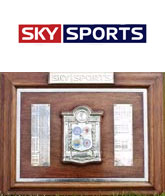
The Victory Shield trophy, in use since the Second World War as the first trophy was lost during the war, with the logo of former sponsor Sky Sports
SportFootball
Founded1925
No. of teams4
CountryRepublic of Ireland Republic of Ireland
 Northern Ireland
 Scotland
 Wales
Most recent
champion
 Republic of Ireland

The Victory Shield is an annual football tournament competed for by the under-16 teams of Scotland, Republic of Ireland, Northern Ireland and Wales. The Victory Shield had traditionally been competed for by the four Home Nations, but the Football Association withdrew the England team from the tournament "for the foreseeable future" in 2015.[1] The competition was continued after England's withdrawal, with the Republic of Ireland taking their place.[2] The competition was competed by under-15 teams until 2001, when switching to under-16 to fall in line with UEFA competitions.[3]

List of previous winners

[edit]

Pre-War

[edit]

Incomplete

Post-War

[edit]

1940s

[edit]

1950s

[edit]

1960s

[edit]

1970s

[edit]

1980s

[edit]

1990s

[edit]

2000s

[edit]

2010s

[edit]

2020s

[edit]

Overall winners since World War II

[edit]

References

[edit]
[edit]
Revisions and contributorsEdit on WikipediaRead on Wikipedia
from Grokipedia
The Victory Shield was an annual international football tournament for under-16 boys' national teams from , , , and the . It served as a prestigious youth competition that developed numerous professional players over its nearly century-long history. The tournament originated in 1925 as a fixture among the , was suspended during , and was revived in 1946 with the inclusion of , which participated until withdrawing in 2015 following a review of its youth development programs. The then joined to maintain the four-team format, with matches typically played in a round-robin structure over three days at a single host venue, one of the participating nations rotating annually. Each team played three games, and the winner was determined by points, with as a tiebreaker; joint victories occurred, such as and sharing the title in 2019 and 2021. In recent years, the dominated, securing victories in 2022, 2023, and 2024—the latter hosted in at , where clinched the title with a 1-0 win over in the decisive final match. won twice since the postwar revival (2000–01 and 2018–19), while held the most overall successes among the current participants. The tournament was discontinued in 2025 following withdrawals by , , and .

Overview

Competition format and rules

The Victory Shield operates as an annual featuring under-16 boys' teams from , the , , and , with each team competing against the others once for a total of six matches. The champion is decided by the highest number of points earned, awarding and one point for a draw; in cases of tied points at the top, teams may share the title, as occurred in when and finished level after all participants drew multiple fixtures. Since a format change in , the competition has been held as a centralized event hosted by one nation, shifting from the prior structure of dispersed home-and-away fixtures played across the season. Matches adhere to standard rules, with no extra time played and draws resulting in shared points; however, a 2024 innovation introduced penalty shootouts in select drawn games to allocate a bonus point to the winner. Age eligibility is restricted to male players under 16 years old at the start of the year, a criterion established in 2001 when the event transitioned from an under-15 schoolboy level to under-16 to better align with competition standards. Teams are selected through national schoolboy associations under the oversight of the Schools’ Association Football International Board (SAFIB), drawing from development pathways rather than academies. The typically occurs in and lasts 1 to 2 weeks when hosted in one location, accommodating all six fixtures within that timeframe, as seen in the 2024 edition spanning October 8 to 13 in .

Participating nations and eligibility

The Victory Shield was originally contested by the under-16 schoolboy teams representing the four : , , , and , with the tournament established in 1925 under the auspices of the Schools' Association Football International Board (SAFIB). Players eligible to participate must be under 16 years of age at the start of the tournament year and are selected by their national schools' football associations, such as the Scottish Schools' Football Association for , the Welsh Schools' Football Association for , the Northern Ireland Schools' Football Association for , and Cumann Peil na mBunscol for the Republic of Ireland. Prior to 2001, the competition's schoolboy focus emphasized participants' active enrollment in schools affiliated with these associations, reinforcing its grassroots educational roots. A significant change occurred in 2015 when withdrew from the , citing concerns over player welfare and the need for young talents to face stronger international opposition to support their development. The entered the competition in 2016 via its schools' football body, effectively replacing England and preserving the traditional four-team structure. Hosting duties rotate annually among the participating nations, providing each host with while coordinating logistics across venues; neutral grounds have occasionally been used for matches to facilitate scheduling and fairness. Scotland's withdrawal in 2025, prompted by fixture congestion, funding constraints, and a perceived decline in the event's overall quality and interest, placed the future of this historic competition in serious doubt, and no edition was held that year.

History

Origins and establishment (1925–1939)

The Victory Shield was established in 1924 as an annual international tournament for schoolboy football teams representing the , organized by the Schools' Association Football International Board (SAFIB), which had been formed to oversee youth internationals. The trophy itself was presented to SAFIB in 1923 by Lord Invernairn, originally intended for senior international charity matches to support post-World War I recovery efforts, but it was soon adapted for the under-16 schoolboy to promote healthy and talent identification among young players from , , and . The initial format consisted of home-and-away matches between the three participating nations, equivalent to under-15/16 age groups, emphasizing amateur participation and educational benefits in line with the era's focus on physical and moral development through sport following the Great War. This structure aimed to nurture future stars while rebuilding community spirit in British football, drawing on the growing popularity of schoolboy games that had seen large attendances and organizational growth since the early . Scotland claimed the inaugural title in 1924, followed by another win in 1925, marking their early dominance, before secured their first victory the following year in 1926. The tournament ran annually through the , with joining as a fourth participant in 1934, expanding the competition's scope. Over the 16 editions from 1924 to 1939, emerged as the most successful side with ten outright wins, underscoring their strength in youth development, while recorded seven triumphs. The Victory Shield held significant cultural value during this time, symbolizing the resurgence of football as a tool for national unity and character-building in the aftermath of , with matches often hosted at professional grounds to inspire broader participation in educational and .

World War II interruption and post-war revival (1940–1947)

The Victory Shield tournament was suspended from 1940 to 1946 due to the outbreak of , which halted all international schoolboy football matches across the amid severe wartime restrictions on travel, gatherings, and resources, as well as the widespread of young males into . This interruption affected the Schools' Association Football International Board (SAFIB), the for such competitions, leaving youth international football dormant for the duration of the conflict. The tournament was revived in 1947, resuming in the traditional schoolboy format for under-16 teams from the four : , , , and . The first edition, spanning the 1946–47 season, featured matches played in May 1947, beginning with England's 3–0 win over at the in on 3 May, followed by a 1–1 draw against at on 10 May, and a 0–2 loss to at in on 30 May; emerged as the overall winners. This revival emphasized the rehabilitation of programs in the recovering nations, providing structured opportunities for physical and social development amid the transition from wartime austerity. Post-war logistical challenges significantly impacted the tournament's organization, including ongoing food and fuel that restricted team travel and accommodations, compounded by the severe winter of 1946–47 and priorities for industrial productivity over recreational activities. These constraints occasionally led to centralized hosting arrangements in subsequent early years to minimize cross-border journeys, though the 1947 fixtures were distributed across host nations. Symbolically, the Victory Shield served as a celebration of national unity, fostering morale among young participants and strengthening interpersonal relations within the through renewed sporting exchanges.

Evolution through the late 20th century (1948–2000)

Following the 1947 revival, the Victory Shield operated as an annual featuring under-15 schoolboy teams from the four , , , and —emphasizing competitive balance through a points-based system where each team played the others once. had joined in 1934, solidifying the four-nation structure and ensuring consistent participation without expansion throughout the remainder of the century. In the 1950s, team selections evolved from strictly school-organized squads to greater involvement by national associations, exemplified by England's establishing a dedicated youth team in 1954–55; this increased organizational professionalism and talent scouting while upholding the amateur ethos central to schoolboy football. The format remained stable with home-and-away fixtures, supplemented by occasional international friendlies to build match experience, as seen in England's additional youth tournaments against European opponents during the decade. England asserted dominance across the period, clinching over 20 outright or shared victories by 2000, including extended streaks such as six consecutive outright wins from 1962–63 to 1966–67, which highlighted their superior depth in youth development compared to rivals; the title was shared in 1967–68. This era also saw minor adjustments for equity, with venues rotating among host nations to maintain fairness, though no widespread shift to neutral sites occurred until later considerations in youth scheduling. Key milestones included the rejection of proposals to broaden participation beyond the , preserving the tournament's focused identity amid growing European youth competitions; instead, it adapted internally by transitioning to an under-16 age group in the late , aligning with advancing standards in player maturation and welfare. By the 1990s, amid broader anti-hooliganism efforts in British football, the Victory Shield prioritized secure environments for youth matches, contributing to its role as a stable platform that fed into UEFA's emerging youth frameworks like the UEFA Youth League precursors.

Modern changes and discontinuation (2001–2025)

In 2001, the Victory Shield transitioned from an under-15 to an under-16 age group to better align with youth competition standards, marking a shift toward greater involvement by national football associations such as (FA) and (SFA). This change, which began with England's team under FA control since 1997 when it assumed responsibility from the (ESFA), aimed to integrate the tournament more closely with professional development pathways for young players. England's participation ended in 2015 following a strategic review by the FA, which cited concerns over player welfare, fixture overload, and the need for higher-level international opposition to support elite development. The joined the tournament in 2016 to replace England, competing alongside , , and , and quickly established dominance by securing the title that year. The competition faced further disruption in 2020 when it was cancelled due to the , halting fixtures including planned matches in England and . The 2020s brought additional challenges, including Ireland's consecutive victories from 2022 to 2024, with the 2024 edition hosted in culminating in a 1-0 win over . However, the tournament's viability waned amid rising professional demands on youth players, stricter welfare regulations, and reduced interest from associations grappling with scheduling conflicts and funding constraints. In May 2025, , , and jointly withdrew, citing domestic fixture clashes and budget cuts, leaving the Republic of Ireland without viable participants and effectively discontinuing the nearly century-old competition after its 2024 finale.

Results and records

Pre-war winners (1925–1939)

The Victory Shield, established in 1925 as an annual under-16 international football tournament among the , saw its pre-war era marked by intense rivalry primarily between and , with participating from the outset and joining in 1934. Over 15 editions from 1925 to 1939, secured 9 outright victories, establishing early dominance through consistent performances in the round-robin format, where teams earned points for wins and draws across matches against each opponent. claimed 6 titles, often through decisive victories in key fixtures, while neither nor lifted the trophy during this period. No championships were decided solely by draws, with winners always determined by superior points totals or . The following table summarizes the year-by-year winners:
YearWinner
1925Scotland
1926England
1927Scotland
1928England
1929Scotland
1930Scotland
1931England
1932England
1933England
1934England
1935Scotland
1936England
1937England
1938England
1939Scotland
Hosting rotated annually among the participating associations, with matches staged at diverse venues such as Hampden Park in Scotland, Roker Park in England, Ninian Park in Wales, and Celtic Park in Northern Ireland to promote fairness and regional engagement. Early editions featured occasional debates over referee neutrality, though no major disruptions were recorded. Statistically, England's 1933 triumph highlighted their prowess with an unbeaten campaign, accumulating maximum points from a 2-1 win over Wales and a 1-1 draw against Scotland, followed by a dominant 1934 defense of the title that included a 4-1 victory over Scotland. These results underscored England's tactical edge, amassing superior goal differences in tight contests.

Post-war winners by era (1947–2024)

The Victory Shield resumed after with the 1946–47 edition, but the post-war era from 1947 to 1970 solidified 's position as the preeminent force among the ' under-16 teams. amassed 15 victories in this period, comprising 13 outright titles (1949–50, 1951–52, 1952–53, 1953–54, 1954–55, 1956–57, 1957–58, 1959–60, 1962–63, 1963–64, 1964–65, 1965–66, 1966–67) and two shared wins (1950–51, 1967–68). followed with nine titles (seven outright: 1947–48, 1955–56, 1958–59, 1960–61, 1961–62, 1968–69, 1969–70; and two shared), while recorded two (one outright in 1948–49 and one shared in 1950–51), highlighting a rare competitive balance that saw the smaller nation upset expectations in the early . From 1971 to 2000, maintained their stronghold, achieving 22 victories overall (15 outright: 1970–71, 1972–73, 1974–75, 1975–76, 1976–77, 1978–79, 1983–84, 1984–85, 1986–87, 1989–90, 1991–92, 1993–94, 1994–95, 1995–96, 1999–2000; and seven shared: 1977–78, 1979–80, 1980–81, 1982–83, 1985–86, 1990–91, 1996–97). The competition stayed exclusively among the , fostering intense rivalries, with Scotland's resurgence in the 1980s particularly notable—they claimed three outright wins (1981–82, 1987–88, 1988–89) amid a series of shared titles that underscored their improved youth development during the decade. Wales and had sporadic successes, including 's breakthrough outright victory in 2000–01. The shift to an under-16 age group in 2001 introduced a more balanced dynamic, though still dominated with 10 outright wins (2001–02, 2002–03, 2004–05, 2006–07, 2007–08, 2008–09, 2009–10, 2010–11, 2011–12, 2012–13) and two shared (2003–04, 2005–06) before withdrawing from the tournament in 2015. This era saw greater parity, with securing an outright title in 2013–14 and in 2014–15, reflecting enhanced competitiveness across the participating nations. 's decision to exit, announced in April 2015, stemmed from concerns that the fixture schedule no longer aligned with their player welfare and development priorities. England's absence from the 2015–16 season onward transformed the competition, inviting the as a permanent participant and leading to a period of Irish dominance. captured five outright victories (2016–17, 2017–18, 2022–23, 2023–24, 2024–25), including a commanding three-year streak from 2022 to 2024 that highlighted their robust . earned one outright win in 2018–19, claimed one in 2015–16, and shared two titles (2019–20, 2021–22); the 2020–21 edition was cancelled due to the , disrupting the annual cycle for the first time since the post-war revival.
SeasonWinner(s)
2000–01Northern Ireland
2001–02England
2002–03England
2003–04England & Scotland
2004–05England
2005–06England & Wales
2006–07England
2007–08England
2008–09England
2009–10England
2010–11England
2011–12England
2012–13England
2013–14Scotland
2014–15Wales
2015–16Wales
2016–17Republic of Ireland
2017–18Republic of Ireland
2018–19Northern Ireland
2019–20Wales & Scotland
2020–21Not played (COVID-19)
2021–22Wales & Scotland
2022–23Republic of Ireland
2023–24Republic of Ireland
2024–25Republic of Ireland

All-time statistics and most successful teams

The Victory Shield has been held in 93 editions across its history, comprising 15 tournaments from 1925 to 1939 and 78 from 1946–47 to 2024–25, excluding instances of cancellation such as the 2020–21 edition due to the . England dominates the all-time winners list with 54 titles (including shared), followed by with 31. , , and the have won 7, 2, and 5 titles, respectively; in cases of shared victories, each participating team receives full credit for the title.
TeamTitles WonPercentage of Editions
5458%
3133%
78%
22%
55%
(Note: Percentages are rounded and sum to more than 100% due to shared titles counting fully for each team.) holds the record for the longest streak of consecutive titles, securing 12 straight wins (including shared) from 2001–02 to 2012–13. These statistics underscore 's unparalleled success, with win rates derived directly from title shares relative to total editions contested.

Legacy and impact

Notable players and alumni

The Victory Shield has served as a crucial platform for emerging talents, with numerous participants advancing to prominent professional careers. From , showcased early promise during the 2006 Victory Shield, contributing to the U16 campaign that highlighted his potential as a dynamic ; he later became a key figure at and Juventus, earning over 80 caps for the senior team. For , played for the U16 team around this period, foreshadowing his long tenure as a defender at Manchester United and over 100 appearances for . In the , was selected for the 2023 U16 squad defending the title, emerging as a prolific forward who has since drawn attention from top clubs like Tottenham Hotspur for his goal-scoring prowess at youth levels. The tournament has produced over a dozen alumni who have reached elite professional levels, including players like , who featured in the 2008 England U16 edition before progressing to and other sides. It functions as a key scouting venue for major clubs, exemplified by interest in prospects such as during Scotland's 2016 Victory Shield matches. Other notable alumni include Scotland's ( senior international, debuted in Victory Shield 2015), Northern Ireland's ( defender, 2019 participant), and Republic of Ireland's (Brighton striker, 2021 squad member).

Influence on youth international football

The Victory Shield pioneered structured international rivalry among the , establishing one of the world's oldest annual football tournaments for under-16 teams when it began in 1925. It fostered regular cross-border matches between , , , and that emphasized competitive development at a level. This format laid foundational principles for organized regional internationals, predating broader European structures and serving as an early model for balanced, low-stakes tournaments focused on skill-building rather than high-pressure outcomes. As a key talent pipeline, the tournament has consistently fed participants into senior international squads across the participating nations, promoting not only technical growth but also cross-border friendships through shared experiences in multi-nation events. For instance, teams from the , which joined after England's 2015 withdrawal, have seen squads evolve into full international contributors, underscoring the competition's role in nurturing pathways from youth to professional levels. Its structure encouraged holistic player maturation, with an early emphasis on welfare—such as controlled match scheduling—that anticipated modern safeguarding protocols in youth football. The discontinuation of the Victory Shield in 2025 highlighted ongoing challenges in global soccer, particularly fixture overload and the need for more diverse opposition to optimize development. England's exit in cited insufficient competitive challenge for elite progression, a concern echoed by Scotland's withdrawal in May 2025 for strategic player enhancement reasons, and Northern Ireland's and ' subsequent decisions to prioritize broader international exposure. These shifts reflected a broader industry trend toward reducing repetitive regional fixtures to prevent burnout and enhance welfare, aligning with UEFA's evolving youth calendars. Post-2025, the tournament's legacy endures through inspired regional replacements that maintain its developmental ethos, such as ' launch of the Cwpan Gary Speed in August 2025, which honors former captain while expanding to include international opponents for continued progression. Archival records of the Victory Shield preserve its historical value, documenting nearly a century of youth football evolution and serving as a reference for modern tournament design in the . Culturally, it symbolized unity in by uniting nations in shared competition, with media coverage of host editions amplifying engagement and indirectly supporting participation growth through national federations' promotional efforts.

References

Add your contribution
Related Hubs
User Avatar
No comments yet.