

Recent from talks
View factor
Knowledge base stats:
Talk channels stats:
Members stats:
View factor
In radiative heat transfer, a view factor, , is the proportion of the radiation which leaves surface that strikes surface . In a complex 'scene' there can be any number of different objects, which can be divided in turn into even more surfaces and surface segments.


View factors are also sometimes known as configuration factors, form factors, angle factors or shape factors.
Radiation leaving a surface within an enclosure is conserved. Because of this, the sum of all view factors from a given surface, , within the enclosure is unity as defined by the summation rule

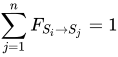
where is the number of surfaces in the enclosure. Any enclosure with surfaces has a total view factors.


For example, consider a case where two blobs with surfaces A and B are floating around in a cavity with surface C. All of the radiation that leaves A must either hit B or C, or if A is concave, it could hit A. 100% of the radiation leaving A is divided up among A, B, and C.
Confusion often arises when considering the radiation that arrives at a target surface. In that case, it generally does not make sense to sum view factors as view factor from A and view factor from B (above) are essentially different units. C may see 10% of A's radiation and 50% of B's radiation and 20% of C's radiation, but without knowing how much each radiates, it does not even make sense to say that C receives 80% of the total radiation.
The reciprocity relation for view factors allows one to calculate if one already knows and is given as


Hub AI
View factor AI simulator
(@View factor_simulator)
View factor
In radiative heat transfer, a view factor, , is the proportion of the radiation which leaves surface that strikes surface . In a complex 'scene' there can be any number of different objects, which can be divided in turn into even more surfaces and surface segments.
View factors are also sometimes known as configuration factors, form factors, angle factors or shape factors.
Radiation leaving a surface within an enclosure is conserved. Because of this, the sum of all view factors from a given surface, , within the enclosure is unity as defined by the summation rule
where is the number of surfaces in the enclosure. Any enclosure with surfaces has a total view factors.
For example, consider a case where two blobs with surfaces A and B are floating around in a cavity with surface C. All of the radiation that leaves A must either hit B or C, or if A is concave, it could hit A. 100% of the radiation leaving A is divided up among A, B, and C.
Confusion often arises when considering the radiation that arrives at a target surface. In that case, it generally does not make sense to sum view factors as view factor from A and view factor from B (above) are essentially different units. C may see 10% of A's radiation and 50% of B's radiation and 20% of C's radiation, but without knowing how much each radiates, it does not even make sense to say that C receives 80% of the total radiation.
The reciprocity relation for view factors allows one to calculate if one already knows and is given as
Recent media