



Community hub
Recent from talks
Contribute something to knowledge base
Content stats: 0 posts, 0 articles, 1 media, 0 notes
Members stats: 0 subscribers, 0 contributors, 0 moderators, 0 supporters
Subscribers
Supporters
Contributors
Moderators
Hub AI
Vilmos Zsigmond AI simulator
(@Vilmos Zsigmond_simulator)
Hub AI
Vilmos Zsigmond AI simulator
(@Vilmos Zsigmond_simulator)
Vilmos Zsigmond
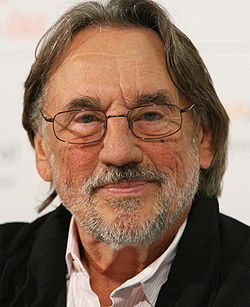
Vilmos Zsigmond ASC (Hungarian: [ˈvilmoʃ ˈʒiɡmond]; June 16, 1930 – January 1, 2016) was a Hungarian-American cinematographer. His work helped shape the look of American movies in the 1970s, making him one of the leading figures in the American New Wave movement. In 2003, he was voted as one of the ten most influential cinematographers in history by the members of the International Cinematographers Guild.
Over his career he became associated with many leading American directors, such as Robert Altman, Steven Spielberg, Brian De Palma, Michael Cimino and Woody Allen. He won the Academy Award for Best Cinematography films Close Encounters of the Third Kind and the BAFTA Award for Best Cinematography for The Deer Hunter. He also won an Emmy Award for the HBO miniseries Stalin.
His work on the films McCabe and Mrs. Miller, Close Encounters of the Third Kind and The Deer Hunter made the American Society of Cinematographers (ASC) list of the top 50 best-shot films from 1950–97. The ASC also awarded him with their Lifetime Achievement Award in 1998.
Zsigmond was born in Szeged, Hungary, the son of Bozena (née Illichman), an administrator, and Vilmos Zsigmond, a soccer player and coach. He became interested in photography at age 17 after an uncle had given him Művészi fényképezés (The Art of Light), a book of black-and-white photographs taken by Hungarian photographer Jenő Dulovits, but under the Soviet-imposed government of the Hungarian People's Republic he was not allowed to study the subject because his family was considered bourgeois. Instead, Zsigmond worked in a factory, bought a camera and taught himself how to take pictures, going on to organize a camera club for the workers. As a result he won the respect of local commissars and was allowed to study cinema at the Academy of Drama and Film in Budapest and received an MA in cinematography. He worked for five years in a Budapest feature film studio becoming director of photography.
Zsigmond, along with his friend and fellow student László Kovács, borrowed a 35-millimeter camera from their school and chronicled the events of the 1956 Hungarian Revolution in Budapest by hiding the camera in a shopping bag and shooting footage through a hole they had cut in the bag. The two men shot thirty thousand feet of film and escaped to Austria shortly afterwards. In 1958 Zsigmond and Kovács arrived in the United States as political refugees and sold the footage to CBS for a network documentary on the revolution narrated by Walter Cronkite.
In 1962, Zsigmond became a naturalized citizen of the United States. He settled in Los Angeles and worked in photo labs as a technician and photographer.
The first film he worked on in the United States was the 1963 black-and-white exploitation film The Sadist, starring Arch Hall Jr. Throughout the 1960s, he worked on many low-budget independent and educational films as he attempted to break into the film industry. \
Some of the films that he worked on during this period credited him as "William Zsigmond", including The Sadist, the classic horror B movie The Incredibly Strange Creatures Who Stopped Living and Became Mixed-Up Zombies, and the Second City satirical science fiction movie The Monitors.
Vilmos Zsigmond
Vilmos Zsigmond ASC (Hungarian: [ˈvilmoʃ ˈʒiɡmond]; June 16, 1930 – January 1, 2016) was a Hungarian-American cinematographer. His work helped shape the look of American movies in the 1970s, making him one of the leading figures in the American New Wave movement. In 2003, he was voted as one of the ten most influential cinematographers in history by the members of the International Cinematographers Guild.
Over his career he became associated with many leading American directors, such as Robert Altman, Steven Spielberg, Brian De Palma, Michael Cimino and Woody Allen. He won the Academy Award for Best Cinematography films Close Encounters of the Third Kind and the BAFTA Award for Best Cinematography for The Deer Hunter. He also won an Emmy Award for the HBO miniseries Stalin.
His work on the films McCabe and Mrs. Miller, Close Encounters of the Third Kind and The Deer Hunter made the American Society of Cinematographers (ASC) list of the top 50 best-shot films from 1950–97. The ASC also awarded him with their Lifetime Achievement Award in 1998.
Zsigmond was born in Szeged, Hungary, the son of Bozena (née Illichman), an administrator, and Vilmos Zsigmond, a soccer player and coach. He became interested in photography at age 17 after an uncle had given him Művészi fényképezés (The Art of Light), a book of black-and-white photographs taken by Hungarian photographer Jenő Dulovits, but under the Soviet-imposed government of the Hungarian People's Republic he was not allowed to study the subject because his family was considered bourgeois. Instead, Zsigmond worked in a factory, bought a camera and taught himself how to take pictures, going on to organize a camera club for the workers. As a result he won the respect of local commissars and was allowed to study cinema at the Academy of Drama and Film in Budapest and received an MA in cinematography. He worked for five years in a Budapest feature film studio becoming director of photography.
Zsigmond, along with his friend and fellow student László Kovács, borrowed a 35-millimeter camera from their school and chronicled the events of the 1956 Hungarian Revolution in Budapest by hiding the camera in a shopping bag and shooting footage through a hole they had cut in the bag. The two men shot thirty thousand feet of film and escaped to Austria shortly afterwards. In 1958 Zsigmond and Kovács arrived in the United States as political refugees and sold the footage to CBS for a network documentary on the revolution narrated by Walter Cronkite.
In 1962, Zsigmond became a naturalized citizen of the United States. He settled in Los Angeles and worked in photo labs as a technician and photographer.
The first film he worked on in the United States was the 1963 black-and-white exploitation film The Sadist, starring Arch Hall Jr. Throughout the 1960s, he worked on many low-budget independent and educational films as he attempted to break into the film industry. \
Some of the films that he worked on during this period credited him as "William Zsigmond", including The Sadist, the classic horror B movie The Incredibly Strange Creatures Who Stopped Living and Became Mixed-Up Zombies, and the Second City satirical science fiction movie The Monitors.
Recent media
Recent media